


 For all latest news, follow the Daily Sun's Google News channel.


GHG Emission from Agriculture and Feasible Solutions
Jiban Krishna Biswas
Published: 18 Jan 2025, 10:29 AM
Bangladesh's agriculture sector, which employs 40% of the population and contributes 12% to GDP, contributes to greenhoue gases (GHG) and climate change to a considerable extent. Rice is a major crop in Bangladesh, with four main ecotypes: Aus, Broadcast Aman (B. Aman), Transplanted (T. Aman), and Boro. Non-rice and crop-specific cropping patterns include wheat, maize, pulses, oils, jute, tobacco and vegetables. Vis-à-vis, livestock also plays a significant role in our economy. But these two important sub-sectors emit a considerable amount of greenhouse gas too. The other GHG emissions from soil nitrification and denitrification are caused by nitrogen-based fertilisers and amendments.
Bangladesh’s livestock subsector contributes significantly to greenhouse gas emissions, with dairy cows accounting for 30% of the total cattle population. Green biomass helps maintain soil organic matter but may increase CH4 emissions. Intermittent drainage decreases the net ecosystem carbon budget by 6-46% compared to continuous flooding. Organic amendments improve soil properties and crop productivity. Rice variety selection, water management, organic and mineral fertilisation, tillage practice, crop establishment methods and other soil amendments are crucial in mitigating GHG emissions from rice paddies.
Breeding efforts focus on developing high-yielding rice varieties, with short growth duration being a key factor. Tillage and crop establishment techniques significantly influence GHG emission patterns. Reduced tillage can reduce GHG emissions by about 40% for rice while ‘no-till farming’, a key component of conservation agriculture, reduces CH4 emissions by 23%. Direct-seeding methods like WDS (wet direct seeding) or DDS (dry direct seeding) seeding are expected to be popular due to water scarcity and socio-economic factors that have the potential to reduce methane emission.
Organic matter management practices, such as straw removal and manure addition, significantly impact net GHG emissions in rice paddies. Optimising the form, timing and application rate of organic matter and tillage practices can also reduce paddy CH4 emissions. Biochar, a charcoal produced through pyrolysis of biomass under O2-deficient conditions, has been proposed as an amendment to reduce GHG emissions from rice paddies. Liming is another effective way of reducing GHG emissions from rice paddies.
Mineral nitrogen management is crucial for reducing synthetic fertilisers and promoting the recycling of decomposable agricultural wastes. The use of cow dung, poultry manure, and vermicompost can significantly impact crop productivity, soil properties and GHG emissions.
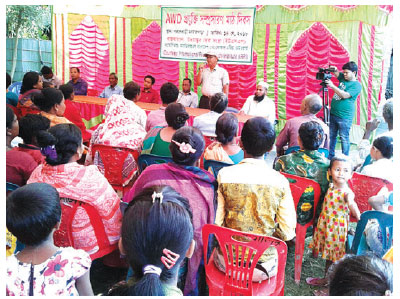
Implementing alternate wetting and drying (AWD) irrigation practices can significantly reduce GHG emissions from rice paddies by optimising drying events and soil drying severity. AWD-irrigation has the potential to improve rice yields and ensure farmers' profitability, though it is yet to gain popularity due to socio-economic constraints. Strategies for promoting AWD adoption include encouraging stress-tolerant crops, following crop diversification by including crops with less or no irrigation demand and developing varieties, cropping patterns, and management practices that increase water productivity and reduce irrigation per unit of crop production. Research investments are needed to promote agricultural diversification and monitor changes in irrigation practices over time.
The country is making progress in greenhouse gas emissions reduction from the livestock sector, biogas programmes, improved feed management, research and development. The commitment of the Bangladesh government to reducing GHG emissions in the livestock sub-sector is evident through biogas programmes, extension of improved feed management practices, advanced manure management systems, and livestock research and development. Policies like the National Adaptation Programme of Action, Bangladesh Climate Change Strategy, and National Adaptation Plan aim to protect the environment, reduce emissions and promote climate resilience. However, challenges such as limited awareness, financial constraints, institutional gaps, and data limitations hinder effective mitigation. To overcome these, Bangladesh's government should integrate agriculture into its GHG emission reduction strategies and consider AWD as a potential mitigation tool.
Islam (2021) proposes a five-stage strategy for AWD adoption in Bangladesh, which includes identifying suitable areas and seasons for AWD irrigation, training and awareness programmes, irrigation scheme-based adoption, Monitoring-Verifying and Reporting, financial and technical support, and the introduction of a ‘Carbon Credit Certificate’. To ensure a more resilient and low-carbon livestock sector, Bangladesh should enhance farmer training, increase financial support, strengthen research and development, promote public-private partnerships and improve monitoring and reporting.
The International Fund for Agricultural Development (IFAD) can play a crucial role in the preparation and execution of Nationally Determined Contributions (NDC) and related issues by promoting Climate-Smart Agriculture practices that reduce greenhouse gas emissions and improve productivity. These practices include minimum tillage, agroforestry, methane reduction in rice cultivation and livestock management. IFAD can also provide training and resources for farmers to adopt low-emission technologies. It can track GHG reduction in agriculture by developing a robust monitoring system, providing technical assistance for accurate emission measurement, and identifying baseline data. Funding for research and innovation initiatives can identify cost-effective solutions. These approaches are concerned with achieving sustainable national and global climate goals.
_____________________________________
The writer is a Senior Consultant of IFAD, former Director General of BRRI and former Executive Director of KGF