


 For all latest news, follow the Daily Sun's Google News channel.


Coastal Agriculture: A Request to Interim Government
Dr. M. G. Neogi
Published: 06 Jan 2025, 01:01 PM

Farmer seeding wheat seeds as relay cropping in coastal regions. Photo: Collected
About one-third area of Bangladesh belongs to the coastal region among which approximately 439,000 hectares (almost 1.1 million acres) of land remains fallow during the dry season. The possible crop to cultivate here is “Aman rice” during monsoon only. After harvesting of Aman rice in December, the land remains fallow for the following 6-7 months. Due to climate change - increased salinity, lack of suitable water for irrigation and water logging in certain areas are the key factors for this significant amount of land to remain barren in coastal regions.
To address this issue as well as to find out affordable and suitable technology to cultivate crops on barren saline land in the most profitable way for the coastal farmers during dry season, we are conducting field research since 2017, in collaboration with the Australian government under Australian Center for International Agricultural Research (ACIAR), in farmers’ field along with farm households giving utmost importance to farmers' requirements. In this research program, Poverty Eradication Program (PEP) is directly involved under my supervision. The local government agricultural office of DAE (Department of Agricultural Extension), Bangladesh Wheat and Maize Research Institute (BWMRI) and local office of Bangladesh Institute of Nuclear Agriculture (BINA) also providing necessary support in this prolific research program.
WHY SELECTING WHEAT TO CULTIVATE IN COASTAL LAND:
Primary reason is that wheat naturally can tolerate some level of salinity and requires minimal water for irrigation. Additionally, there is rapidly increasing demand of wheat among Bangladeshi people due to their changes in food habit, even though the cultivation area for wheat has not increased. Scarcity of available land for wheat cultivation makes difficult to meet the needs. Another most vital reason for cultivating wheat in coastal regions that there is huge uncultivated land are available in the coastal regions during dry season which may possible to bring under wheat cultivation to meet the nation’s demand.
Currently, Bangladesh requires 7.5 million tons of wheat annually but produces only 1.2-1.2 million tons domestically. The shortfall of 6-6.5 million tons of wheat is importing in every year, leading to a massive outflow of foreign currency. Therefore, research was undertaken to explore wheat cultivation in coastal saline lands to meet this growing demand.
WHY RELAY CROPPING TECHNOLOGY IS NECESSARY FOR WHEAT CULTIVATION IN COASTAL REGIONS:
Relay cropping technology involves planting a second new crop in same land while the first crop is still in the field with its mature stage. Wheat prefers cooler weather, growing best at temperatures below 15 degrees Celsius.
Due to climate change, winter season is shortening in Bangladesh, where it is more shortening in coastal regions. For this reason, sowing wheat seeds in mid-November in coastal regions ensures high quality head/spikes formation of wheat under favorable conditions in January’s cold temperature which confirms higher yields. Thus, the ideal time for sowing wheat seeds in coastal regions of Bangladesh is mid-November.
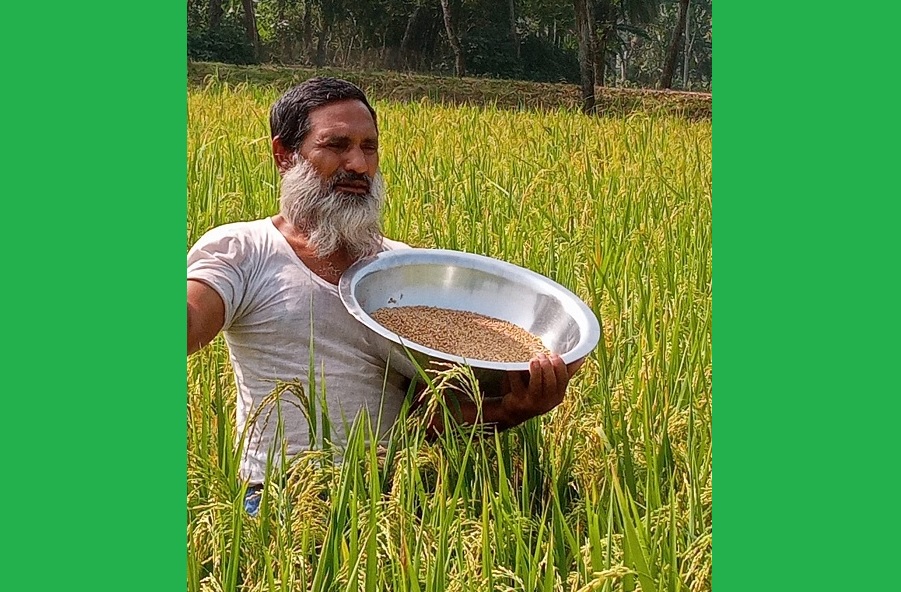
Caption: Farmer seeding wheat seeds as relay cropping in coastal regions
However, during mid-November, Aman rice is still in its maturing stage which is to be harvested in December. Therefore, in order to cultivate wheat on time, wheat seeds are broadcasted directly into the standing Aman rice fields in mid-November where Aman rice is still in semi-mature stage. This method, called relay cropping, enabled wheat cultivation without disturbing the standing rice crop.
VERY SPECIFIC REASONS TO GET SUCCESSFUL WHEAT PRODUCTION THROUGH RELAY CROPPING TECHNOLOGY IN COASTAL REGIONS:
1. Timely planting in mid-November: Wheat seeds were sown in mid-November in relay cropping method when Aman rice was in ripening stage, which allowing them to get benefit from January’s favourable cool weather, resulting in high quality spikes and good yield.
2. Minimum or no salinity level in mid-November: Soil salinity levels are normally lower in November, providing a conducive environment for wheat seeds to germinate which helping to get a good harvests.
3. Available soil moisture in mid-November: Most fields retain sufficient moisture in November, enabling wheat plants to access necessary moisture during this period, which is beneficial for the crops. These three factors collectively contributed to the remarkable success of relay wheat cultivation in saline fallow lands.
STEP WISE RELAY WHEAT CULTIVATION TECHNOLOGY WITH CONSIDERATION OF FOLLOWING 12 POINTS IN A PROFITABLE WAY:
Relay technology reduces production costs by eliminating the requirement for plowing, making it environment friendly. Moreover, wheat cultivation requires less water for irrigation and by using relay cropping technology we can bring it to minimum, that is only three to four light irrigations are sufficient for cultivation of wheat by relay method.
Additionally, unseasonal rains between November to February due to climate change further reduce the need for irrigation. Light rainfall during this period benefits wheat growth, lowering water dependency.
1. Appropriate land selection with proper drainage facilities for relay wheat cropping: Improving water drainage system is the foremost prerequisite for relay wheat cultivation. Due to climate change, unpredictable rainfall patterns necessitate effective drainage systems for wheat crops as wheat does not tolerate waterlogging.
Hence, proper drainage facilities must be ensured. Excess rainwater should drain quickly where supplementary irrigation systems should also be available. So, land should be selected with availability of proper drainage and irrigation system which is the pre-condition for successful relay wheat cropping.
2. Selection of aman rice varieties under aman rice - relay wheat cropping system: Short duration high yielding Aman rice variety should be selected for Aman rice - relay wheat cropping system, as short duration Aman rice varieties matures early, allowing farmers to harvest them by early December, enabling young wheat seedlings to develop quickly without competition for sunlight, air and nutrient.
A number of high yielding short duration Aman rice variety developed by Bangladesh Rice Research Institute (BRRI) and Bangladesh Institute of Nuclear Agriculture (BINA) should be prioritized, as most of these Aman rice varieties remains upright in its mature stage and having no lodging tendency in its life cycle which is very important for seeding wheat seeds in rice field under relay wheat cropping system.
3. Weed management under aman rice - relay wheat cultivation system: Maintaining a clean field by managing weeds during Aman rice cultivation helps minimize weed issues during relay wheat cultivation. Thus, proper weed control during Aman rice cultivation prevents weed infestations in the following relay wheat crop. Applying proper doses of appropriate herbicides in rice cultivation enhances rice yields which residual effects ensures a weed-free environment in relay wheat field also, resulting better growth and yield of relay wheat also.
4. Optimal timing for sowing wheat seeds in coastal regions: Due to shortened winters, especially in coastal regions, mid-November is the most suitable time for sowing wheat in coastal belt. This timing allows the wheat to grow well with more healthy spikes in favourable environment and ensures increased production, also allows the wheat to be harvested before salinity increases significantly in March.
5. Selection of short duration wheat varieties for relay planting in coastal regions: In dry season, soil salinity successively increasing while soil salinity peaks in March. Thus, short duration wheat varieties, like BARI Gom 30 should be selected for relay cropping in coastal regions. These varieties mature in approximately 100 days.
Thus, if, farmers seeding these seeds in mid-November, allowing farmers to harvest the crop by the end of February, which is before March’s salinity surge. It may mentionable that when salt-tolerant cum short duration variety will be developed, then more production of wheat through relay technology would be ensured.
6. Amount of wheat seeds requirement for relay cropping in coastal regions: Generally, 120 kg of wheat seeds per hectare (16 kg per bigha) is required for conventional wheat cultivation. Due to salinity and infertile soil in coastal regions, less number of tillers are forming, causing less yield. Relay cultivation also requires higher seed rate. Based on last three years experiments, 165 kg per hectare (22 kg per bigha) seed rate is good for maximum yield.
7. Pre-sowing seed treatment of wheat seed: To ensure good germination, wheat seeds should be soaked in water for at least two hours before planting. After soaking, excess water should be drained and kept the seeds in a shaded area and then broadcasting them onto the field. If the land seems dry, then a light irrigation should be applied before seeding the seeds to ensure adequate moisture available in the soil.
8. Harvesting Aman rice while keeping wheat seedlings intact in relay planting: Farmers can harvest rice using traditional sickles without harming wheat seedlings which is growing in rice field as relay cropping. Coastal farmers are normally harvesting their rice six to seven inches above from field level which is totally saved for wheat seedlings.
Research showed that even mechanical harvesters do not damage wheat seedlings. Just to keep in mind, when the first row harvesting is completed, the harvester operator will make U-turn of the machine in outside of the relay wheat field for next row harvesting.
However, care must be taken when turning harvesters to avoid crushing wheat seedlings. It was observed that after harvesting of rice by harvester, wheat seedlings quickly recover within 2 to 3 days afterward.
9. Irrigation management for relay wheat cultivation: Relay wheat cultivation requires only three to four light irrigations. According to the Bangladesh Bureau of Statistics (BBS), there are 347,671 ponds or water bodies in the coastal region, covering an area of 37,530 hectares.
Only renovating these ponds for rainwater storage can facilitate relay wheat cultivation on 375,300 hectares of fallow land where farmers can engage themselves also in fish farming for a period of 6 months utilizing those water bodies. Through renovation of these ponds, canals and other water bodies, farmers may ensure additional production of wheat from 85% of the total fallow land in the coastal regions.
Furthermore, farmers can dig a pond on 10% of their land, about 6 feet deep with 6 feet length and breadth, then placed a thick plastic sheet in the bottom and surroundings of the pond to retain rainwater. This water can support fish farming for six months and irrigate the remaining 90% of the land for relay wheat cultivation.
Another research shows that the layer of water just beneath the saline soil is absolutely unsuitable for irrigation. But water level below 1100 to1200 feet is free from salinity and suitable for irrigation. In most cases, salinity of water at this particular layer is less than 0.5 dS/meter which is not only suitable for irrigation but also suitable for drinking.
With the help of submersible pump, this water can be uplifted from a depth of 1100 feet and further. Total cost including purchasing and installation of the pump will be around 1.5 lac Taka require. Through this submercible pump, it is possible to irrigate more than 50 bighas (6.6 ha) fallow land to cultivate relay wheat and other rabi crops which is also usable as drinking water.
10. Fertilizer doses and its proper time to apply: Research indicates that applying fertilizers immediate after harvesting of rice improves the yield of relay wheat. Farmers should slightly irrigate the land if it remains dry and then apply 135 kg of urea (18 kg per bigha), 165 kg of TSP (22 kg per bigha), 135 kg of potash (18 kg per bigha), 112 kg of gypsum (15 kg per bigha), and 7.5 kg of boron (1 kg per bigha) to the wheat field after harvesting the rice. Fertilizers should not be applied when the plants are wet.
However, another 75kg urea per hectar (10 kg per Bigha) has to be applied as top-dress after 50 days of seeding of wheat seeds. A light irrigation may require, if the land remains dry during fertilizer applications.
11. Rodent Control: Measures must be taken to control rodent populations from the beginning of wheat cultivation that can damage wheat crops.
12. Wheat harvesting of relay cropping: The normal life cycle of the short duration BARI wheat 30 variety is 100 days. By sowing it in mid-November, farmers can harvest it by the end of February. This timing allowing for a good yield which helps to avoid the adverse effects of salinity that rises from March.
As it was possible to avoided extreme salinity in March, BARI wheat 30 variety can avail to complete its normal 100 days life cycle which ensures good yield.
Research has shown that sowing wheat using conventional methods in 18th of December, just after harvesting of rice, resulted in early maturation of wheat within 80-90 days, causing lower yields where grain weight was lower compared to relay wheat grain weight due to high salinity levels by March.
COST BENEFIT ANALYSIS OF RELAY WHEAT CULTIVATION:
In relay planting, the cost per bigha is approximately Tk. 5,000, (Tk. 37,500/ha) yielding about 400 kg (3 t/ha) of wheat. At a market price of Tk. 40 per kg, the total income is Tk. 16,000/bigha (Tk. 120,000/ha).
If relay wheat cultivation is expanded to the 439,000 hectares of fallow land of the coastal region in dry season, it could potentially yield 1.3 million tons of wheat.
Keeping the effects of climate change in mind, coastal farmers can yield an ample share of wheat just after harvesting of Aman rice which is cost effective as well as beneficial. By adopting relay wheat production, farmers can cultivate an additional profitable crop during the dry season, effectively converting single-crop land into double-crop land. This technology will not only benefit coastal farmers but also contribute significantly to the country's food security, particularly in addressing the wheat deficit while reducing wheat imports.
NEW INSIGHTS FROM RELAY WHEAT RESEARCH:
Relay technology enables farmers to harvest an additional crop after Aman rice while simultaneously reducing soil salinity which indicates a revolutionary change in coastal farming.
Traditionally, after harvesting of Aman rice, most of the coastal regions become fallow for 6-7 months in dry season due to increased salinity. This fallow period in coastal regions leads to capillary movement of salt also known as Evapotranspiration, the process by which salt moves from below to the Earth’s surface leading to increased salinity through out the fallow land of coastal regions.
But, cultivating relay wheat in Aman rice, there is no scope for soil to become dry, thus, no scope for capillary movement of salt, hence, the moisture retention helps mitigate salinity issues. As a result, allows good harvesting as well as ensures high quality of wheat production.
The Soil Science Department of Bangabandhu Sheikh MujiburRahman Agricultural University conducted a labouratory test on coastal soil on 6th March, just after, a day of harvesting of relay wheat where it clearly indicated the salinity level of 5.48 dS/meter in relay wheat plot. Whereas, the salinity level of the corresponding fallow land is 9.63 dS/metre on the same day.
Hence, it is proven that relay technology not only ensuring additional crop but also ensuring reduction of salinity level which is quite far-reaching for the coastal farmer. Thus, soil tests indicated lower salinity levels in relay wheat plots compared to adjacent fallow land, demonstrating that this technique not only boosts crop yield but also improves soil quality.
In 6th March 2023, the Director General of the Bangladesh Wheat and Maize Research Institute (BWMRI), Dr. GolamFaruq visited the coastal farmers and their relay wheat plots at Kalapara saline zone of Patuakhali district and praised Dr. Neogi for the success of relay wheat in saline fallow lands, emphasizing its potential to enhance food production and farmer income in coastal areas significantly.
POTENTIAL FOR ANOTHER ADDITIONAL CROP AFTER RELAY WHEAT:
Relay wheat reduces soil salinity, which opens a possibility for third crop. Relay wheat farmers could plant a third crop - Boro rice after harvesting relay wheat, with a condition of availability of suitable water for irrigation during dry season in coastal regions. This approach can further increase agricultural productivity in coastal regions with three crops (aman rice - relay wheat - boro rice) in a calender year. Farmers are looking forward to planting a short duration late boro rice variety (eg. Binadhan-14), right after harvesting of relay wheat in this ongoing research.
We hope that, due to the sub sequential decrease of salinity, harvesting boro rice could be beneficial for the coastal farmers. To be more precise, yielding wheat by relay technology leading to subsequent decrease of salinity of soil has opened doors for harvesting three crops altogether, that is aman rice - relay wheat - boro rice allowing bountiful of crops to bring home and establishing this project worthwhile.
CONCLUSION:
It is quite disgraceful fact that the farmers of coastal regions has faced significant inequalities and massive discremination from every former ruling government. It is hoped that the present government will adopt this innovative technology into national programs to extend through out the coastal regions, helping transform single-crop land into double-crop land and significantly contributing to food security in coastal areas.
The writer is a Researcher - Griffith University and recipient the highest state award “Independence Award-2021” for his contribution to science and technology