
 For all latest news, follow the Daily Sun's Google News channel.


Heavy rains throw murikata onion farming off track
Farmers are concerned that the delayed planting may impact both the quantity of onions they can harvest and the prices they will receive
Amanur Aman, back from Rajbari
Published: 04 Nov 2024, 10:58 AM
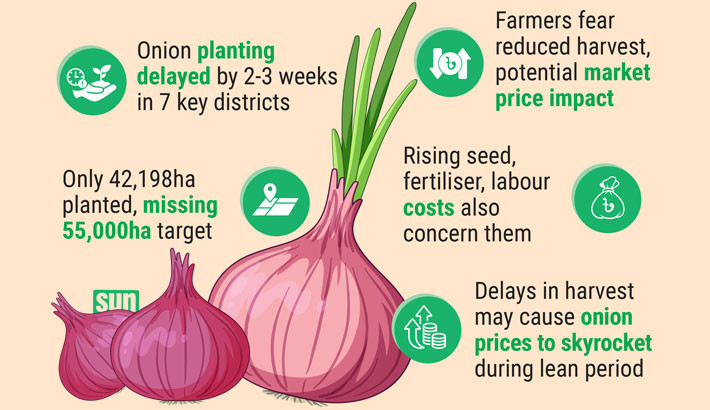
The planting of “murikata” onions – a cultivation method where onion bulbs are directly planted to speed up the harvest – was delayed by two to three weeks this year across seven major onion-producing districts in Bangladesh.
Farmers are concerned that the delayed planting may impact both the quantity of onions they can harvest and the prices they will receive.
Persistent heavy rains in September and October have been blamed for disrupting planting schedules, according to officials and farmers.
Despite the setback, the Department of Agricultural Extension (DAE) remains optimistic, saying that farmers may still avoid significant losses in terms of onion prices, even though murikata onion planting fell approximately 25% short of this season’s target.
However, consumers are likely to feel the impact, as the delay may cause onion prices to skyrocket during the upcoming lean season.
In Bangladesh, onions are cultivated in two distinct phases. The early season onions, commonly known as murikata, are typically planted from early September to early October. Later-season onions, known as chara (seedlings), are sown between November and January.
Murikata onions generally reach the market within 80 days of planting.
DAE officials in the affected districts told the Daily Sun that the target was to plant murikata onions across approximately 55,000 hectares in seven key districts this season. However, only 42,198 hectares have come under the cultivation.
These districts include Kushtia, Jhenaidah, Magura, Faridpur, Rajbari in the southwest, and Rajshahi and Pabna in the north.
Pabna is the top-producing district, followed by Faridpur and Rajbari.
Combined, these districts account for nearly half of the country’s total onion production.
This season, around 188,000 hectares of land were allocated to onion cultivation across these districts, with an anticipated yield of roughly 1.9 million tonnes.
The national demand for onions is approximately 3.5-3.6 million tonnes, while total production this year is expected to reach around 3.2 million tonnes.
The district-wise breakdown is as follows: Kushtia (3,600 hectares), Magura (10,000 hectares), Faridpur (5,588 hectares), Jhenaidah (6,800 hectares), Rajbari (5,450 hectares), Pabna (2,800 hectares), and Rajshahi (7,960 hectares).
Farmers noted that repeated heavy rains left many fields waterlogged, leading to delays in planting by two to three weeks.
In some low-lying areas, seeds began to rot even before germination. Consequently, yields are expected to be somewhat lower this year, and farmers are concerned about profitability due to increased costs for fertilisers, pesticides, and seeds.
Sirajuddin Pramanik, a farmer from Rajbari, reported that he was forced to delay planting by three weeks, which will likely delay his harvest and disrupt his financial planning.
He also pointed out that seed costs have risen, with prices now ranging from Tk8,000-9,000 per maund, up from Tk5,000-6,000 last year.
The price of a 50-kg BADC DAP fertiliser sack has increased from Tk1,000 to Tk1,200-1,250, while Bangla DAP prices have risen from Tk1,500 to Tk1,700-1,800.
Labour costs have also surged, he added.
Pikul Ali, an onion farmer from Sujanagar in Pabna, expressed concerns that the delayed planting might lead to increased flowering, which could reduce yields. He is also worried about potentially lower prices in the market due to the delay.
According to the Rajbari Agricultural Extension Department, planting has been completed on approximately 1,000-1,200 hectares in the district so far.
However, agricultural officials believe that despite the increased costs and delayed planting, the impact on yield should be minimal, and they expect farmers to benefit from favourable prices.
Dr Shahidul Islam, deputy director of the Rajbari DAE, stated that the district’s target onion production remains around 50,000 tonnes, and he does not anticipate the delay will significantly affect the overall yield.
“In the current scenario, there is little risk of loss from onion cultivation,” he mentioned.
Mahmudul Faruq, additional director of the Rajshahi DAE, said that farmers are planting the high-yielding Nasik-53 variety of onions, which is expected to protect them from potential losses.