
 For all latest news, follow the Daily Sun's Google News channel.


Ageing vehicle fleet poses nationwide safety, environmental risks
Over 73,000 vehicles aged 20+ years operate across country
Published: 28 Sep 2024, 09:55 AM
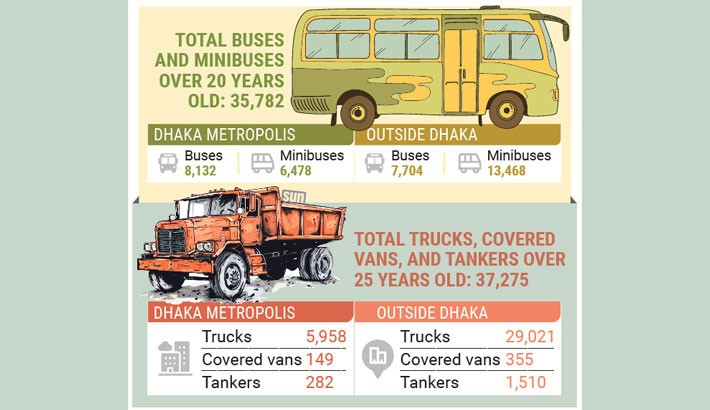
More than 73,000 vehicles, aged over 20 years, continue to operate on roads across Bangladesh, posing significant safety and environmental risks. These ageing vehicles, including buses, minibuses, trucks, and tankers, contribute to road accidents and exacerbate air pollution nationwide, according to experts.
Sources from the Bangladesh Road Transport Authority (BRTA) told the Daily Sun that there are 35,782 buses and minibuses over 20 years old, with 8,132 buses and 6,478 minibuses operating in Dhaka metropolis.
Additionally, there are 37,275 trucks, covered vans, and tankers over 25 years old. Of these, Dhaka has 5,958 trucks, 149 covered vans, and 282 tankers.
This information was disclosed by the BRTA in a letter sent to the Ministry of Environment, Forest and Climate Change in April this year, in response to the ministry’s request for details on buses and minibuses older than 20 years, as well as trucks, covered vans, and tankers older than 25 years, the sources said.
The move came following the ministry’s decision to remove buses over 20 years old from Dhaka to reduce air pollution.
According to BRTA sources, as of 31 March 2024, the authority had registered 6,017,438 motor vehicles across 20 categories. Among these, 54,687 buses, 28,322 minibuses, 150,676 trucks, 48,983 covered vans, and 6,944 tankers were registered in five categories. In total, 289,612 vehicles in these five categories are registered with the BRTA, of which 70,053 are over 20 years old.
Section 36 of the Road Transport Act addresses the determination of a vehicle’s lifespan or “economic life”, but this has not been practically enforced. In May 2023, the BRTA issued a notification setting the economic life of buses, trucks, covered vans, and tankers. While this was intended to be implemented immediately, the decision was never enforced, and the notification was withdrawn in August of the same year. Allegations suggest that the BRTA succumbed to pressure from transport owners.
When asked about the overall situation, Sk Md Mahbub-E-Rabbani, director (road safety) of the Bangladesh Road Transport Authority (BRTA), told The Daily Sun, “To operate on the roads, vehicles must have registration, fitness certificates, route permits, and tax tokens. If these are absent, legal action can be taken against the vehicle.
“However, BRTA cannot enforce the law; this is the responsibility of the police. We have a few magistrates who conduct some mobile courts.”
He added, “Currently, there is no economic life span determined for vehicles, but we are working on it. If a decision is ever made that expired vehicles can no longer operate, we will not issue route permits to such vehicles.”
Meanwhile, stakeholders argue that merely determining the lifespan of vehicles is insufficient; a policy is required to manage the disposal of expired vehicles. This would necessitate the establishment of a motor vehicle scrapping system, which the government has yet to implement.
Saiful Alam, general secretary of the Dhaka Road Transport Owners Association, told The Daily Sun, “We will work with the BRTA to determine the economic life of vehicles. The transport system needs rebuilding. The last government destroyed everything.”
Md Hadiuzzaman, a transport expert and professor at the Bangladesh University of Engineering and Technology (BUET), told The Daily Sun, “Vehicle manufacturers typically set the economic life of a vehicle at 10-15 years. However, as a developing country, we allow some leniency for owners, granting an additional 5-10 years.”
Nevertheless, vehicles that have outlived their economic life are extremely hazardous, he noted, adding that structural weaknesses in these vehicles will lead to more accidents.
“Repairing expired vehicles is difficult, resulting in more black smoke emissions and increased air pollution. There are also indirect effects, such as these old vehicles breaking down on roads, causing traffic jams. Half of the vehicles in the capital have already exceeded their economic life. Removing old vehicles from the roads isn’t a technical issue, but a political one. Vehicle owners are linked to political parties, so these vehicles continue to operate through muscle power. Those responsible for addressing the situation remain indifferent.”
BRTA unable to identify how many registered vehicles are off the road
The BRTA initially provided manual registrations for motor vehicles. Since 1991, vehicle-related services have been computerised.
From 2010 onwards, the BRTA has issued automated registration numbers through the BRTA Information System (BRTA-IS).
However, registration details from the manual system, prior to automated number generation, were integrated into the BRTA-IS. At that time, most vehicle owners did not have mobile phones, meaning their contact numbers were not recorded.
Consequently, motor vehicles registered even before Bangladesh’s independence remain listed in the BRTA-IS, although most of these vehicles are no longer in use.
The BRTA has indicated that it is working on verifying delinquent vehicles through the BRTA-IS to create a list of off-road vehicles and remove them from the database.
However, the current system lacks the capability to identify which registered vehicles are no longer in use.
The BRTA estimates that around 30% of all registered vehicles are likely off the roads.