
 For all latest news, follow the Daily Sun's Google News channel.


Israel's Invasion of Rafah city in Gaza
As exodus from Rafah continues, UN urges reopening of aid lines
Daily Sun Report, Dhaka
Published: 10 May 2024, 07:26 PM
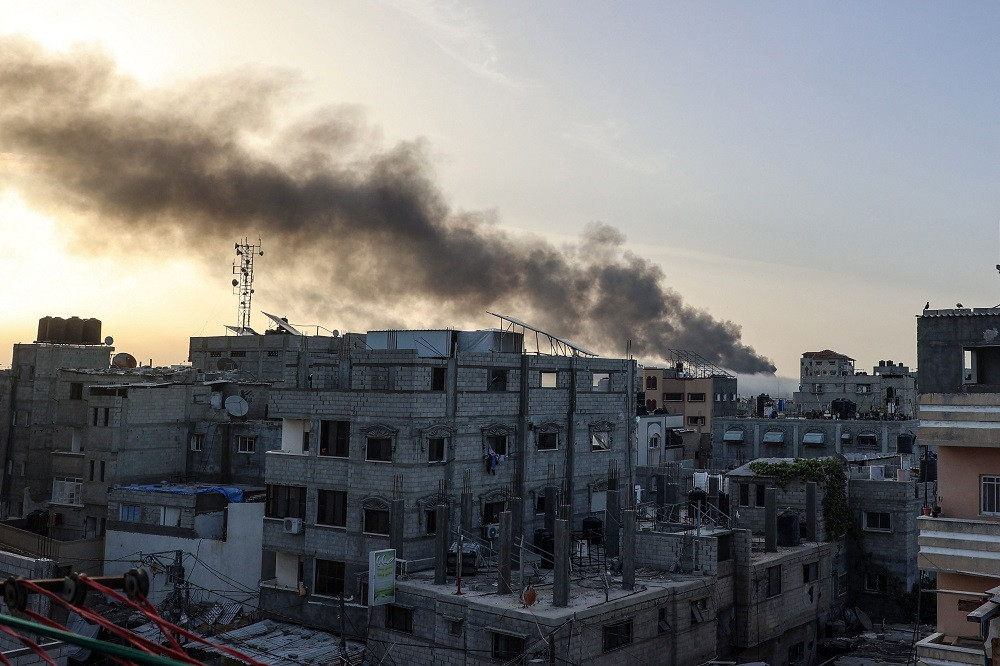
Smoke rises above building at sunrise, in the aftermath of an Israeli bombardment in Rafah in the southern Gaza Strip on 10 May. Photo: AFP
With no let-up in the Israeli military operation in Gaza’s southernmost city of Rafah into Friday, UN humanitarians issued renewed calls for a ceasefire as “the only hope” to avert further bloodshed and restore desperately needed aid deliveries.
“As Israeli Forces’ bombardment intensifies in Rafah, forced displacement continues,” said the UN agency for Palestinian refugees, UNRWA, in a post on X. “Around 110,000 people have now fled Rafah looking for safety. But nowhere is safe in the Gaza Strip, and living conditions are atrocious. The only hope is an immediate ceasefire.”
In addition to the immediate threat from ongoing military actions, UN aid agencies have warned with increasing urgency that the humanitarian operation across the enclave has been crippled, reads a UN news statement.
“Impossibly, again, it will worsen if humanitarian operations are not revived in the next 48 hours,” said Hamish Young, UN Children’s Fund (UNICEF) Senior Emergency Coordinator in the Gaza Strip.
In a related development, UN Secretary-General António Guterres strongly condemned a new attack by protesters on an UNRWA facility in Jerusalem. “I condemn the recent attack on @UNRWA’s Headquarters in East Jerusalem. Targeting aid workers and humanitarian assets is unacceptable and must stop,” the UN chief said in a post on X.
His comments underscored those of UNRWA Commissioner-General Philippe Lazzarini on Thursday, who reported that Israeli residents had “set fire twice to the perimeter” of the agency’s headquarters, marking the second time UNRWA had been targeted in a week amid weeks of demonstrations.
Back in Gaza, the latest images from Rafah provided by UNRWA showed a steady stream of people leaving the east of the city with cars, motorbikes, and donkey carts laden with their belongings, in response to evacuation orders from the Israeli military.
Most of those displaced are seeking safety in Khan Younis and Deir al Balah. But these areas lack the basic services required to support civilians who need food, shelter, and healthcare, aid teams maintain.
Roads to the coastal zone of Al-Mawasi where Gazans have been instructed to move, “are jammed,” said UNICEF’s Mr Young. Speaking from Rafah via video-link to journalists in Geneva, he described desperate scenes as families were uprooted once again, with “many hundreds of trucks, buses, cars, and donkey carts loaded with people and possessions” continuing to stream out of the southern city.
“People I speak with tell me they are exhausted and terrified and know life in Al-Mawasi will, again, impossibly, be harder,” he said. “Families lack proper sanitation facilities, drinking water, and shelter. People are making improvised toilets by digging holes in the ground around groups of tents. Open defecation is on the rise.”
“One of the fathers told me he had nothing other than bad options to choose from. And as he was telling me where he was going, he started sobbing. Then his children started crying and then started asking me what to do. It’s just a tragic situation, and there’s just nowhere safe in Gaza for children.”
“Civilians in Gaza are being starved and killed...This is Gaza today,” said the UN’s top aid official, Martin Griffiths. In a social media post on X, the veteran aid official warned late Thursday that for days, “nothing and no one had been allowed in or out of Gaza.”
The closure of Rafah and Kerem Shalom crossings in southern Gaza—the main entry points for critically needed aid—food, water, fuel, and medical supplies—”means”no aid,” Mr Griffiths continued. “Our supplies are stuck. Our teams are stuck,” he said, a message echoed by aid teams whose assessment missions have been cancelled because of a lack of fuel.
Meanwhile, civilians have faced and repeatedly fled intense and daily bombardment and clashes, “and we are prevented from helping them,” the emergency relief chief insisted. Meanwhile, the UN World Food Programme (WFP) reported that its main warehouse in Gaza was now out of reach.
“Our main warehouse is now inaccessible. No aid has entered from southern crossings in two days,” said WFP Palestine Country Director ad interim Matthew Hollingworth on X late Thursday. “Thousands of people are on the move. Only one bakery is still working. Supplies of food and fuel in Gaza will only last one to three days. Without them, our operations will go into a standstill.”
The outlook is equally dire for the enclave’s remaining medical facilities, warned the UN World Health Organization (WHO), which said that “without fuel, the whole system collapses.” The WHO is responsible for fuel deliveries to all hospitals in Gaza, but it has had to suspend missions to the north so that those in the south can stay open, said spokesperson Dr. Margaret Harris.
“All the things that a hospital does, all the lifesaving treatments, no longer can be done, even if you’ve got somebody back from the brink, you’ve operated on them, you’ve put them on a ventilator, the ventilator stops, they no longer breathe.”