
 For all latest news, follow the Daily Sun's Google News channel.


As the world population is increasing and the standard of living is going up in most low and middle-income countries, so is the energy demand. The global energy consumption was 5,653 TWh (Terawatt hours) in the year 1800, which rose to 178,899 TWh in 2022 and is expected to reach 205,555 TWh in 2040, as stated in an article published in Our World in Data. Only around 17% of the energy consumed in 2022 was clean energy. Clean energy, which includes solar, wind, hydropower and nuclear energy, is so named because in its production no greenhouse gas is emitted.
Thus, 83% of globally consumed energy in 2022 came from fossil fuels: oil, coal and natural gas. As we burn fossil fuels directly for heating, cooking or running vehicles or convert them to electricity we add greenhouse gases to the atmosphere. The world is now confronting climate change and the only way to control the situation is to reduce energy consumption and shift to clean energy.
Anthropocene: Has it Already Begun?The developed countries are consuming much more energy than the developing countries. Based on the data published by the US Energy Information Administration, the following chart illustrates the per capita energy consumption (kWh/person) of G7 nations compared to Bangladesh and India in 2022. The difference is overwhelming.
During the last two decades, industrialised nations have marginally reduced per capita energy consumption but the trend for developing countries is the opposite. Thus, cutting back on energy consumption is a far cry.
As for shifting to clean energy, a range of concerns has been pointed out in an article titled “The Dark Side of Solar Power” published in the Harvard Business Review in June 2021. The astounding amount of waste that the solar panels will generate at their end of life estimated at 30 years would initiate a new global environmental hazard. Harvard researchers have also forecasted similar problems for other clean energy technologies. For example, they estimate that, in the US alone, the waste from wind turbines will be more than 720,000 tons during the next 20 years.
Globally, the auto industry is moving toward electric cars in a big way. This should reduce the carbon emission of the transportation sector. But then, it will increase the demand for electrical power which will, in turn, surge the carbon emission by the power industry. Thus, it becomes a trade-off, and the net effect might not bring much change in global emissions.
Ahead of COP 28 – the United Nations Climate Change Conference, held from 30 November to 12 December 2023 in the UAE, the UN published its 14th Emissions Gap Report. The report mentioned that although nations have long been making persistent pledges to reduce greenhouse gas emissions, the reality on the ground is different. In 2022, global greenhouse gas emissions reached a new record high, with an increase of 1.2% from the previous year.
This winter we are seeing severe weather in the northern hemisphere with extreme cold, snow storms, sleets, rains, floods and high waves on the coasts. A news report by The Guardian attributes these weather events to the rapid warming of the Arctic, occurring at a rate four times faster than the rest of the planet. The report also mentions that the US had experienced the fifth hottest summer in a row last year. Perhaps these phenomena represent the irreversible climate change—our new reality. Has the Anthropocene (coined by Eugene F Stoermer a Professor of Biology at the University of Michigan, USA, as a new epoch in the geological time scale) really begun?
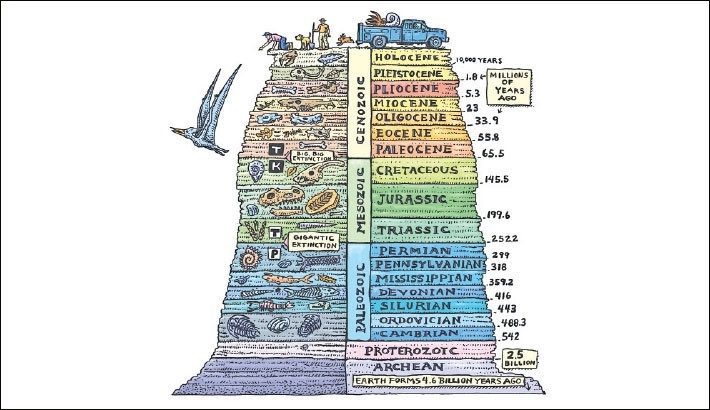
The geological time scale divides the Earth’s age into hierarchical time intervals: eon, era, period, epoch, and age, marking the distinct changes that occurred in the Earth’s history during those intervals. Officially, we are now living in the Holocene epoch that began about 11,700 years ago after an ice age. The Holocene is characterised by a warm and stable climate conducive to the sustainable living of humans and other animals.
Many scientists, including Stoermer and Nobel Laureate Dutch meteorologist and atmospheric chemist Paul J Crutzen, believe that the Holocene has ended and a new epoch Anthropocene has already begun.
In their resea rch article published in the Quaternary International Journal, Zalasiewicz et al. observed that since the first test nuclear explosion in 1945 in New Mexico, USA, there had been, on average, one nuclear detonation every 9.6 days until 1988 with worldwide radioactive fallout. Such insane activities coupled with dumping staggering amounts of greenhouse gas into the atmosphere from the start of the Industrial Revolution have so severely and irreversibly impacted the Earth that it can be considered as the beginning of a new geological epoch.
The world leaders’ half-hearted approach, and slow and inadequate measures, to contain greenhouse gas emissions probably do not count anymore. The Anthropocene may have already begun.
____________________________________________
The writer is a former corporate professional and academic