



 For all latest news, follow the Daily Sun's Google News channel.


The first views of Hong Kong repeatedly disintegrated as they washed down my plane window in a rainy obscurity. It was pouring on touchdown, reinforcing my concern that Hong Kong mostly welcomes in rain, often denying a mere visitor full access to her psyche. But the traveller in me would not give up, as I firmed up with a strong drive to explore her, no matter what.
My airport cab, speeding through the rain, offered the first glimpses of the city. I saw a rain-drenched city full of high-rises, some shooting for the sky. Hong Kong, I reckoned, was a city perhaps best understood in terms of clouds and rains, playing with the lush hills that carry her on their laps. That is the language of nature here, and one better accepts it to be friends with her before unmasking her. She is swept by water bodies narrowing into her heart from the sea, offering sweeping views of the harbour. I thought of similarities to Singapore, only to dispel comparison because this was much more than a modern metropolis. Here, nature was more beautiful and playful.
My hotel, Harbour Grand, offered panoramic views from my upper floor windows. I would sit and watch the light-steeped Victoria Harbour late into the evenings after my return from a day’s exploration. I realised her beauty is enhanced manifold from a high vantage point.

One aspect of Hong Kong’s beauty lies in the fact that she is often consummate chaos wrapped in order. After an engagement, when you snap out of this seemingly utter bedlam, you find nothing is actually out of control. You were just sucked into a different, more engrossing and noisy world for an unforgettable experience. Nowhere is it more evident than in the marketplace, and the street-side eateries. There is hustle and bustle everywhere, with diners – some undecided for an annoyingly long time – cacophony before the kiosks.
I had a craving for the famous roast duck, a signature dish. I bumped into a street-side restaurant near Tsim Sha Tsui station. After my thoughtful choice, I waited for a while, as my food didn’t show up in the order it was received. My rhetorical flourishes were challenged by a visibly irritated Cantonese-speaking server when I dared to ask for my roast duck. She lightly scolded me in thick broken English, implying that many others had ordered the same dish, and mine wasn’t special enough to warrant extra attention. Many orders served had looked exactly like mine, as I looked on helplessly with higher order numbers flying off the kitchen. Finally, the juicy roast duck and bok choy on rice noodles, immersed in a duck-bone-infused broth, appeared and it was worth the rebuke. It was delicious.

In my quest to taste another signature dish, in Kowloon, I walked hungry and exhausted in humidity toward Kam Wah Café. My GPS guided me to a small, non-descript, and packed café in Mong Kok. This café is famous for making another signature dish: pineapple buns. I entered and immediately got into hot water with the person at the main desk. She figured out what I wanted but got irritated when I took a few long moments to decide what to have with it. Coffee and tea were on offer. Once I sided with tea, she reminded me of hot and cold variants of it. As I hesitated again, she got more annoyed. It was like expecting something out of a child’s mouth but not quite hearing it. Then when I murmured cold tea, she asked me if I wanted lemon in it. When I paused again, debating lemon, she seemed to be losing it. Finally, sensing my time was running out before an inevitable denial of service, I quickly settled for, um, whatever. “Okay, okay, lemon, please! ”, my voice barely audible. Thank God, at least the pineapple bun was firmly decided. A few scars of embarrassment later, when my coveted pineapple bun finally came with all her glory, all my sweaty exhaustion evaporated in seconds. “Who cares about the tea?” The sugary golden crust on the bun with the fresh slab of melting butter inside was out of this world.

It is customary to have milk tea with a pineapple bun. But, on the spur of the moment, I lost my ability to don an educated hat, as I desperately wanted to get away from her probing look with anything that could remotely accompany my bun. My euphoria was ephemeral. No sooner had I devoured my yummy bun than I was rushed away from my table as new diners almost stumbled on me. It seemed like a conveyor belt. My short lifecycle came to an end, relishing a meal and being immediately pushed off it. When I finally zoomed out of my Kam Wah predicament, everything looked orderly and peaceful from outside, ready for another gourmet.
In the evening, my order for claypot rice in Temple Market didn’t invite any confusion or impatience, as it was somewhat a straightforward dish. Street-side, I sat down among the locals to enjoy a local dish of slow-cooked hot fluffy rice, topped with chicken and a poached egg, drizzled with sauce. This time my table was secure.

Victoria Peak offers a 360-degree view of the clouds, lazily drifting around in the gentle breeze, creating large dancing shades on the harbour and the hills, as if to introduce me to the salient aspects of the landscape. As my eyes chased them around, I gradually took a peek into her resolve, the lush hills, her heartbeat, the splash of the Victoria Harbour, her colours, the flora and her character, and the everyday lives of the locals. The fragrance of her flowers makes up her scent. A dazzling array of beautiful flowers adorns the flower market road in Mong Kok. Their neat arrangements, colours, and varieties blew my mind away. I felt tempted to buy bouquets in every shop, only to realise I didn’t have a home there.
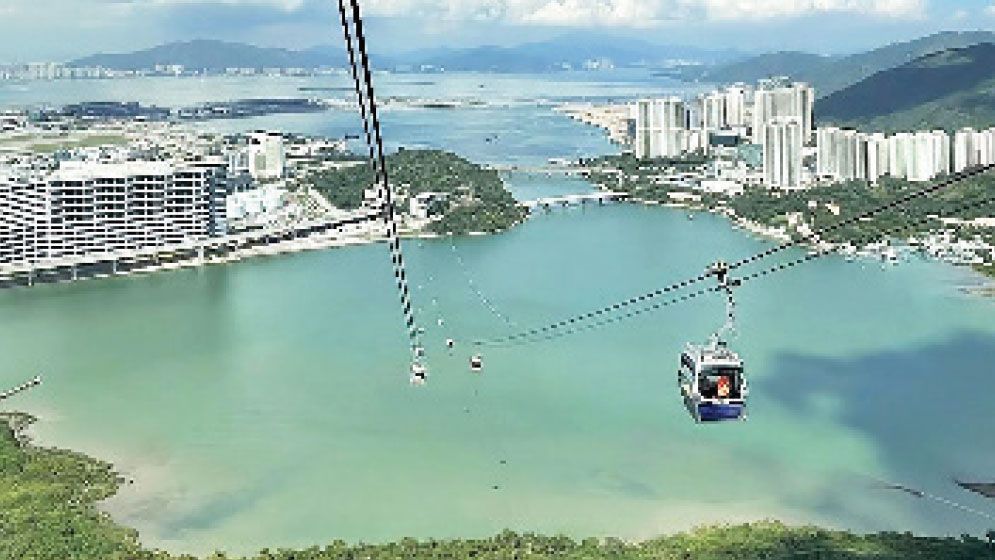
Hong Kong is complete with all her elements complementing one another. The hills close and far not only hold the city on a loving palm but also hold their own secrets close to their chests, waiting to be explored only by a strong curiosity. My final trek, meant to be mostly spiritual, continued away from the city, on a swaying cable car from the Tung Chung terminal on Lantau Island. The spectacular 25-minute ride took me high above the valleys, sandwiched by the high hills. As the cable car climbed up one high hill after another, the city slowly faded, and the new airport came into full view. I thought those planes could only catch fleeting views at high speeds, while I could savour every tree, every wildflower, and every bird from my slow-moving vantage point at my own pace, as the changing elevation and weather offered varied species. “Do they envy me?" I wondered. I soaked up the vast expanse of the blue sea on one side and attempted a poem, only to be disrupted by the sight of the towering Buddha on a hill. Finally!!
A Chinese gate is a majestic gateway to the closely held treasures of Ngong Ping. This place felt like a sanctuary, deep in the hills that refused to identify with the general perception of Hong Kong. She carves out her own proud identity, blissfully oblivious to a famous city nearby, and offers a fresh insight.

Although the Big Buddha sat high up there, his imposing presence could be felt everywhere in this small town. As I strolled around the gate and found myself surrounded on each side by restaurants and souvenir shops for a short stretch, it seemed like a small town nestled among the hills, sort of a base camp a mountaineer prepares in, before undertaking the final daunting 268-step ascent to the top of the hill where Buddha sat. The tenacity of one’s mind met a stern challenge here, but I saw no resignations, as most elderly folks made it with multiple breaks. I pushed on like a warrior. Buddha sits proudly on the top tier of a two-tiered circular platform as a monarch presiding over everything that goes on below. The bottom tier has the six golden devas representing six perfections needed to achieve enlightenment. The message of peace here was being carried far away by the gentle breeze sweeping through the valley to the troubled world.
The elegant, colourful, sun-swept Po Lin Monastery down in the valley beckoned me as I walked down the stairs and through the vista. In the courtyard were the circular stone pits and burning incense sticks as people prayed around them. The aroma of the incense intersected with the scent of nature, resulting in a pervasive spiritual resonance in the form of a serene white smoke. A vibe was being created to groom one before entry into the monastery. The internal compound offered a view of the architectural marvel of the monastery and a respite to reflect on the meaning of life.
When I entered the ornate, gilded grand hall of the monastery, I found a friendly monk with a group of curious young minds. They stood around him to learn the teachings of Buddhism with undivided attention. They prostrated and paid their respect to the three Buddha statues.
He then extended his hands to me with a grin. After pleasantries, he educated me on the bells and drums kept on either side of the shrine hall, and why they are used in the morning and afternoon routines. Interestingly enough, he referred to the living, trapped in sufferings. According to Buddhism, the sound of the drums echoes and awakens the living in the hell of agony, and liberates them. These bells are the only instruments that can be heard by them.
The main teaching aims at emptying our souls, which are corrupted gradually after birth by the distractions, temptations, messages, and conflicts of this conventional world, to regain purity. We lose it as we become conflicted and confused. This emptiness of the soul, free of duality, the concept of good and bad, is the oneness or suchness. Our struggle, he insisted, is to always fight to rid our souls of the duality to discover our intrinsic qualities for inner peace. A pure mind is free from evil and suffering and is therefore at peace.
The philosophy of Buddhism lies with the lotus, a flower that rises cleanly from the mud, implying that a soul can rise above sufferings. The lotus is born with flowers and the seeds at the same time, meaning good practice and enlightenment coexist. This simultaneity explains the attainment of heaven through practice while living in this world.
His parting gift was a sacred chant for me. I listened, fixated for a while, but when his exuberance extended the chant to repeated patterns, I politely thanked him for cleansing and enriching my soul and took my leave.
Walking away from the monastery, with the spirit of suchness, I suddenly felt like a baby, cleansed and reborn. I lived in those moments fully, my heart content. The sense of my origin and destination faded into insignificance, and a greater purpose was born. I grew apprehensive because once I reached the city down below, the conflicted and prejudiced world could again start impinging on my purified soul.
All religions preach harmony and peace. But do we really take that core message to heart irrespective of religion, ethnicity, and nationality? It is still very hard to fend off the evils of division that corrupt our souls and make us what we become.
C’est la vie!
The writer is a US-based software engineer, thinker and essayist