


 For all latest news, follow the Daily Sun's Google News channel.


Ground Improvement in Modern Era Prefabricated Vertical Drains and Cement Mixing Piles

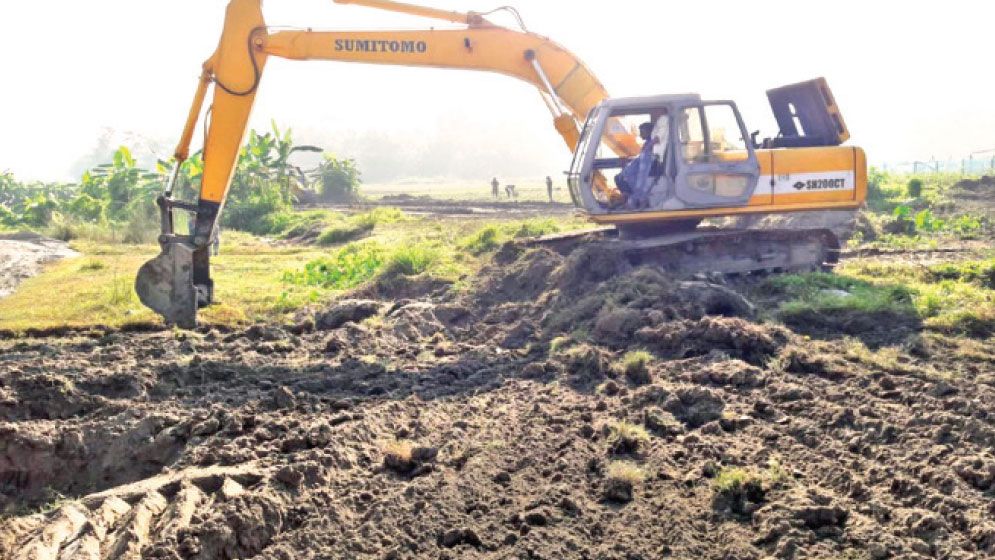
Stripping of ground (Padma Bridge Rail Link Project, Bhanga Junction)
Bangladesh is the largest delta in the world. Most of the parts of the country is formed by the deposition of the sediments. Due to this formation, soil in most parts of the country is soft. Hence, constructions on this type of soil require special treatment. Thereby, for any type of construction, determining ground condition becomes a prerequisite. Soil treatment is an important tool to increase the load bearing capacity of inferior quality soil. The purpose of this article is to provide a sustainable solution for construction in soft and weak soil prevailing in Bangladesh.
In modern era, incorporation of Prefabricated Vertical Drains (PVDs) and Cement Mixing Piles (CMP) have significant importance in enhancing the soil characteristics i.e. strength, stability etc. to a desired level which allows safe construction. Sometimes it is difficult to construct the structure if the water table is higher. Bangladesh is prone to earthquake and devastation may occur due the liquefaction behavior of the soil during earthquake. To mitigate this problem in the context of Bangladesh, Prefabricated Vertical Drains (PVDs) may effectively be used to sweep away the excess aqua pressure in order to provide required strength to relatively weaker soil. Cement Mixing Pile (CMP) is another invention in present-day context for increasing the load bearing capacity of soil with soft and clayey characteristics. These are popular now a days because of cost effectiveness and proven suitability for enduring heavier applied load.
Project That Used Prefabricated Vertical Drains and Cement Mixing Piles
Padma Bridge Rail Link is an important mega project of the country which is implemented under the direct supervision of the Bangladesh Army. It is one of the important corridors for passenger and freight transportation between Eastern and Western part of the country.
Different types of advanced technologies have been used in this mega project. At first soil investigation was carried out for the whole project. Most of the parts of this project run through the marshy land. As per the soil investigation report, decision was taken so as to how effectively the soil condition can be improved to withstand the structural and vibrational load. Prefabricated Vertical Drains (PVDs) and Cement Mixing Pile (CMP) are the two important techniques those are widely and effectively used in the project.
Working Principle of Prefabricated Vertical Drains (PVDs)
For Prefabricated Vertical Drains construction, primary step is the careful survey of the site and thereafter cleaning it to attain desired level of construction.
As already mentioned before, most parts of the rail line were constructed through low land area where the water table was relatively higher. Major part of the Embankments was constructed by filling sand. So, safety and sustenance of the embankment due to the train operation was a challenge because of this high-water table through these low lands. To overcome this challenging issue, soil improvement was necessary and PVDs is one of them to improve the soil condition. The primary purpose of PVD installation is to drain out water beneath the soil and facilitate pre-consolidation, thereby enhancing the stability and load-bearing capacity of the foundation. To confirm water drainage, piezometers are installed in the PVD sections to monitor pore water pressure. When the pore water pressure curve is found flat/stable, it is assumed that the water is successfully drained out.
PVD for structural layer carried out after clearing & grubbing completed, ponds (if any) were filled up to 500mm higher than their water level by using the push-fill method and by materials those were used for embankment filling. Thereafter, the structural layer works could be carried out once the filling ponds were compacted. The unqualified materials were removed and embankment filling materials were used to fill up to the designed level. Settlement observation is an important part of the construction. For this, settlement monitoring devices are used, and with settlement monitoring devices installed at Prefabricated Vertical Drains sections, the monitoring for settlement is performed as per stipulated frequency and methods. The initial readings from settlement monitoring are collected after Prefabricated Vertical Drain works have been completed and before filling subgrade bed. After filling the subgrade bed, the preloading may be started. Based on monitoring values, it is necessary to make an analysis whether the degree of consolidation of soft ground treated by PVD meets the requirement of 95% consolidation or not. The settlement during construction have limited impact on the structures, but the settlement of subgrade after acceptance has large impact on the constructed structures. In extremely soft areas where equipment cannot operate, a working platform is constructed. In waterlogged zones, the ground is raised at least 500mm above water level before placing geotextile sand layers. The construction supervision consultant (CSC) team was always present during the construction and ensured the desired quality of the work. As a member of consultant team, I witnessed the overall works, approved the materials and controlled any deficiencies which were noticed.

Quality Control of Prefabricated Vertical Drains (PVDs)
The PVDs provide a shorter drainage path, allowing water to escape vertically and then laterally through the sand blanket. Once pore pressure stabilises, it indicates that consolidation is complete and soil has gained sufficient strength.
Implementation of quality control procedures are required to verify conformance with the contract specifications. Verification is accomplished by examinations, tests, measurement and inspection and by verifying records. Verification procedures were developed using applicable testing and inspection methods along with acceptance criteria. CSC played a vital role to ensure overall quality of this project.
Cement Mixed Piles (CMP)
Cement Mixing Pile (CMP) is used to strengthen weak, soft, or loose soil underground. Where pile construction is not feasible but underground soil or base has to be improved, cement mixing pile is an alternative option at relatively low cost to withstand the surcharge loads. In this type of pile, slurry cement is directly mixed with the soft earth by heavy machinery and improve the soil condition. Cement Mixing Pile (CMP) is adopted for bridge embankments to form a composite foundation system. This method is particularly applied in sections with low embankment or excavation height (H < 1m). They are also implemented beneath the bottom slabs of underpasses and culverts, including the associated transition sections to enhance ground stability and load-bearing capacity.
Working Principle of Cement Mixing Pile (CMP)
Cement Mixing Pile is as like bored pile construction. For CMP, firstly site preparation is carried out by leveling the ground to a uniform surface. Following the shop drawing, setting out is performed by RTK (Real-Time Kinematic) machine to establish a boundary line. Pile spacing is carefully maintained using strings and steel rulers by inserting pegs and forming a grid layout on the ground. Normally, OPC 42.5 cement is used for CMP grout, with a water-cement ratio of 0.45 to 0.55. The cement content is maintained at 12%. Based on site conditions, the water-content ratio was adjusted as water content and void ratio varied location wise. Important to note that, the grout needs to be non-stop stirred and cannot be stored more than 02 hours.
Drilling the cement grout beneath the soft soil is the main part of this method. The drilling sequence follows a systematic pattern starting from one longitudinal line and progressing systemically to subsequent rows eventually forming a linear pattern. The minimum construction time for total construction of each CMP should be more than 40 minutes. Once the Cement Mixing Pile installation is complete, some cleaning works are essential. Here the soil on the top of the pile has to be removed. In addition to this, proper leveling of the soil in between the adjacent CMP needs to be ensured.
Risk Assessment and Control Measures
It should comply with the requirements of the Bangladesh health and safety and security legislation, regulations, codes of practice and guidance, etc. and additionally, all relevant and appropriate internationally recognised standards and established best practice. All personnel employed for the construction shall be physically fit, suitable, and adequately trained to carry out the duties for which they are employed. Operators of plant, equipment and vehicles shall have the required licenses and/or certificates of competence, good eyesight, good hearing and be able to understand all safety signs. CSC played a significant role to ensure all these criteria.
The main damage in Prefabricated Vertical Drains (PVDs) and Cement Mixing Pile (CMP) construction is machinery hazards. Proper management and quality inspection is required before and during the construction to minimise the risk.
The implementation of ground improvement techniques such as Prefabricated Vertical Drains (PVDs) and Cement Mixing Piles (CMP) has proven to be essential for ensuring the stability and long-term performance of embankments constructed on soft and compressible soils. The real time on ground challenges encountered i.e. low bearing capacity, excessive settlement, and excessive pore water pressure can be precisely mitigated by adequate ground knowledge, meticulous ground investigation, appropriate design and orderly implementation. Accelerated consolidation blended with safety and quality is a pre-requisite of modern days’ construction which can be significantly achieved by effective use of PVDs and CMP.
To ensure proper ground improvement method and to eradicate design uncertainties, precise bore-log data and soil parameter evaluation are crucial. CMP displays relatively better strengthening in localised area particularly in bridge approaches and transition zones whereas PVD is suitable for deep soft clay layers. Assessment of consolidation behavior of ground is important which can be ensured by proper application of the instruments such as piezometers and settlement plates.
Appropriate platform preparation is mandatory to expedite equipment movement and attain installation quality in very soft or waterlogged areas. Finally, well-trained operators and continuous supervision ensure technical specifications and eventually overall construction quality is improved.
_______________________________________________
The writer is an army officer from the Corps of Engineers of Bangladesh Army