


 For all latest news, follow the Daily Sun's Google News channel.


A Rohingya Girl, a Genocide and Thanaka
Dr Ehatasham Ul Hoque Eiten
Published: 13 Dec 2025, 12:00 AM

Amid the harsh realities of refugee life in Kutupalong Camp, the largest refugee settlement in the world, located in Ukhiya, Cox’s Bazar, a young Rohingya girl paints her face in gold dust, a centuries-old Burmese tradition. The delicate art on her face evokes Andy Dufresne’s timeless dialogue from the cult classic “The Shawshank Redemption” (1994): “Hope is a good thing, maybe the best of things, and no good thing ever dies.” Thanaka – a paste made from ground tree bark – is a signature of Burmese identity. For two thousand years, Thanaka has been an integral part of life in Myanmar, irrespective of people’s religious and cultural identity. Things started to change for the Rohingyas – the Muslim minority of Rakhine (Arakan) province – in the 1960s, following the military coup of Ne Win in 1962. State-sponsored ultra-nationalism was enforced with Burmanisation policies, and the Rohingyas began losing their cultural and civic identity. The final blow came in 1982 when the Myanmar parliament passed the Citizenship Law, denying their nationality. They became stateless overnight. A country once united by Thanaka was now divided by religion and ethnicity.
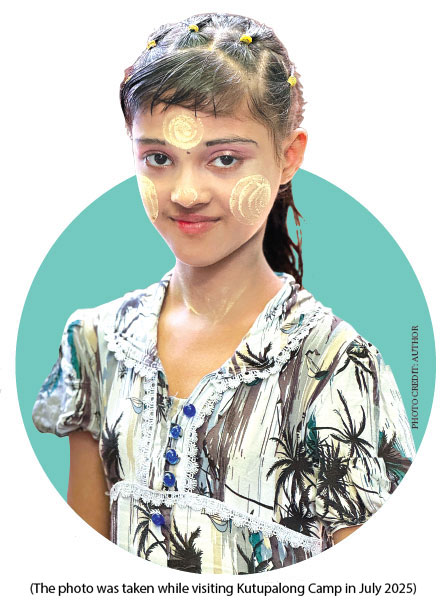
Then came the waves of genocide and ethnic cleansing. Mass killing, rape, arson attacks, forced displacement and other crimes against humanity in 1978, 1991-92, and 2017 compelled the Rohingyas to flee en masse to neighbouring Bangladesh, where they now live in refugee camps with the bare minimum of basic human rights. The living conditions in the camps temporarily built in parts of Teknaf, Bangladesh, are so deplorable, with limited access to food, shelter, sanitation and healthcare, that survival itself feels like a luxury. Yet, young Rohingya girls still paint their faces with Thanaka. This simple act is extraordinary. The beautifully designed Thanaka patterns on their faces symbolise a lost connection to Myanmar, the country that drove them from their land, destroyed their dreams, stripped them of their necessities and took their national identity. Yet, deep inside, they still carry the heart of the land that rejected them. They continue to identify themselves with the culture they once shared with the rest of Myanmar, and they still dream of returning to their ancestral homeland.
The host country, Bangladesh, has shown a genuine commitment to seeking their repatriation, a goal that aligns with its national interests. The longer the Rohingyas stay in the country, the greater the security threat becomes, as vulnerable groups can be exploited by extremists or foreign interests. Meanwhile, Myanmar has shown its willingness to take them back under the supervision of the international community, but its sincerity is highly questionable when it comes to implementing the resettlement of the Rohingyas. While the US and the EU have been pressuring Myanmar on various platforms, China and Russia have remained silent. The ongoing war between the Arakan Army and the Myanmar military has recently intensified, further complicating any prospects of resettlement. The reality is that the Rohingyas are unlikely to return to their homeland anytime soon. And so, the Thanaka Girl lives in her small tent – boiled in the summer heat, drenched by monsoon rain and chilled by the winter wind coming from the Bay of Bengal. She will not have an opportunity to study mathematics or play cricket. She may never see the world beyond the restricted territory of the camp. Yet, every morning she applies Thanaka one more time to her face, the fragrance reminds her of home, the design reflects her identity and the craft whispers hope: that one day she will be free, that one day she will return home and that one day she will be able to call a piece of land her country.
___________________________________________________
The writer teaches English at Daffodil International University, Dhaka. He can be reached at [email protected]