


 For all latest news, follow the Daily Sun's Google News channel.


No Give-and-Take in Talks for National Interest
Special Correspondent, Dhaka
Published: 25 Nov 2026, 01:17 PM
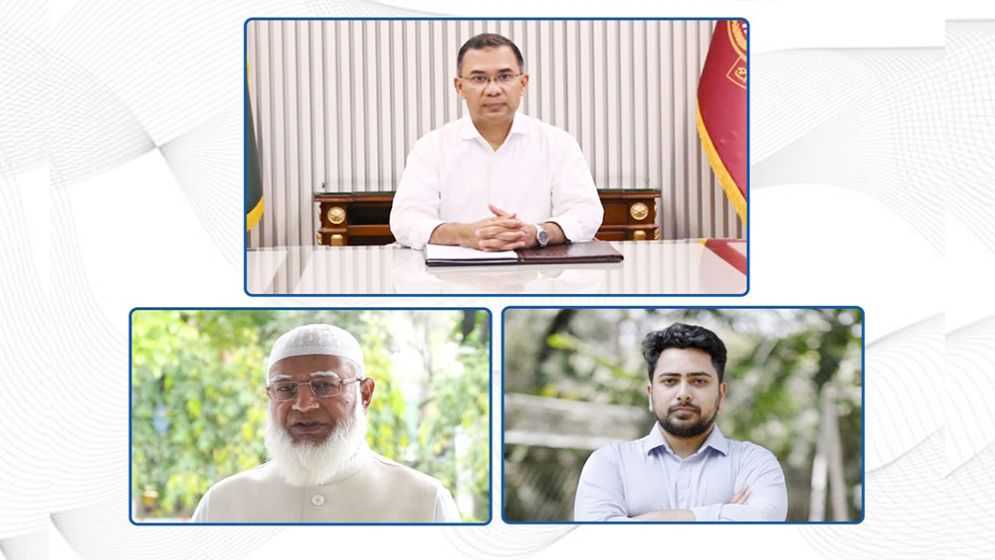
Democracy has multiple viewpoints. The coexistence of differing opinions is the true beauty of democracy. However, for the sake of the country and the welfare of the people, political parties must rise above party opinions. They must step outside partisan interests and work to protect national interests. That is why martyred President Ziaur Rahman said: party is greater than individual, and country is greater than party. Sometimes, following that very policy of setting aside party interest for the country—a policy adopted by Shaheed Zia—is his worthy son, Tarique Rahman.
When anti-democratic forces began attempting to create anarchy and sabotage in the name of politics in the country, right then Prime Minister Tarique Rahman called for national unity. He did not merely issue a call and sit idle; Prime Minister Tarique Rahman has taken the initiative to hold talks with anti-fascist political parties that participated in the July mass uprising. During a recess of the fourth session of Parliament, which ended on November 18, a one-on-one meeting was held between Prime Minister Tarique Rahman and Leader of the Opposition Shafiqur Rahman. In that one-on-one meeting, the Prime Minister spoke of building anti-fascist unity.
Following that, the Prime Minister arranged a series of talks with political parties. First to join the dialogue was the NCP. On November 23, a meeting was held between the Prime Minister and the NCP. In the dialogue with the Prime Minister, the NCP delegation—led by Nahid Islam—included NCP Member Secretary Akhtar Hossain, Senior Joint Convener Hasnat Abdullah, and Joint Convener Akram Hussain. After the discussion and lunch, Nahid Islam came out and spoke to journalists. The NCP leaders had a 35-minute discussion with the Prime Minister.
After the NCP, the Prime Minister will hold talks with Jamaat, the opposition party in the Jatiya Sangsad. Because the Ameer was abroad, talks with Jamaat have not taken place so far. Amid discussions over the Prime Minister's dialogue with political parties, Jamaat Ameer Shafiqur Rahman is returning home from Australia by cutting his trip short.
Sources close to Jamaat say that after his Australia visit, the Jamaat Ameer was scheduled to visit Malaysia for one day. He also had a program there to attend an event organized by expatriate Bangladeshis. According to the pre-scheduled plan, the Jamaat Ameer was supposed to return home next Thursday; however, cancelling his Malaysia visit, he returned home on Wednesday.
It has been learned that Jamaat-e-Islami, the opposition party in Parliament, is interested in participating in the dialogue or exchange of views that Prime Minister Tarique Rahman has initiated with political parties. The party is attaching importance to this initiative of the national unity process. However, not alone—the party wants to sit in dialogue together with all parties of the 11-party alliance.
However, it is being observed that in these dialogues, political parties are bringing up various issues outside the core agenda. For example, in the meeting with the Prime Minister, several issues including the July Charter came up from the NCP. They told the Prime Minister that if unity is wanted, priority must definitely be given to reform, justice, and the country's sovereignty. Speaking to journalists after the meeting, NCP Convener Nahid Islam said that the current situation did not develop in a single day. He said the situation deteriorated over the past seven to eight months after the election due to deterioration in the law-and-order situation, compromise on the question of justice, not taking a firm stand regarding the defeated forces of '24, and not having a clear stance on diplomatic relations with India. Commenting that a single-party constitutional amendment committee is obstructing the process of implementing the referendum verdict, Nahid Islam said that for this reason, the NCP called for abolishing the committee. At the same time, the party spoke of implementing the July Charter in light of the referendum verdict.
It has been learned that these issues will also be raised by Jamaat in the upcoming dialogue. Contact has been made with Jamaat from the Prime Minister's side. The date and time have not yet been finalized. However, it has been conveyed that Jamaat is positive about participating in the dialogue. At the same time, it has also been said that if dialogue happens, it must take place collectively with the 11-party alliance. And other parties, including the National Citizen Party (NCP), should also be called to it. Jamaat wants to sit collectively as an 11-party group because in this dialogue they want to talk about issues like the referendum and implementation of the July Charter. They are vocal on these demands in Parliament and are also holding movements on the streets. Are these issues urgent in this discussion?
In developed democratic countries, we see that despite extreme conflict and differences of opinion between the government and the opposition, on urgent questions of the country they set those differences aside, discuss urgent matters, and find a path to resolve them. Take the example of the United Kingdom: there, the opposition between the Labour Party and the Conservative Party is the main strength of that country's democracy. Yet whenever any problem related to the national interest arises, they sit in discussion and try to resolve it. In recent times, an all-party meeting was held in the United Kingdom over the question of participating in the Iran war alongside the United States and Israel, where they decided not to take part in the war. Regarding immigration as well, all parties in Britain are working unitedly. That does not mean the ruling Labour Party is accepting other demands of the Conservative Party. Differences of opinion between the two major political parties in the United States are extreme now, yet on matters of the country's internal security and terrorism, the two parties agree and work together. Even though Democrats do not agree with all of Trump's unilateral decisions, they work together in the national interest. This is the beauty of democracy. This is the core foundation of democracy. Differences of opinion will exist among political parties, but working together in the greater interest of the country is the hallmark of healthy democratic politics.
Prime Minister Tarique Rahman has set a unique example by introducing this culture of multiparty democracy in Bangladesh. To prevent arson terrorism and terror across the country, he held a one-on-one meeting with the Leader of the Opposition. Now, for the peace and stability of the country, he is holding discussions with all political parties. This kind of practice was not seen in Bangladesh in the past. Since becoming Prime Minister, just as Tarique Rahman has made Parliament effective, he is also giving importance to the opposition's views. Opposition parties should also practice these norms now. What is needed now is national unity to prevent terrorism.
There will be debates and differences of opinion over a referendum or the method of constitutional amendment. The government and the opposition will discuss and debate that in Parliament. In the upcoming election, the people will evaluate these differences and disputes. Through votes, they will give their verdict on who is right and who is wrong. But when the people of the country are under attack, pursuing one's own agenda at the expense of national unity is not the right thing to do. The national interest is not a give-and-take. The Prime Minister has stepped forward to create a democratic environment in the country. Now opposition parties must also be responsible.