


 For all latest news, follow the Daily Sun's Google News channel.


BNP moves to purge AL backers, reinstate over 500 expelled leaders
Daily Sun Report, Dhaka
Published: 20 Nov 2026, 12:00 AM
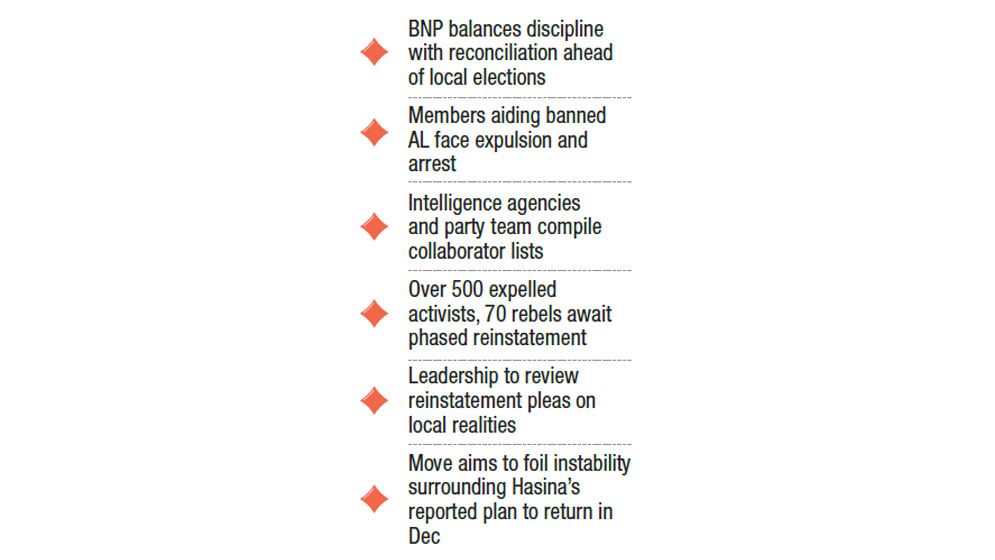
The ruling BNP has launched a twin-track organisational overhaul ahead of the 21 January local government elections, moving to purge members accused of aiding the banned Awami League while preparing to reinstate more than 500 previously expelled leaders and activists.
Central to the reconciliation drive is a plan to rehabilitate at least 70 rebel candidates who defied party directives to contest the 12 February parliamentary election independently.
By resolving grassroots fractures alongside a strict crackdown on internal misconduct, the party leadership aims to consolidate unity and prevent a repeat of its parliamentary election divisions.
Under the disciplinary drive, the BNP has warned of permanent expulsion and legal action against any member found sheltering fugitive Awami League figures, helping suspects evade custody, or interfering in police investigations.
A standing committee member, speaking on condition of anonymity, said intelligence agencies are compiling lists of alleged collaborators from the central to grassroots levels.
Simultaneously, a high-level BNP investigation team is preparing its own dossier to verify complaints and submit substantiated findings to the party’s top leadership.
Insiders said the crackdown targets members accused of shielding wanted Awami League activists or using political clout to secure the release of suspects arrested over sabotage and violence.
Several policymakers noted that the timing is also intended to pre-empt potential instability surrounding ousted fascist Sheikh Hasina’s reported plan to return to Bangladesh in December.
Zero tolerance for political patronage
Repeated reports have surfaced of local BNP figures intervening to free individuals accused of attacks and subversive acts during the Awami League’s rule.
Several leaders, from the grassroots to the central committee, told the Daily Sun on Thursday that some local functionaries have sheltered fugitive Awami League activists for financial gain, personal benefit, or family ties.
Home Minister and BNP Standing Committee Member Salahuddin Ahmed recently underscored the party’s stance, stating that organisational measures are taken whenever misconduct emerges.
He added that the party has instructed law enforcement and the administration to prosecute expelled members under existing laws so no one can evade accountability under the BNP banner.
BNP Acting Secretary General Advocate Ruhul Kabir Rizvi echoed that warning, stating the party would show no leniency towards criminal behaviour or breaches of discipline.
“If allegations are substantiated, they will be permanently expelled from all levels of the party, including their primary membership. The law enforcement agencies will also be instructed to take legal action against them,” he told the Daily Sun, adding that merely contacting police to seek the release of an arrested Awami League member would be treated as harbouring the banned party.
Addressing an event in Dhaka on 31 October, Standing Committee Member and Prime Minister’s Political Adviser Mirza Abbas warned of strict action against anyone sheltering Awami League activists. Fellow Standing Committee Member Nazrul Islam Khan said the party was ensuring no one uses its identity as a shield for crime, noting that protecting controversial Awami League figures severely damages the BNP’s public standing.
Over 500 expelled leaders may return
While tightening the screws on alleged collaborators, the party is moving to bring back more than 500 leaders and activists expelled for violating party discipline during the 13th parliamentary election, including at least 70 independent rebel candidates, according to a source at the Nayapaltan central office.
Some expulsion orders have already been rescinded, with remaining applications set to be cleared in phases. Monirul Islam, former general secretary of the Narail district unit – who ran independently against BNP nominee Dr Fariduzzaman Farhad in Narail-2 – has already been restored to his post. Earlier, in August, the party lifted the expulsions of six leaders across Narail Sadar, municipal, and Lohagara upazila units.
While most of the 70 rebel candidates have petitioned for a return, the status of seven who won parliamentary seats in defiance of the party – Barrister Rumin Farhana, Lutfor Rahman Khan Azad, Sheikh Mujibur Rahman Iqbal, Abdul Hannan, Atikul Alam Shawon, Salman Omar Rubel, and AZM Rezwanul Haque – remains unclear.
Meanwhile, former Dhaka North City BNP convener Saiful Alam Nirob, another expelled leader, joined a capital procession marking National Revolution and Solidarity Day on 7 November at the invitation of BNP Chairman and Prime Minister Tarique Rahman. Nirob later told reporters his loyalty to the BNP remained steadfast regardless of his formal status.
With several expelled figures eyeing the upcoming local polls – and some threatening to run as independents if sidelined – policymakers view internal consensus as vital.
Individual scrutiny and consolidation
Rizvi noted that while nearly all rebel candidates have admitted their mistakes and sought reinstatement, the party will avoid a blanket amnesty.
Cases are being assessed individually, with priority given to leaders whose return is dictated by local political realities or whose infractions were minor.
Citing Monirul Islam’s reinstatement, Rizvi explained that the popular local leader had likely missed out on the Narail-2 ticket due to alliance calculations, prompting Tarique Rahman to review his case favourably.
Between February and September 2026, the BNP issued 71 central expulsion notices – part of wider disciplinary action against over a hundred members for extortion, land grabbing, violence, and harbouring controversial figures – a sweep that has also forced the resignations of several ministers and MPs.
Policymakers believe firm central oversight will choke off political patronage and prevent the banned Awami League from regrouping at the grassroots. However, as one leader seeking reinstatement observed, the strategy's ultimate success hinges on how consistently the party enforces discipline and manages reconciliations across every tier.