


 For all latest news, follow the Daily Sun's Google News channel.


Capitalism, imperialism doomed to fall, leftist leaders say
Speakers call for guiding spontaneous people’s movements towards the right political goals
Daily Sun Report, Dhaka
Published: 14 Nov 2026, 10:41 PM
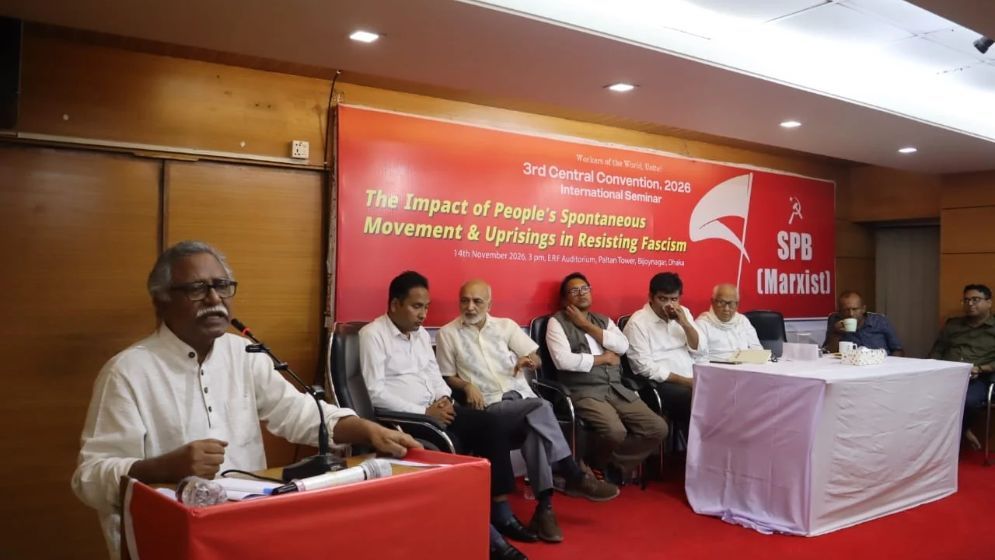
Photo: Daily Sun
People's movements against capitalist and imperialist exploitation are growing across the world. However, to make these movements successful, it is essential to build revolutionary political forces under the leadership of the working class and guide people's struggles towards the right goals, said leftist political leaders.
They made the remarks at an international seminar organised by the Socialist Party of Bangladesh (Marxist), popularly known as Basad (Marxist), at the Economic Reporters Forum auditorium in the capital on Saturday afternoon.
Titled "The Impact of People's Spontaneous Movement and Uprisings in Resisting Fascism,” the seminar was attended by leaders of leftist political parties from India, Sri Lanka and Nepal, along with politicians, academics and journalists from Bangladesh.
Prabhas Ghosh, general secretary of India's Socialist Unity Centre of India (Communist), said economic inequality, unemployment, poverty and market crises are inevitable consequences of capitalism. These problems are worsening, prompting people in different countries to take to the streets.
He said US imperialism has carried out wars and aggression in different countries, putting countless lives at risk.
He cited Iraq, Libya and Afghanistan, as well as the ongoing Israeli aggression in Palestine. The war in Ukraine has also intensified due to the involvement of imperialist powers, he added.
Prabhas Ghosh said the world would not have witnessed such a situation if a socialist system had existed. However, spontaneous people's movements could achieve their goals only under the leadership of a revolutionary party guided by the correct ideology. He stressed that revolution is the only way to establish an exploitation-free society.
Pubudu Jayagoda, central education secretary of Sri Lanka's Frontline Socialist Party, shared his experience of the country's 2022 mass uprising.
He said mass committees played an important role in the movement against the economic and political crisis in Sri Lanka.
People would repeatedly rise against capitalist exploitation, but their movements could succeed only if they were politically conscious and organised through mass committees under the leadership of a revolutionary party, he added.
Narendra Bahadur Singh, a central committee member of Nepal's Communist Party (Maoist), said spontaneous movements in different countries were challenging established state systems. However, fascism could not be eliminated without changing the economic structure based on exploitation.
Referring to Nepal's recent Gen Z movement, he said economic hardship, unemployment, inequality and the failure of the ruling class to address these problems had triggered the protests.
However, the movement failed to fulfil people's expectations as it did not have a clear objective of transforming the existing state system, he said.
Bahadur Singh stressed the need to establish links among working-class movements in different countries and strengthen international solidarity among communist parties.
Nepalese leftist intellectual Kumar Upadhyay said mass movements could create temporary resistance, but people's fundamental problems would remain unresolved as long as the capitalist system continued.
Despite a major uprising in Nepal, there had been no significant improvement in employment opportunities or the country's economic situation, he said, calling for stronger anti-capitalist movements.
Prof Anu Muhammad called for building unity among exploited people across South Asia. He also proposed taking initiatives to form a "Democratic Unity of South Asia".
He said capitalist ruling classes in different South Asian countries are continuing exploitation and plundering, while people are fighting against such practices. Strong unity among the oppressed people of the region is essential to strengthen these struggles.
New Age Editor and journalist Nurul Kabir said interest in leftist politics is growing across the world.
He said the fundamental principles behind Bangladesh's independence were freedom from exploitation, equality and the establishment of a society free from discrimination. However, no ruling party had been able to fulfil those aspirations since independence.
He alleged that the Awami League's prolonged rule had led to authoritarianism and widespread plundering. On the other hand, the BNP is following similar policies in governing the country after the mass uprising, he said.
As a result, questions had emerged over the ability of conventional bourgeois political parties to resolve people's problems, Nurul Kabir added.
He stressed the need for unity among leftist political parties in Bangladesh and greater cooperation among leftist forces internationally.
Abdullah Al Kafee Ratan, coordinator of the Democratic United Front and general secretary of the Communist Party of Bangladesh (CPB), said leftist forces had played an important role in Bangladesh's mass uprising.
However, their organisational weaknesses and absence from a leading position had prevented the aspirations behind the uprising from being fulfilled, he said.
Both the interim government and the subsequent BNP government had failed to meet people's expectations, he added.
Presiding over the seminar, Masud Rana, coordinator of the central executive forum of the Basad (Marxist), said changing the government alone could not end exploitation and fascism.
He said an exploitation-free state could only be established by transforming the existing unequal capitalist state and social system through a socialist revolution led by the working class.
Masud Rana alleged that the BNP government, like the previous Awami League government, is protecting business interests. He accused the government of using police to suppress workers' protests over wage demands.
He also criticised initiatives to lease the country's seaports to foreign companies and implement agreements with the United States that he described as contrary to national interests.
Despite the sacrifices made by working people during the July mass uprising, their aspirations are being ignored, he said, calling for stronger anti-imperialist and socialist movements in Bangladesh and across the world.
The seminar's keynote paper was presented by Indrani Bhattacharya Soma, a member of the party's central executive forum. Joydeep Bhattacharya, another member of the forum, moderated the event.
The seminar condemned imperialist aggression against Iran, Cuba and Palestine and called on anti-imperialist political parties and forces across the world to build stronger united movements against such aggression.