




 For all latest news, follow the Daily Sun's Google News channel.


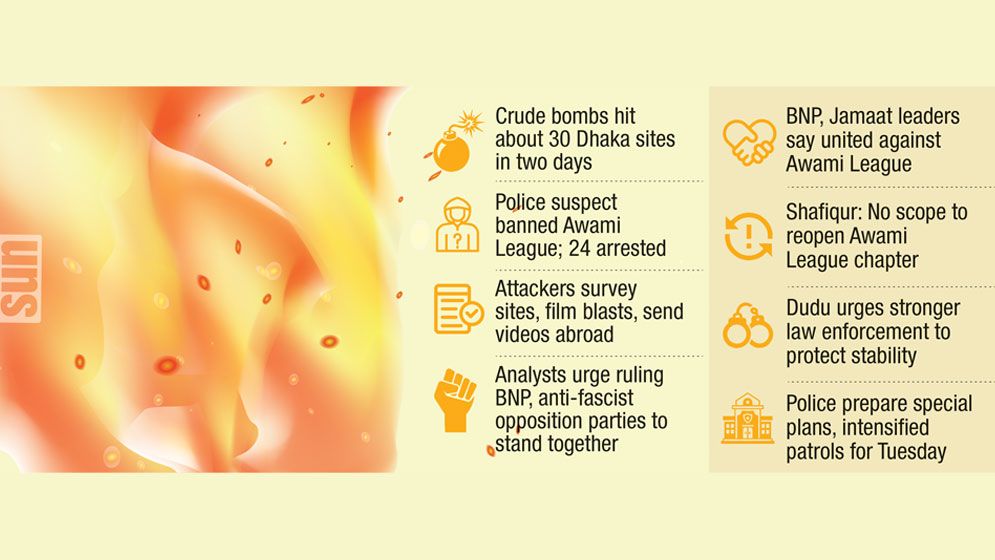
Crude bombs exploded at about 30 locations across Dhaka on Sunday and Monday, with police suspecting banned Awami League activists of trying to spread panic and stoke political tension ahead of December, even as analysts urge the ruling BNP and other anti-fascist political forces to stand together against any attempt to destabilise the country.
The blasts and arson attacks have targeted police stations, government offices, universities and other important sites, and 24 suspected Awami League men have been arrested.
The Dhaka Metropolitan Police (DMP) has stepped up surveillance, checkpoint operations and searches.
The incidents follow recent street violence, arson attacks on public vehicles and unrest linked to garment workers’ protests. No political party has publicly presented conclusive evidence about who is behind the attacks.
A senior DMP official, speaking anonymously, said the attackers chose locations with limited CCTV coverage and few police personnel, used motorcycles without number plates and fled quickly.
Suspects often visited sites a day or two earlier, the official said, and worked in small groups: one surveyed the location, another threw the bomb, a third filmed it and another watched for witnesses.
“They then send the video to some people living abroad. The amount of money they receive depends on the sensitivity of the location where they carry out the attack,” the official said, adding that police had received no advance intelligence about the specific attacks, although surveillance of suspected individuals had been increased.
A senior Special Response Battalion (SRB) official, also speaking anonymously, blamed members of the banned party and said intelligence indicated they might try more organised attacks.
“We have intelligence information indicating that they may attempt to carry out such incidents in a more organised manner. However, our intelligence activities have been significantly strengthened. We will be able to thwart their attempts completely,” the official said.
Another law enforcement source said a banned organisation had been carrying out such covert attacks since August, and that police personnel across the country had earlier been alerted to possible sabotage.
DMP Deputy Commissioner (Media) Akhtar Hossain said on Sunday that miscreants were trying to spread panic and that police establishments might have been targeted.
He said three people had been detained over the explosions at Dhaka University’s TSC, and that checkpoint-style searches were under way under every police station’s supervision, with suspected individuals being questioned and searched.
The Detective Branch (DB) had earlier arrested people involved in making crude bombs and recovered explosive materials, he said, and CCTV footage was being reviewed to identify people collecting inflammable substances.
On Monday, explosions were reported between 6am and 8am near government offices and educational institutions. Local sources said a procession was brought out under the banner of Rampura thana Awami League, led by its convener Mostak Ahmed, and that eight to 10 crude bombs exploded during it. Rampura police station Duty Officer Riaz confirmed the incident and said two separate cases were being prepared.
Blasts were also reported near a KFC outlet in Dhanmondi, a coffee shop in Khilgaon, Banasree G block, the DMP’s Tejgaon Division office, Cantonment police station, BRAC University, Government Titumir College, Aftabnagar Passport Office and Shanta Morium University of Fashion and Technology. In the evening, shops in front of Mirpur Bangla College gate were set on fire amid several explosions, and crude bombs went off near Dhaka Central Jail. A Lovely Paribahan bus was torched near Farmgate Metro Station. Two crude bombs exploded near Dhaka CMM Court around 6pm, where two people were detained and their motorcycle seized.
On Sunday, crude bombs exploded outside Pallabi police station, the CID office in Pallabi, the Darus Salam Traffic Zone office and Uttara East police station, where three blasts were reported in succession. A bomb thrown towards the Ansar headquarters in Khilgaon exploded inside the premises. Jatrabari police station was targeted on three consecutive days. Between 6pm and 7pm, blasts hit several spots at Dhaka University, including TSC, VC Chattar, the Senate Building and near Jagannath Hall, while others went off outside North South University and Southeast University. A parked Jolsiri Cantonment School bus was set on fire on 100 Feet Road in Vatara at around 5:40pm.
Police said Ashraful, identified as a Chhatra League member, was arrested for allegedly attempting a crude bomb attack in Rupnagar, and Md Biplob Khan, 33, another alleged Chhatra League leader, was held in Turag. Twelve people were arrested over a 5 November attack on law enforcers in front of the Golf Club in Cantonment: four by local police, five by the DB and three by the Special Response Unit. Rampura police arrested Shraban Sardar, 20, and Robin, 27, over the Banasree blast, and three people were held over the bus arson on 100 Feet Road.
Police said they had made special arrangements for Tuesday. “We have a special plan for Tuesday, but we are not disclosing the details at this stage,” said Paltan police station OC Ariful Islam. Vatara OC Mazharul Islam said a separate special plan was in place. Pallabi OC Jalal Uddin said police were prepared in both uniform and plain clothes. “Our regular patrols are continuing as usual, and they will be intensified further on Tuesday,” he said.
The attacks come as deposed Prime Minister Sheikh Hasina is reported to be seeking to return from India in December. She faces a death sentence handed down by the International Crimes Tribunal in November last year over crimes against humanity during the July-August 2024 crackdown, and has rejected the verdict and disputed the tribunal’s legitimacy. On Monday, media reports said she had applied to the Bangladesh mission in New Delhi for a new passport and national identity card. The government continues to seek her extradition under the bilateral agreement, while Hasina has said she intends to enter Bangladesh as a citizen. The Awami League’s activities remain banned and its registration suspended.
The BNP, Jamaat and the National Citizen Party (NCP) all oppose the Awami League, but have traded accusations at recent rallies. Jamaat leaders and the NCP, one of Jamaat’s key allies, have accused the BNP of seeking an understanding with the Awami League. BNP leaders have alleged that Jamaat has links with the ousted forces and wants to push the country into a fresh crisis, as they allege it did during the Liberation War in 1971. None of the parties has publicly produced conclusive evidence.
Addressing a rally in Rajshahi on 20 October, Prime Minister Tarique Rahman said he had intelligence that the fallen autocrat and a faction of the opposition had joined forces to create instability and labour unrest. Jamaat Ameer and Leader of the Opposition Dr Shafiqur Rahman said in a post on his verified Facebook page that the people of Bangladesh would not accept any attempt to rehabilitate the Awami League. He said the party’s chapter was closed on 5 August 2024, the day it was ousted by a mass uprising, and that there was no scope to reopen it.
Prof Dr Sabbir Ahmed of Dhaka University’s Political Science Department told the Daily Sun that the government and the opposition were equally responsible for the unstable situation. Neither side has settled its stance on Hasina’s extradition, he said, and policy-level loopholes had allowed subversive activities, including cocktail blasts and arson attacks on public transport. The recent incidents and the disunity among the parties, he said, indicated a sharp reemergence of the fascist force in the country.
Jamaat spokesperson and Assistant Secretary General Ehsanul Mahbub Jubayer told the Daily Sun that his party’s unity against the reemergence of fascist forces would remain intact.
“But the ruling BNP will be held responsible if the ousted Awami League gets political space in the country, as it did not uphold its promise regarding reform to the constitution,” he said.
The political rift was spotted, he said, when BNP and allied lawmakers refused to take the secondary oath for the Constitution Reform Council on 17 February. The parties remain at odds over implementing the referendum verdict in light of the July National Charter.
BNP Vice Chairman Shamsuzzaman Dudu told the Daily Sun there was no split on the issue of resisting the Awami League.
“BNP, Jamaat and NCP do politics, upholding their own political ideologies, but there is no disunity among us in terms of resisting the reemergence of the Awami League in the country,” he said.
He said the activities of the fallen party’s men could not be called politics and that they wanted to plunge the country into a fresh crisis. The government must strengthen law enforcement agencies to deal effectively with subversive activities and maintain a firm grip on law and order, Dudu said, to ensure political stability, economic progress and sustained development.
Read More