


 For all latest news, follow the Daily Sun's Google News channel.


BNP leader Dr Rafiqul Islam honoured at Shanghai hospital
Daily Sun Report, Dhaka
Published: 28 Oct 2026, 08:38 PM
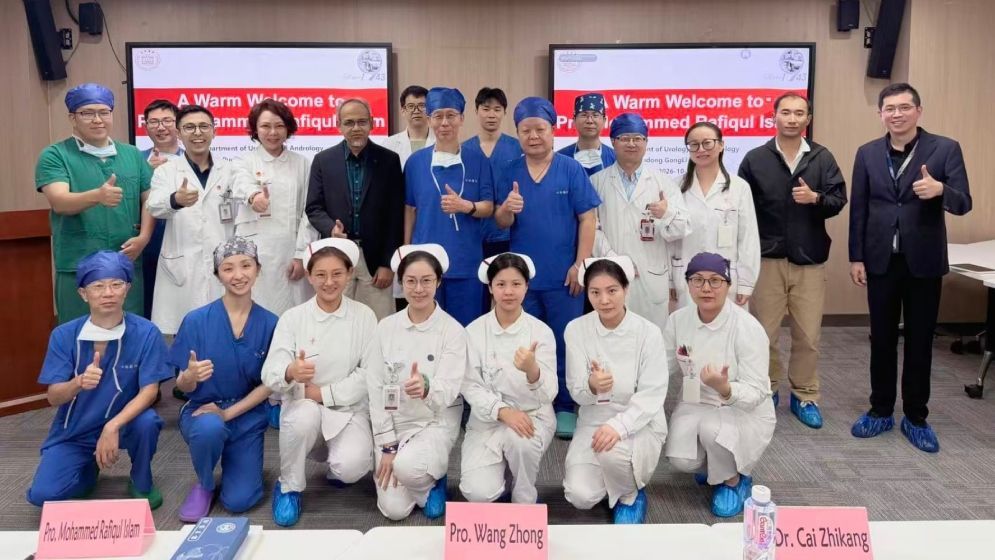
Professor Dr Md Rafiqul Islam, BNP’s
health affairs secretary and a faculty member at the Bangladesh Medical University,
has received a special reception at Shanghai’s Pudong Gongli Hospital as part
of an advanced training programme in robotic surgery.
At a ceremony held on Wednesday,
discussions focused on the development of urology and endourology in Bangladesh
and strengthening cooperation between the two countries in medical education
and technology.
Professor Zhong Wang, head of the
Department of Urology and Endourology at Pudong Gongli Hospital, delivered the
welcome address. He praised Professor Rafiqul Islam’s professional expertise as
an SIU fellow, his dedication to medical science, and his ideas and future
plans for developing Bangladesh’s healthcare sector. Prof Zhong also expressed
optimism about Rafiqul’s initiatives to modernise urology, endourology and the
broader healthcare system in Bangladesh.
During the event, Professor Rafiqul
Islam outlined recent advances in Bangladesh’s urology sector. He said the
country was making progress in specialised fields such as urology and
endourology. Modern surgical techniques, the use of advanced medical equipment,
improved physician skills and the expansion of specialised services were
creating new opportunities for the country’s healthcare system.
He described the introduction of
robotic surgery in Bangladesh as a significant milestone in medical science,
adding that the current government was also placing importance on advancing the
use of this modern medical technology.
However, he stressed that
establishing robotic surgery sustainably requires more than installing
state-of-the-art equipment. It also calls for skilled surgeons and trained
operating theatre teams, regular hands-on training, equipment maintenance,
research and the development of training systems that meet international
standards.
Professor Rafiqul Islam said robotic
surgery represents an important advancement in modern surgical practice. When
applied by skilled professionals to appropriately selected patients, the
technology can offer greater precision and control in complex procedures. He
noted that it holds particular promise for various complex urological
operations.
He added that Bangladesh should
expand the scope of robotic surgery in the future while increasing the use of
modern technology in endourology and other specialised medical fields.
Praising China’s progress in
healthcare modernisation, its technological capabilities in robotic surgery and
its experience in advanced medical training, Professor Rafiqul Islam said
China’s expertise could play an important role in making Bangladesh’s
healthcare system more modern and technology-driven.