


 For all latest news, follow the Daily Sun's Google News channel.


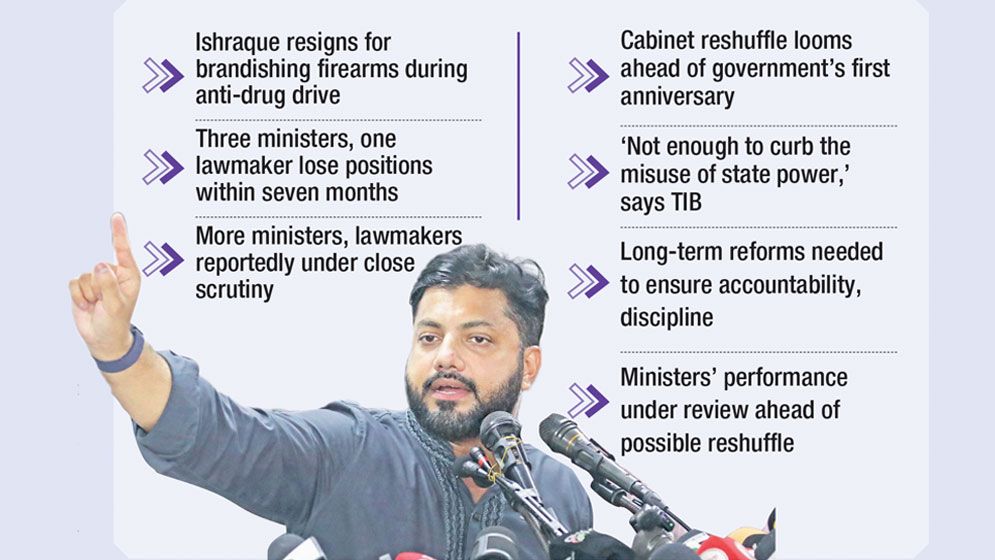
With several cabinet members and a female lawmaker losing their posts in just seven months, Prime Minister Tarique Rahman has sent a strong warning to his cabinet colleagues and party lawmakers. The resignation of State Minister for Liberation War Affairs Ishraque Hossain reinforces the message that controversy, misconduct and political missteps will not be tolerated.
Political analysts said that Tarique Rahman, also chairman of the ruling party, the BNP, has already shown that he is maintaining a zero-tolerance policy towards misconduct by his government and party colleagues to ensure accountability to the country’s people in line with his electoral commitments.
Amid mounting controversy over his participation in an anti-drug drive while carrying a firearm, State Minister for Liberation War Affairs Ishraque Hossain tendered his resignation on Monday following a conversation with Prime Minister Tarique Rahman, in a move aimed at sparing the party further embarrassment.
Ishraque, the eldest son of Sadeque Hossain Khoka, the last mayor of the undivided Dhaka City Corporation, made the announcement while addressing a press conference at the National Press Club on Monday.
"I met the prime minister and told him that, effective today, I have voluntarily sought release from my responsibilities as state minister for the Ministry of Liberation War Affairs," he said.
He said he had told the prime minister that he wanted to focus full-time on eliminating drugs in Dhaka-6 and neighbouring areas, as well as any other areas he might take on in the future, and addressing other problems affecting people's lives across the country.
He said he visited the Gandaria area on Saturday as part of a coordinated social resistance initiative against drugs, involving local residents and law enforcement agencies.
According to him, the operation was a joint undertaking agreed upon by police, local politicians andcommunity leaders. He also said he had raised the firearm in self-defence.
The incident took place near Gandaria Railway Station in the Dhaka-6 constituency. A video of the incident was posted on his Facebook page and quickly went viral, prompting widespread discussion and criticism among people from all walks of life across the country.
At one stage, Prime Minister Tarique Rahman on Sunday asked Ishraque to step down from his ministerial post.
Ishraque said at the press conference that media coverage had focused on his carrying a firearm during the operation rather than its main objective of combating drug trafficking.
“I told the prime minister that I wanted to resign so that I could continue the anti-drug campaign,” he said, adding that the prime minister had asked him to continue the initiative and address other problems affecting people in his constituency.
At the end of the press conference, Ishraque reiterated his commitment to the anti-drug campaign, describing it as a long-term effort.
He called for cooperation from local residents and the relevant authorities to tackle drug trafficking and address other public concerns in Dhaka-6 and adjoining areas.
Ministers under close watch
At present, excluding the Prime Minister, there are 26 full ministers. Additionally, there were 24 state ministers; following Ishraque’s resignation, the number of state ministers now stands at 23.
Following the recent resignation of reserved-seat lawmaker Ferdousi Ahmed Mishti and the removal of cabinet members Zahir Uddin Swapon from the Ministry of Information and Broadcasting and Dipen Dewan from the Ministry of Chittagong Hill Tracts Affairs, at least two to three ministers and some lawmakers are under the prime minister’s close watch. A joint secretary general of the party, speaking on condition of anonymity, told the Daily Sun that these individuals could face the same fate at any time if they misused state power.
The prime minister is also considering a cabinet reshuffle that would introduce some new faces ahead of the first anniversary of the government, and ministers’ performance is being evaluated as part of the process, said the BNP leader.
According to the leader, the prime minister pledged in his election manifesto to build a state where ministers and lawmakers are held responsible and accountable to the people, adding that his latest decision reflects that commitment.
As the BNP-led government approaches its first anniversary, the possibility of a major cabinet reshuffle is growing, with the prime minister seeking to tighten discipline and reinforce accountability within both the party and the government, according to several senior party leaders.
Earlier, the prime minister reshuffled his cabinet, removing two ministers, Zahir Uddin Swapon and Dipen Dewan, reportedly because of their underperformance in their respective roles.
However, the reshuffle came following Mirza Fakhrul Islam Alamgir’s election as president. It elevated Rashiduzzaman Millat to full minister for Civil Aviation and Tourism and transferred former minister Afroza Khanom Rita to the Food Ministry.
Later, on 1 October, the prime minister asked BNP reserved-seat MP Ferdousi Ahmed Mishti to step down from Parliament following her alleged involvement in an attack, looting and vandalism at the Radda MCH-FP health centre in the Mirpur area of Dhaka.
While talking to the Daily Sun, BNP Vice Chairman Shamsuzzaman Dudu said, “Our party Chairman and Prime Minister Tarique Rahman has set an example of his zero-tolerance policy by taking steps against such political anomalies, and he also sent a tough and stern message to his party’s rank and file to stay away from wrongdoing.”
Such a decision will yield good results both for the people and for the government, he said, adding that the decision would be appreciated by people from all walks of life across the country.
“Our party founder, Shaheed President Ziaur Rahman, used to say that a party is greater than the individual and the country is greater than the party. Prime Minister Tarique Rahman has upheld that principle by removing these ministers and a lawmaker,” he said.
‘Not enough to curb the misuse of state power’
Talking to this reporter, Transparency International Bangladesh (TIB) Executive Director Dr Iftekharuzzaman said the prime minister had set an example by removing Ferdousi Ahmed Mishti from Parliament and Ishraque Hossain from the cabinet, but it was not enough to curb the misuse of state power.
“I think the government is embarrassed by such misuse of power by its minister and lawmaker,” said the Bangladesh chapter chief of the anti-corruption watchdog.
“Although the prime minister’s move does not go far enough, it is a positive sign that a precedent is being set for removing ministers or lawmakers from office over their misuse of power,” he said.
“The ruling party must adopt a long-term policy of self-correction and accountability to address the situation, a challenge that will serve as a litmus test of its commitment to reform. Otherwise, it will be suicidal for both the party and the government,” he said.
Read More