


 For all latest news, follow the Daily Sun's Google News channel.


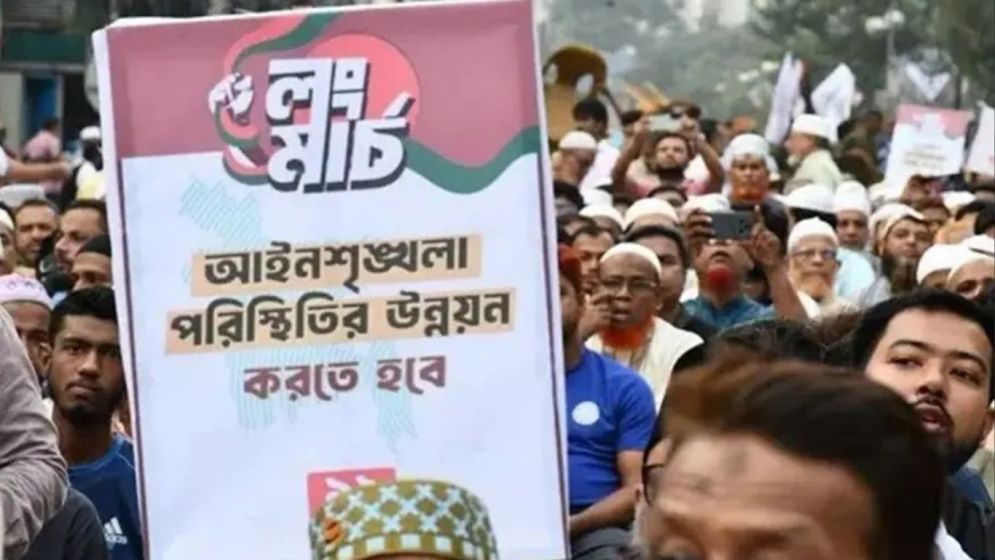
There was something distinctly programmatic about the 11-party alliance’s Dhaka-Chattogram march. The convoy was large, the crowds larger, and the political rhetoric larger still.
At Mahipal in Feni, Jamaat-e-Islami Ameer and Opposition Leader Dr. Shafiqur Rahman warned of hearing “the footsteps of fascism.” Elsewhere, LDP Chairman Col. (retd) Oli Ahmad offered a far more precise projection: the current government, he claimed, would fall by December, urging the alliance to maintain discipline in anticipation of assuming power.
December
It is a remarkably specific timeline for an opposition leader to forecast. Governments typically transition through electoral defeat, shifts in parliamentary majorities, or the exhaustion of constitutional mandates—they rarely come with expiration dates announced from political rally stages. Yet, the language emanating from the alliance increasingly mirrors a coalition preparing for an unconstitutional rupture rather than a standard democratic contest.
The distinction is critical
The alliance’s platform rests on six core demands: the implementation of a referendum verdict, accountability for the July killings, resolution of acute energy shortages, price stabilization, improved law and order, and the insulation of the civil administration from political partisanship. These are urgent public grievances that no administration can afford to dismiss.
However, legitimate grievances do not inherently validate extra-constitutional methods of redress. When figures like Nahid Islam suggest that the six-point platform could soon consolidate into a “single-point demand,” and when Dr. Shafiqur vows that street agitation will persist until rights are secured, the political destination ceases to be ambiguous.
The fundamental question facing the country is not whether citizens retain the right to protest—they do. The question is whether sustained street mobilization can usurp a national mandate and dictate the timeline for the removal of an elected government.
The Crowd and the Ballot
The visual scale of the mobilization along the Dhaka-Chattogram highway demonstrated notable organizational capacity. But a highway is not a ballot box.
A multi-kilometer crowd can project political momentum, but it cannot manufacture a national mandate. This remains a recurring temptation in South Asian political culture: the conflation of crowd mobilization with broad-based representation. When an opposition party marshals the largest gathering, it risks convincing itself that it speaks for the entirety of the populace, blurring the line between defeating a government politically and unseating it through relentless street pressure.
It is precisely this blurriness that leaves emerging democracies vulnerable.
Dr. Shafiqur’s warnings demand careful parsing, particularly given the gravity of the rhetoric employed. Pointing to systemic inequities—such as electricity disparities between the residences of power officials and ordinary households—strikes a potent chord, much like accusations that the administration is resurrecting the partisan architecture of past regimes.
Yet, charges of authoritarianism carry a burden of proof. When every administrative misstep, partisan appointment, and policy disagreement is labeled as fascism, the terminology is stripped of its historical weight. More importantly, those who invoke the language of tyranny must demonstrate a commitment to the institutional limits of power. Replacing one political machine with another that treats the state as a spoils system merely changes the occupants of the offices.
The Jamaat Factor
Jamaat-e-Islami’s repositioning as the primary engine of an opposition coalition requires rigorous political scrutiny.
While its leaders and members possess every legal right to participate in political life, democratic legitimacy is not conferred automatically by electoral participation; it must be substantiated through consistent conduct. The party’s historical leadership record during the 1971 Liberation War—marked by convictions at the International Crimes Tribunal—remains a deeply sensitive chapter in the national consciousness.
That history does not necessitate permanent political exclusion, but it does impose a heightened burden of accountability. If the party presents itself as a custodian of democratic norms, it must prove that institutional power is not merely a vehicle for partisan dominance. The true test of democratic conviction is measured not by how a political force behaves while out of power, but by what it does when it acquires it.
The NCP’s Strategic Dilemma
For the National Citizen Party (NCP), the political paradox is sharper still. Emerging directly from the July movement, the party was built on the promise of a decisive break from dynastic politics, patronage networks, and winner-takes-all governance.
Today, it finds itself marching alongside Jamaat.
Party leadership may frame this alignment as temporary arithmetic or tactical pragmatism, but politics has a persistent way of exposing the limits of expediency. If a movement predicated on systemic reform culminates in traditional alliances and conventional street-level pressure for state control, the public is left to question what distinguished it from the status quo.
The answer will likely materialize at the ballot box—or perhaps before it.
External Currents
Simultaneously, regional developments offer a cautionary backdrop regarding external influence. In Malaysia, statements from PAS President Abdul Hadi Awang regarding alleged historical foreign overtures to destabilize the government have reignited debates over sovereignty and regime change, even as those claims remain matters of political contention.
While the 2024 political upheaval in Bangladesh generated its own wave of speculation—and subsequent denials from international capitals regarding interference—the underlying lesson remains constant: national sovereignty is most secure when foreign actors are entirely absent from domestic political equations.
The Test Ahead
Whether December brings the political shift predicted by the opposition or simply marks another unfulfilled projection, the broader institutional stakes extend far beyond any single alliance or electoral cycle.
The central hazard is not that an opposition party wins an election, but that the election itself is reduced to a rubber-stamp exercise validating a political outcome already engineered on the streets.
When that happens, the defining question for the nation is no longer who won the vote, but who decided that the government had already fallen.