




 For all latest news, follow the Daily Sun's Google News channel.


The Jatiya Sangsad (JS) witnessed a historic and unprecedented session on Thursday, passing 31 bills in a single day, the highest number ever approved in one sitting in the country’s legislative history.
The record-breaking passage was aimed at formalising a substantial number of ordinances issued during the one-and-a-half-year tenure of the interim government led by Prof Yunus.
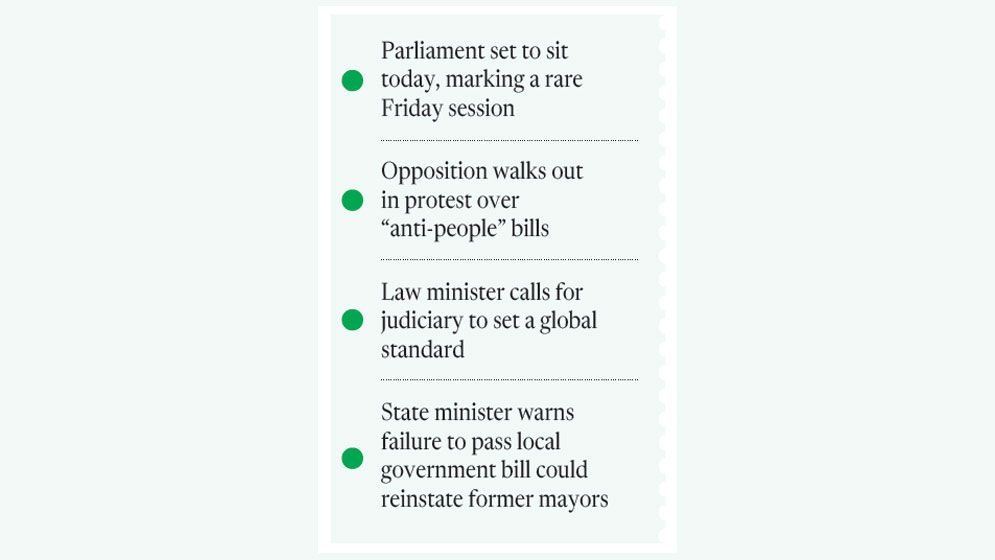
Under constitutional provisions, all ordinances must be ratified within one month of the first sitting of the 13th Parliament, a deadline set to expire today. However, several ordinances remain pending, prompting the continuation of parliamentary proceedings today, an unusual move, as Friday sittings have not been held in recent years.
Ruling party Whip GK Gaus told the Daily Sun that the remaining ordinances would be addressed during Friday’s session.
Heated debate amid record legislative activity
Despite opposition protests and intense debate, parliament passed the 31 bills across both morning and afternoon sessions on Thursday. While Jamaat-e-Islami and its allied members of parliament participated throughout the legislative process, they later staged a walkout, alleging that several of the bills were “anti-people”.
Notably, Jamaat opposed the National Freedom Fighters Council (JAMUKA) Amendment Bill, while its ally, the National Citizens Party (NCP), supported it.
Earlier in the week, parliament passed two bills on Sunday, seven on Monday, and 14 each on Tuesday and Wednesday, reflecting an accelerated legislative agenda.
The parliament passed the following bills: The National Sports Council (Amendment) Bill, 2026; the Bangabandhu Sports Welfare Foundation (Amendment) Bill, 2026; the Sheikh Hasina National Youth Development Institute (Amendment) Bill, 2026; the Bangladesh Energy Regulatory Commission (Amendment) Bill, 2026; the Public Procurement (Amendment) Bill, 2026; the Overseas Employment and Migration (Amendment) Bill, 2026; the Bangladesh Labour (Amendment) Bill, 2026; the Local Government (Union Parishad) (Amendment) Bill, 2026; the Legal Aid Services (Amendment) Bill, 2026; the Supreme Court Secretariat (Repeal) Bill, 2026; the Supreme Court Judges Appointment (Repeal) Bill, 2026; the National Human Rights Commission (Repeal and Re-enactment) Bill, 2026; the National Freedom Fighters Council (Amendment) Bill, 2026; the Land Use Control and Agricultural Land Protection Bill, 2026; the Bangladesh Telecommunication (Amendment) Bill, 2026; the Bangladesh Gas (Amendment) Bill, 2026; the Human Organ Transplant Bill, 2026; the Foreign Donations (Voluntary Activities) Regulation (Amendment) Bill, 2026; the Prevention and Suppression of Human Trafficking and Migrant Smuggling Bill, 2026; the Forest and Tree Conservation Bill, 2026; the Bangabandhu Sheikh Mujibur Rahman Novotheatre (Amendment) Bill, 2026; the Bangabandhu Science and Technology Fellowship Trust (Amendment) Bill, 2026; the Zila Parishad (Amendment) Bill, 2026; the Local Government (Municipality) (Amendment) Bill, 2026; the Local Government (City Corporation) (Amendment) Bill, 2026; the Bangladesh Building Regulatory Authority Bill, 2026; the Capital Development Authority Bill, 2026; the Upazila Parishad (Amendment) Bill, 2026; the Personal Data Protection Bill, 2026; the Bangladesh House Building Finance Corporation (Amendment) Bill, 2026; and the Negotiable Instruments (Amendment) Bill, 2026.
Parliamentary Secretariat sources confirmed that no previous parliament had passed such a high number of bills in a single day. The milestone was achieved on the 12th working day of the first session of the 13th Parliament.
Opposition stages walkout
Opposition lawmakers, led by Opposition Leader and Jamaat Ameer Dr Shafiqur Rahman, staged a walkout on Thursday evening, protesting the passage of several bills despite their objections.
“It is unfortunate that despite our reasonable concerns, several anti-people bills have been passed. We do not wish to take responsibility for them and are therefore walking out,” said Shafiqur.
Following the announcement, opposition members exited the chamber. In response, Home Minister Salahuddin Ahmed questioned the rationale behind the boycott, noting that opposition MPs had participated in earlier stages of the legislative process.
“I hope you will return after the Maghrib prayer,” he remarked. Jamaat members subsequently rejoined the session after the break.
This marks the third walkout by the opposition within 12 days, following earlier protests on March 12 and April 1.
Law minister calls for transparent and accountable judiciary
Law, Justice and Parliamentary Affairs Minister Md Asaduzzaman emphasised the need for a transparent and accountable judiciary while presenting the Supreme Court Judges Appointment (Repeal) Bill, 2026.
He stated that the judiciary must deliver quality justice and become a trusted institution, adding that Bangladesh should aim to set a global example in judicial standards.
The minister criticised past judicial appointments, alleging that political considerations had undermined the integrity of the system. He underscored the government’s commitment to reform through transparent processes and constitutional provisions.
Hannan Masud criticises Local Government Bill
NCP MP Hannan Masud strongly criticised the proposed Local Government (City Corporation Amendment) Bill, 2026, arguing that it weakens local governance and raises concerns about political overreach.
He questioned whether the ruling party was attempting to replicate past practices, warning that vague provisions such as “special circumstances” and “public interest” could be used to remove elected representatives arbitrarily.
Hannan also alleged irregularities in recent elections and cautioned that the proposed changes could undermine democratic institutions.
State minister defends local government reforms
In response, State Minister for Local Government, Rural Development and Cooperatives Mir Shahe Alam defended the bill, stating that failure to pass it would reinstate previously elected Awami League mayors and councillors within seven days under the existing legal framework.
He argued that administrative appointments were necessary in the absence of elections and maintained that the bill would facilitate timely polls under a revised, non-partisan system.
The minister also rejected allegations of electoral malpractice, asserting that recent elections had been free and fair.
Human rights and electoral reforms
Parliament also passed the National Human Rights Commission (Repeal and Re-enactment) Bill, 2026, despite opposition objections. The legislation repeals an ordinance issued during the caretaker government and reinstates the 2009 law governing the commission.
Additionally, four separate bills were passed restoring non-partisan symbols in local government elections, reversing the 2015 shift to party-based symbols.