


 For all latest news, follow the Daily Sun's Google News channel.


Cut Taxes, Grow the Market: Why Bangladesh Should Reduce Smartphone Import Duties
Sifat Khan
Published: 16 Nov 2026, 09:07 PM
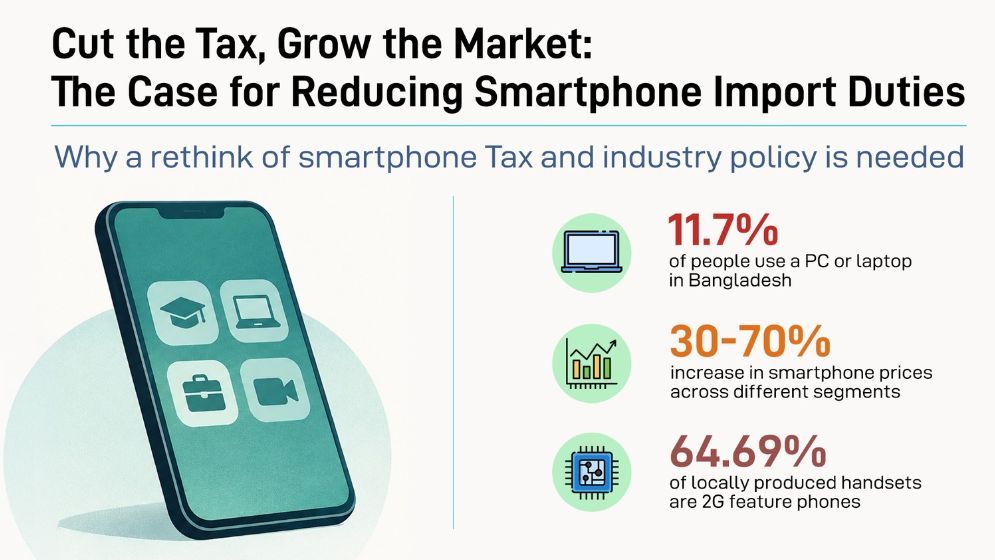
When a freelancer in Dhaka joins a client meeting, edits a video, or sends an invoice, the device doing the job is rarely a luxury. In a country where only 11.7% of people use a PC or laptop, a high-performance smartphone often serves as the primary computer. Yet the country's tax and industrial policies continue to treat smartphones as premium consumer goods rather than essential tools of a growing digital economy. As Bangladesh prepares to implement the National Equipment Identity Register (NEIR) from January 2027, this contradiction deserves closer attention. The question is no longer simply how to regulate the handset market, but whether the country's policies are keeping pace with how people actually work, learn, and do business.
Consider the people who depend on these devices every day. Students use smartphones to attend online classes, access learning materials, and complete assignments. Freelancers rely on them to communicate with international clients, manage projects, and deliver work. Small online businesses use phone cameras to photograph products, create promotional content, and engage with customers. For content creators, photographers, and video makers, processing power, memory, and camera capabilities directly affect the quality of their work. Mobile banking, digital payments, and other essential online services have also made smartphones central to everyday economic activity. For these users, a capable smartphone is not a status symbol. It is an instrument of productivity.
Yet the policy environment has not fully recognised this shift. Bangladesh has 15 smartphone brands operating in the market and 17 factories engaged in smartphone production and assembly. Of these, more than half manufacture only 2G feature phones; a segment that still accounts for 64.69% of total local handset production. This raises an important question about the direction of the country's smartphone industry. While the global market continues to move toward increasingly capable smartphones, a significant share of domestic manufacturing capacity remains tied to basic devices that are rapidly losing relevance. Industrial protection should help local manufacturers move up the value chain, not anchor the industry to a product category the world is leaving behind.
The imbalance becomes more apparent when the structure of incentives is considered. Local manufacturing and assembly receive significant tax and VAT advantages, but these incentives do not necessarily translate into broader technological capacity or a stronger smartphone ecosystem. Feature-phone production, which requires relatively limited labour, continues to receive substantial policy support. Meanwhile, the devices that enable more advanced digital services and professional activities remain expensive for consumers. A policy framework designed to protect domestic production must also consider what the country needs to produce, what consumers need to use, and how the industry can become more competitive over time.
The urgency is greater because the global smartphone industry is facing another cost challenge. Rising demand for memory chips from the artificial intelligence industry has reportedly pushed memory prices up by as much as 600% over the past 18 months. The effects are already being felt in Bangladesh, where smartphone prices across different segments have increased by an estimated 30% to 70%. With the global supply situation unlikely to improve in the near term, consumers may continue to face higher prices over the next two to three years. In this environment, maintaining a heavy tax burden on imported smartphones risks adding another layer of pressure to an already expensive market.
This is also a question of investment confidence. Most of the smartphone brands operating in Bangladesh have links to foreign investment. These companies make long-term decisions based on the predictability of regulations, the competitiveness of local production, and the potential for market growth. Frequent policy changes or incentives that favour one segment of the industry over another can weaken that confidence. Bangladesh has an opportunity to attract more investment in smartphone manufacturing, component production, and technology-related services. Realising that opportunity requires a policy environment that rewards innovation, encourages higher-value production and provides a clear direction for the industry.
NEIR can play an important role in bringing discipline to the handset market. By identifying unregistered devices, detecting duplicate IMEI numbers, and supporting efforts to trace stolen phones, the system can strengthen market accountability and assist law enforcement. However, enforcement alone cannot create a healthy industry. Its success will depend on whether consumers have access to affordable, officially available devices and whether businesses can operate under a stable and transparent regulatory framework.
Bangladesh therefore needs to look beyond the immediate objective of regulating handset imports. It must build an industrial policy that recognises smartphones as essential infrastructure for education, entrepreneurship, employment, and digital services. That means reviewing the balance of incentives across different categories of devices, supporting the transition toward more advanced manufacturing, and ensuring that local producers remain competitive without making technology unnecessarily expensive for consumers. It also means providing investors with a consistent, business-friendly framework that encourages long-term commitments.
The digital economy cannot grow on outdated assumptions about what a phone is meant to do. For millions of people, it is already a classroom, an office, a marketplace, and a gateway to financial services. Bangladesh's policies must reflect that reality. NEIR can regulate which devices enter the network, but a forward-looking industrial and tax policy must determine whether the country can afford the technology that will shape its future.
The writer is a lecturer in the Department of Law at Northern University Bangladesh.