


 For all latest news, follow the Daily Sun's Google News channel.


Are Japan and the U.S. losing South Korea as an ally?
Tokyo needs a Plan B as trust between Washington and Seoul erodes
By Masahiro Matsumura
Published: 12 Nov 2026, 02:28 AM
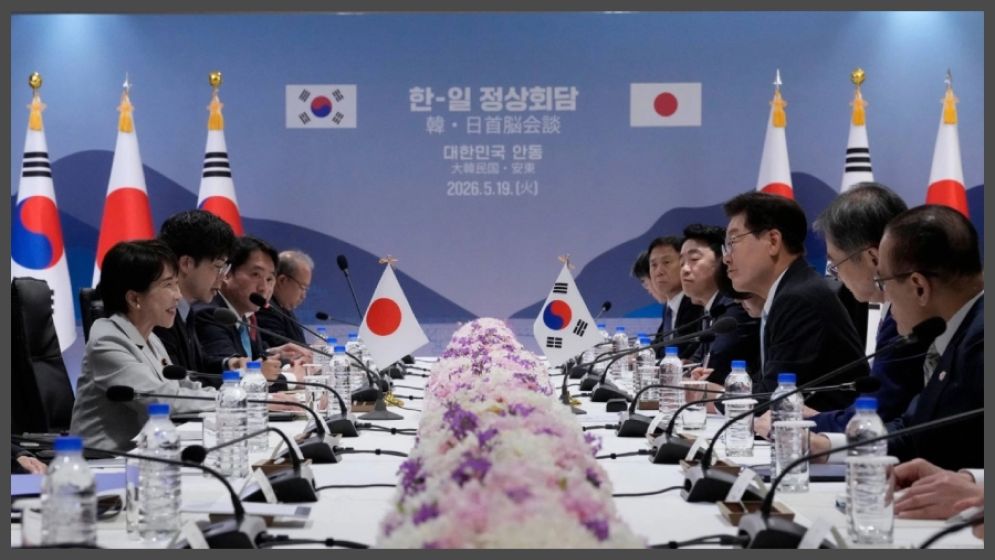
Prime Minister Sanae Takaichi and South Korean President Lee Jae Myung hold talks in Andong, South Korea, on May 19. | Pool / via REUTERS
The poor showing by U.S. President Donald Trump’s Republican Party in the midterm elections has weakened his administration politically, raising questions about the future of American foreign policy and Washington’s commitment to longstanding alliances.
These uncertainties are particularly consequential in Northeast Asia, where strains in the U.S.-South Korea alliance threaten trilateral security cooperation with Japan.
Since South Korean President Lee Jae Myung took office after a snap election in June 2025, tensions in the alliance have grown, jeopardizing cooperation among Washington, Tokyo and Seoul as regional threats mount. Latent friction in the alliance stems from a steady accumulation of Seoul’s subtle pro-Beijing signals, perhaps due to its growing deference to Beijing’s preferences on intelligence and regional deterrence.
During the 2022 South Korean presidential election campaign, candidate Lee Jae Myung expressed support for the main principles of the Moon Jae-in administration’s “Three No’s” position: no additional deployment of U.S. Terminal High Altitude Area Defense batteries in South Korea, no participation in a U.S.-led regional missile defense network and no move toward a trilateral military alliance with the United States and Japan.
In this context, the summit meeting between Lee and Xi Jinping in Beijing this past January raised concern, even though the officially released Chinese and South Korean readouts contained no explicit reference to the “Three No’s” position. But in Washington, the impression matters almost as much as the text. If U.S. officials believe that Seoul is quietly reverting to the logic of the “Three No’s” policy, then doubts about South Korea’s strategic reliability will deepen.
Under such circumstances, Washington’s trust in the South Korean government on intelligence matters seems increasingly fragile. In October, the Chosun Daily reported that a planned visit by Lee Jong-seok, director of South Korea’s National Intelligence Service (NIS), to the U.S. National Geospatial-Intelligence Agency in March was not approved, most likely due to his well-known anti-American leanings, although another article reported that Director Lee’s visa application to the United States was not denied.
In addition, Business Korea claimed that visa issuance for South Korean NIS personnel scheduled to work at the embassy in Washington had been delayed. The NIS rejected the characterization that the United States had refused to issue the visas, stating that the two countries were consulting over the delays.
These episodes are politically important in the sense that South Korean mainstream debate has shifted toward the possibility that U.S. intelligence agencies do not fully trust their South Korean counterparts.
Furthermore, South Korean lawmaker Jung Cheong-rae, then-chairman of the ruling Democratic Party of Korea and a politician strongly associated with President Lee, was unable to obtain a U.S. visa before a planned parliamentary visit to Washington because his application remained under review.
The South Korean Foreign Ministry claimed that it was inappropriate to link Jung’s case to the overall state of the alliance. Even so, when visa delays, intelligence frictions and public political controversy are taken together, they become difficult to dismiss as isolated bureaucratic mishaps. In alliance politics, symbols matter and the symbolism here is unmistakably negative.
All of these developments would significantly corrode mutual trust as the basis of trilateral intelligence sharing. The circumstances are reinforced by remarks from South Korean Unification Minister Chung Dong-young, who identified North Korea’s Kusong region as a suspected site of uranium enrichment during a National Assembly committee session in March.
Trust is perhaps most important to the nations’ shared missile warning system. Japan, South Korea and the United States contribute differently and complementarily to missile warning. Specifically, Japan is valuable in the early detection phase, South Korea is important for tracking and assessment from the peninsula and the United States integrates data into a wider operational picture. Such a division of labor is all the more important as North Korea improves its missile capabilities, including maneuvering and hypersonic systems that compress decision times and complicate interception. If intelligence cooperation based on the General Security of Military Information Agreement becomes politically constrained or operationally unreliable, trilateral deterrence will be ineffective.
Historically, the United States has repeatedly reviewed the size and role of its forces in South Korea since the 1953 Korean War armistice, most notably during the Carter administration (1977 to 1981). Today, Washington increasingly needs to make a strategic shift toward deterring China in the Indo-Pacific.
That means Washington now expects Seoul to shoulder primary responsibility for conventional deterrence on the peninsula while remaining strategically aligned with wider U.S. regional goals. In fact, a series of recent statements by senior U.S. and combined command officials continues to affirm the importance of the alliance for peace and stability both on the Korean Peninsula and across the Indo-Pacific.
Without trust, the transition to wartime operational control slows. Deeper technology sharing becomes politically harder. Sensitive intelligence flows are restricted. Joint planning becomes hedged by suspicion. In such a climate, the alliance may become severely hollowed out.
Thus, under the assumptions of a significantly weakened U.S.-South Korea alliance and no effective trilateral security cooperation, Tokyo needs a prudent Plan B for stronger bilateral coordination with Washington, better independent surveillance and targeting support, more robust defense postures in Japan’s southwest islands and contingency planning for a Korean Peninsula crisis.
Risks involved in the current evolutionary changes are increasingly real now under President Lee. And if such risks further grow, Tokyo will have to seriously prepare to bear a far greater share of the strategic burden.
Masahiro Matsumura is a professor of international politics and national security at St. Andrew’s University (Momoyama Gakuin Daigaku) in Osaka.
Source: The Japan Times