


 For all latest news, follow the Daily Sun's Google News channel.


Destructive politics destroys the economy too
Special Correspondent
Published: 12 Nov 2026, 12:00 AM
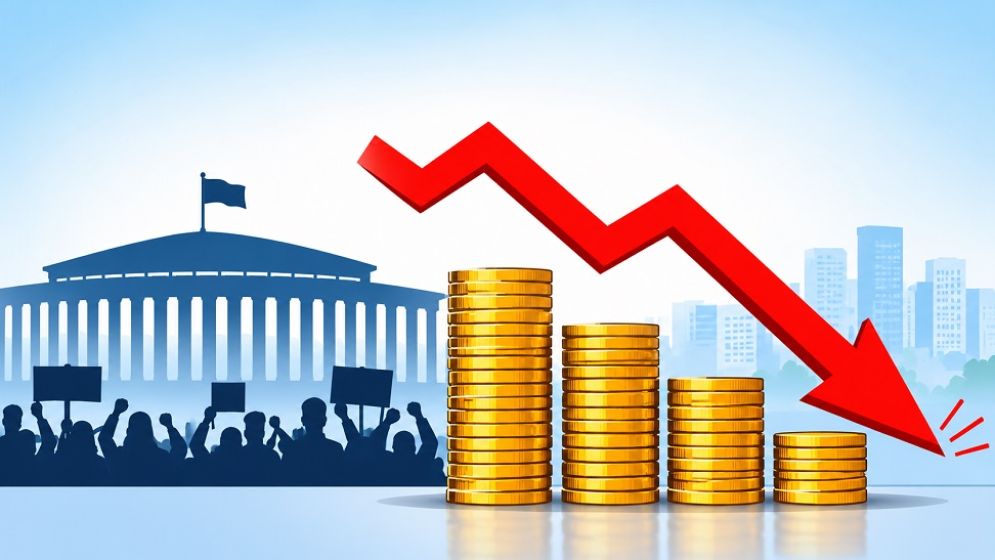
Destructive politics destroys the economy too. Representational Image
Politics and the economy are complementary to each other, like the two tracks of a railway. Neither can function effectively without the other. Just as an escalating economic crisis erodes political stability and undermines a government’s popularity, a political crisis can severely cripple the economy. Political instability breeds economic uncertainty, casting a shadow over business and trade. New investments dry up, production is disrupted, and the livelihoods of poor people come under threat, leading to unemployment and a host of other problems. Maintaining a balance between political stability and economic progress is therefore critically important for the country and its people.
Bangladesh’s economy is currently passing through a difficult period. According to the International Monetary Fund (IMF), the country’s economic growth could be the slowest in South Asia, while inflation is likely to remain the highest in the region. In the current fiscal year, GDP growth may fall to 3.2%, while average annual inflation could reach 10.9%. There is little indication of a strong economic turnaround over the next few years. Rather, the IMF estimates that growth could plunge to 2.2% in the next fiscal year. Such sluggish growth will put further pressure on investment and employment, while high inflation will continue to erode people’s purchasing power. Meanwhile, the World Bank recently reported that nearly eight million people had fallen below the poverty line over the past four years, while approximately 62.5 million remained at risk of falling into poverty. The impact of economic vulnerability, therefore, is not confined to growth figures; it is directly affecting people’s livelihoods. A fragile banking sector, an energy crisis, sluggish private investment and a revenue shortfall are making the situation even more complicated. Concerns are mounting over economic recovery, job creation and living standards. The World Bank has reported that private sector credit growth has fallen to its lowest level in 33 years. Gas and electricity shortages have forced many factories to operate below capacity, while some have reduced working hours, suspended production or laid off workers. Foreign direct investment fell by 15% last year. The government has also had to spend several billion dollars more on fuel oil imports. Meanwhile, revenue collection remains sluggish, with the National Board of Revenue (NBR) falling short of its target and the revenue shortfall exceeding Tk25,000 crore in the first two months of the current fiscal year (July-August). Thus, multiple pressures are weighing heavily on the economy.
In this situation, tackling the economic crisis is the government’s foremost challenge. Since assuming office, the BNP government, led by Tarique Rahman, has been striving to address these problems.
There is no lack of sincerity on the government’s part in tackling the multidimensional economic challenges inherited from the past. However, economic development cannot be achieved through the government’s efforts alone. It requires national unity, collective efforts and a peaceful political environment. Political instability and violence take the heaviest toll on the economy.
After a prolonged period, Bangladesh has an elected government and a functioning parliament. At this juncture, there were widespread hopes that the country would break free from the cycle of political violence and establish a tolerant and peaceful political climate. However, recent developments suggest that terrorism and sabotage are once again raising their heads in the name of politics. Over the past few days, miscreants have carried out attacks, set fire to cars and trains, vandalised property and exploded crude bombs in different parts of the country. Roads have also been blocked in several areas, while government and private installations have come under crude bomb and petrol bomb attacks. For the past few days, destructive activities have also been carried out by deliberately inciting garment workers. From midnight last Monday until Tuesday afternoon, acts of violence, sabotage and road blockades were reported in at least 21 districts. Besides Dhaka and Chattogram, the affected districts include Faridpur, Barguna, Manikganj, Naogaon, Kishoreganj, Natore, Gopalganj, Shariatpur, Madaripur, Rajshahi, Kurigram, Rangamati, Cox’s Bazar, Feni, Netrakona, Khagrachhari, Khulna, Noakhali and Lalmonirhat. These developments are deeply concerning, as such incidents have a direct impact on the economy.
Bangladesh is already paying a heavy economic price for the ongoing violence and sabotage. If the country’s average daily GDP is $1.5 billion and one-third of economic activity is disrupted, the resulting loss would amount to $500 million, equivalent to at least Tk5,000-6,000 crore a day. Entrepreneurs, particularly those operating in the informal sector, along with working-class people and transport workers, bear much of this burden. When buses are torched, crude bombs are exploded and acts of sabotage take place, a climate of fear sets in. People in urban areas become reluctant to leave their homes, while businesses and traders are forced to operate with extreme caution. Transport entrepreneurs, in particular, face constant anxiety over the possibility of their vehicles being vandalised or set on fire. Drivers and their assistants suffer even more, as they are deprived of work and income while facing the additional risk of physical injury. The informal sector, which accounts for 80-85% of the country’s economic activity, is particularly vulnerable. The livelihoods of millions of daily-wage earners depend on these activities. Consequently, small vendors, roadside tea stall owners and people who travel daily from Narayanganj to Dhaka for business are among those facing serious hardship.
Political violence and sabotage will also create major obstacles for investors and exporters. Fearing attacks on covered vans, exporters may hesitate to transport goods to ports. Moreover, around 80% of the export sector is linked to imports, as industries depend on raw materials and intermediate goods brought in from abroad. Disruptions, therefore, affect both imports and exports. If vehicles cannot reach ports regularly, exporters will struggle to ship goods on time, leaving many businesses unable to fulfil their export orders. Such insecurity will inevitably have wider economic consequences, adding to inflationary pressures.
Engineered unrest among workers has also triggered a crisis in the readymade garment (RMG) sector, forcing entrepreneurs to incur daily losses and disrupting the timely shipment of export consignments. This will affect export earnings and have a knock-on effect on other sectors of the economy.
Industrial entrepreneurs affected by worker unrest, sabotage and arson attacks may also struggle to repay their bank loans, increasing the risk of defaults. This would further weaken the banking sector, which is already fragile and burdened with non-performing loans (NPLs).
Taken together, these developments could further undermine the country’s already fragile economy, with ordinary citizens bearing the brunt of the consequences. The government’s foremost responsibility, therefore, is to bring these acts of violence and sabotage under control. It must adopt a zero-tolerance policy towards arson attacks, political violence and anarchy, while ensuring that those responsible are brought to justice.