


 For all latest news, follow the Daily Sun's Google News channel.


Say no to arson terrorism and politics of sabotage
Special Correspondent
Published: 11 Nov 2026, 12:00 AM
File Photo
A 14-year-old boy is fighting for his life in the intensive care unit (ICU). Outside, his mother prays: “O Allah, I dedicated my son to Your path to study Your Book. Please show him mercy.” Sonia Akhtar was seen crying in anguish outside the ICU on the third floor of the National Institute of Burn and Plastic Surgery in the capital. Her son, Azizul Islam Siam, was brought to Dhaka after being injured in a fire at a madrasa in the Signboard area of Fatullah, Narayanganj. Sixty-three students, including Azizul, who fell ill after inhaling smoke, have been admitted to the National Institute of Burn and Plastic Surgery.
This incident is horrific and inhumane. Such events are unacceptable in a civilised society. Those responsible for such acts are enemies of the people. A wave of terrorism and sabotage appears to have re-emerged in Bangladesh. Covert attacks, crude bomb explosions, bus arson and other acts of sabotage are taking place in different parts of the country, with Dhaka being a particular target.
On Tuesday, incidents of violence and sabotage were reported from different parts of the country. Fresh protests by garment workers have erupted. The industrial belt of Ashulia in Savar has become tense over a three-point demand, including an increase in the minimum wage for garment workers. On Tuesday morning, workers stopped work and staged demonstrations at several factories in the Jamgara and Nishchintapur areas. At one point, when they attempted to block the Baipail-Abdullahpur road, clashes and chases broke out between the workers and the police. Police fired tear gas and sound grenades to bring the situation under control. Two garment workers were injured.
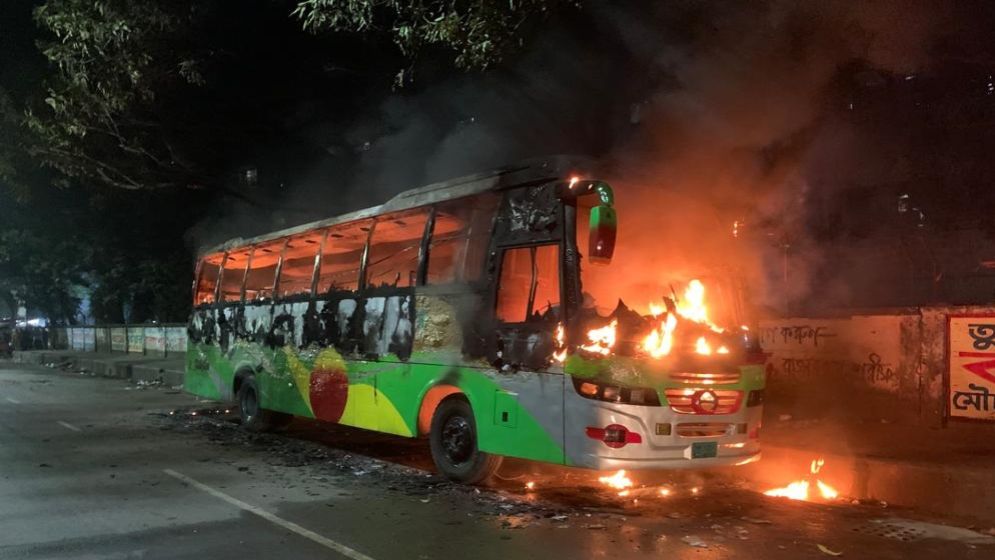
In Mohanganj, Netrokona, miscreants set fire to the intercity Haor Express, burning at least four seats in one of its coaches. At the new bus stand in Faridpur, a driver named Kalachan Sheikh, who was sleeping inside a parked local bus, died when the vehicle was set on fire. At the Gaabtali intersection in the bypass area of Naogaon town, two parked buses belonging to Al Baraka Paribahan were set ablaze. In Zanjira, Shariatpur, miscreants chanting various slogans and armed with wooden poles (logi-boitha) blocked the southern toll plaza of the Padma Bridge, exploded more than 100 crude bombs and vandalised vehicles.
These incidents pose a direct threat to democracy in Bangladesh. Those responsible for such acts are enemies of democracy and the interests of the people. Bangladesh is currently going through a difficult period, with the effects of the global economic crisis also weighing on the country. At a time when the government, under the leadership of Tarique Rahman, is working to overcome these challenges, such incidents are taking place.
Today, scenes on the streets of Dhaka and other towns evoke strange and terrifying memories among ordinary people. Buses suddenly bursting into flames, passengers scrambling desperately to save their lives, and loud crude bomb explosions on deserted thoroughfares or at busy intersections all seem to bring back an old, familiar script. During the past decade and a half of Awami League rule, political arson attacks and state-sponsored machinations were used to instil fear among the public, ruthlessly suppress political opponents and dissenting voices, and maintain political power. The pattern and nature of the recent crude bomb explosions and arson attacks bear an unsettling resemblance to those tactics. Consequently, a natural question arises in the public mind: is the force defeated in the mass uprising returning to its familiar methods as a last resort? When politics becomes completely detached from the people, does sabotage become the ultimate weapon of a banned group?
Prime Minister Tarique Rahman has called on everyone to unite against any sinister attempt to create instability through sabotage and conspiracy by exploiting the country's political and economic challenges. He said no conspiracy, whether domestic or foreign, could undermine the unity and progress of the people. He also emphasised the importance of all parties and groups working together in the national interest.
Against this backdrop, there have been calls to rise above political differences and remain united in the national interest against sabotage, violence and anti-national activities. Political parties, social forces and ordinary citizens all have a responsibility to help maintain peace, stability and a democratic environment in the country. Rather than allowing divisions to deepen, a coordinated stance in the national interest can play an effective role in bringing the situation under control.
Therefore, the time has come to speak out against arson terrorism and sabotage. We must stand united against these destructive activities and say no to the politics of terror.