




 For all latest news, follow the Daily Sun's Google News channel.


Why EU-China Trade Relations Have Deteriorated
Milton Ezrati
Published: 08 Nov 2026, 08:47 PM
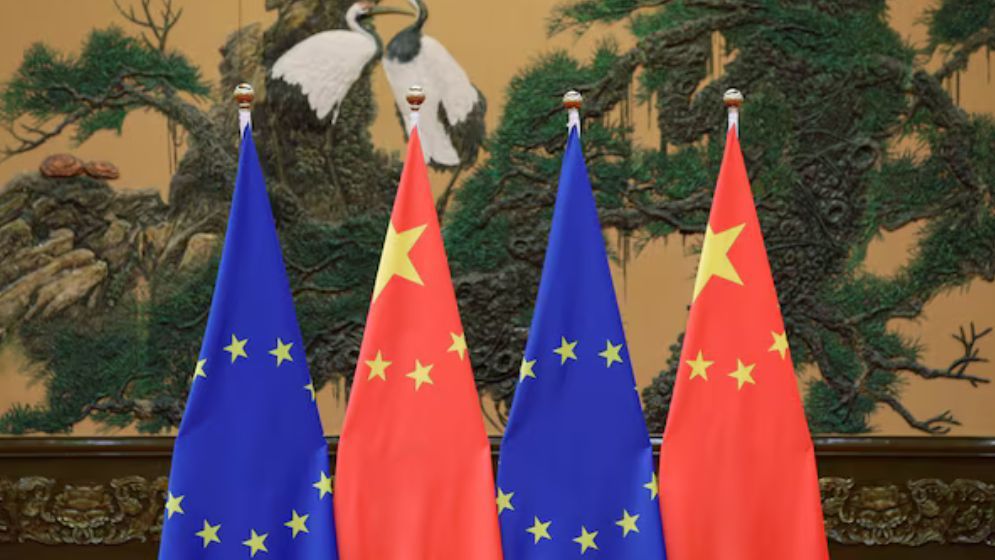
Flags of European Union and China are pictured during the China-EU summit at the Great Hall of the People in Beijing, China, 12 July 2016. Photo: Reuters
In the last year or so, trade relations between Europe and China have shifted radically, going from near symbiosis to acrimony and hostility. The change is no accident. It has emerged out of a confluence of otherwise unrelated developments that have at once put Europe on its back foot and at the same time given it leverage with Beijing that it previously lacked.
For some time until recently, both the Europeans and the Chinese were delighted with trade arrangements. The Chinese public and businesses seemed to have a voracious appetite for European products, while European consumers welcomed a full flow of attractively priced Chinese goods. The trade balance tipped against Europe but was manageable.
At times the Europeans complained about Chinese government subsidies to exporters and other objectionable trade practices but nowhere near the intensity or decibel level of Washington’s complaints. European industrialists, enjoying highly profitable business operations in China, restrained anything European Union (EU) negotiators might do to alienate the Chinese authorities.
Four developments in particular unraveled this rather happy interchange. Beijing’s efforts to upgrade the value added of its manufacturing under the so-called “Made in China 2025” program began to compete successfully with European business operations in China. At the same time, the investments Beijing made under that program outstripped the needs of the domestic Chinese economy, driving Chinese production to go abroad for sales more than ever. Since US hostility to Chinese trade under presidents Donald Trump and Joe Biden (and then Trump again) blunted Chinese prospects in the American market, China turned to Europe to unload its products and, in doing so, threatened domestic European business.
The impact on the once-highly profitable European operations in China was profound. A once-fabulous pace of growth in the sales of European fine machinery and luxury goods suddenly collapsed. The fate of European auto brands is indicative of the more general turn. Between 2003 and 2022, sales of Mercedes cars in China rose 24 percent a year, while BMWs rose 20.2 percent a year, and Audi’s rose at a rate of 12.6 percent. But in just the last year, as Chinese competition has come online, the trends now run in reverse.
Not all these auto producers report their sales figures on the same time schedule, but what figures are available makes the turn clear enough. Mercedes sales in China by the middle of 2026 had fallen 30 percent from levels 12 months earlier. BMW’s China sales fell 25 percent in the 12 months ended in this year’s third quarter, and Audi’s sales fell 12 percent through the first quarter of this year. The scions of European industry no longer saw any reason to temper official EU criticisms of Chinese practice.
Even as Chinese product began to edge the Europeans out of the domestic Chinese market, Beijing’s Made in China 2025 program so built-up production capabilities that they far exceeded any domestic needs, which in any case were depressed by the far-reaching repercussions of the country’s property crisis.
The new, enlarged production so swamped domestic abilities to absorb the new product that a cutthroat competition depressed producer prices and, with it, any profitability in domestic sales. Prices fell every month through 2025, and into the beginning of this year, and producer price indices have only risen in recent months because the fighting in the Persian Gulf has raised the price of imported energy and other raw materials. Desperate, the newly built-up Chinese producers turned abroad for sales just as the Trump tariffs cut opportunities in the United States by some 50 percent in 2025 and blunted growth so far this year.
China had nowhere to turn but Europe for markets that could make up the difference. The impact showed quickly. Over the course of 2025, EU goods imports from China rose 12.5 percent. That flow continued to grow in 2026, with an 8 percent gain over the 12 months ended in the middle of the year. With lost sales to Chinese competition in China and a new flood of Chinese goods flowing into Europe, the bilateral trade deficit with China became much less manageable. It jumped from a deficit of €66 billion in the first quarter of 2024 to one of €103 billion by the second quarter of this year, almost doubling in two years.
The trend terrified European business and political leadership. European Central Bank (ECB) President Christine Lagarde worried that China trade will erode the “pillar” of European economic strength, its mid-tech manufacturing. France made its position clear last February with a government report provocatively entitled, “The Chinese Steamroller,” in which it characterized Chinese imports as a threat to European well-being.
Germany and France, which once had differences on how to handle China, came together. German Chancellor Friedrich Merz has echoed these sentiments expressed in the French government report. Complaining vociferously about Chinese government subsidies and financial help to exporters, the Europeans began to sound more and more like American officials from years past.
But unlike the past, the Europeans now had some leverage in Beijing. Because the American tariffs have left China few options besides Europe, Beijing has abandoned its former rather dismissive approach to trade complaints. In the past, when EU trade negotiators complained of Chinese government practices, Beijing would make accusations of lawlessness, threaten retaliation, and at best promise to encourage Chinese people and businesses to buy more European products.
But this year, Beijing has become much more accommodating. When earlier this year the Europeans imposed tariffs on Chinese-made electric vehicles (EVs), Beijing rather meekly agreed to cap its European sales of plug-in and hybrid vehicles at 350,000 and only increase them by 6 percent a year going forward.
This is but one example. There is talk in EU circles of building on the EV export cap with something similar for chemicals. The EU is also discussing what it calls a “diversification instrument” to ensure that European business has supply connections beyond China. Beijing has not breathed a word of criticism for these actions. Trump, it seems, has inadvertently given the Europeans a cudgel with which to beat Beijing.
The Europeans are well aware that, in the words of Elvire Fabry, director of trade and economic security at the Paris-based Jacques Delors Institute, they have but a “small window of opportunity,” but Europeans are clearly willing to make hay while the sun shines. Meanwhile, China’s leadership in Beijing may have the feeling that they have overplayed their hand.
The write is a contributing editor at The National Interest
Source: The National Interest