


 For all latest news, follow the Daily Sun's Google News channel.


India's household and its poverty decline: The asset others are paying to rebuild
Arun Anand
Published: 05 Nov 2026, 02:18 PM
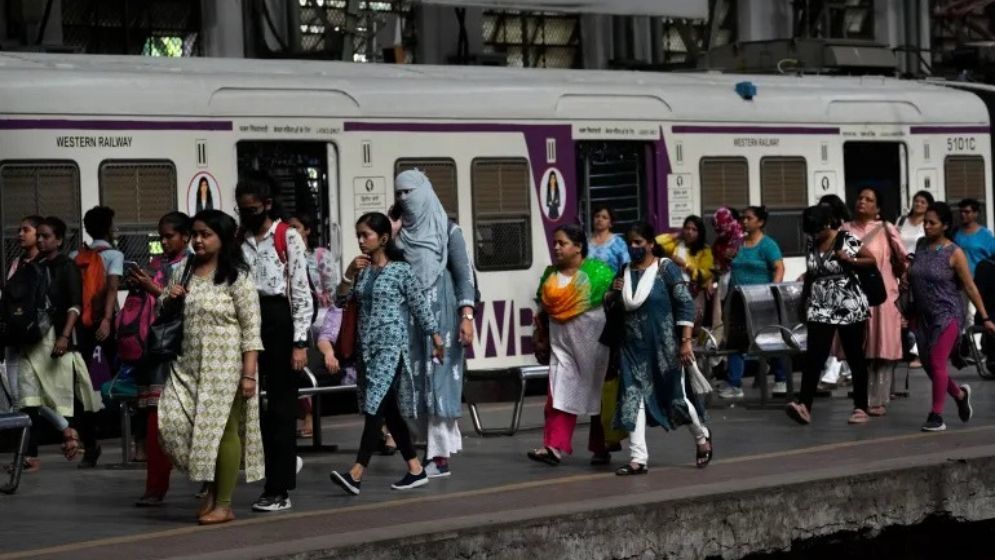
Railway passengers at a platform during peak hours at Churchgate station in Mumbai, India. AP File Photo
The World Bank's India Poverty and Equity Brief for October 2026 made headlines by highlighting the dramatic reduction in poverty in India. According to the report, between 2011 and 2023, the share of Indians living below the lower-middle-income poverty line of $4.20 a day (2021 purchasing power parity) fell from 57.7% to 16.1%. Thus, about 496 million people moved out of poverty during these years. Extreme poverty in India, measured at $3.00 a day, declined from a staggering 27.1% to a mere 2.6%.
The
real story behind these numbers offers a larger lesson for both policymakers
and society. To understand it, we need to examine how India achieved the
remarkable progress highlighted in the report.
The
World Bank estimates that about 134 million more Indians found work between
2017 and 2023, almost twice the growth in the working-age population. A large
number of these new workers were women in rural India. Food subsidies and
social transfers, meanwhile, left families with more money to spend on other
needs.
Put
these facts side by side, and a pattern emerges. The gains came through the
household. There were more earning hands under one roof, while social transfers
reached the family kitchen. Textbook economics usually focuses on an individual
worker responding to market incentives. India's experience worked differently.
India's
poverty decline is, at its core, a household story. Japan, China and South
Korea are now spending heavily to rebuild the family units they allowed to
weaken. India still has this asset largely intact. It is also the unit the
Rashtriya Swayamsevak Sangh (RSS) has always placed at the centre of its
thinking. For the Sangh, the basic unit of society as well as the economy is
the kutumb (family), not the individual.
The
family as an economic institution
Western
economics recognised the importance of the household relatively late. When Gary
Becker won the Nobel Prize in Economics in 1992, the Royal Swedish Academy
noted that he viewed the household as "a small factory", producing
services for its members using time and purchased consumer goods as inputs. The
latter were regarded as intermediate inputs in the household's production
process. For Western economists, this represented a new school of thought. For
an Indian family, it is simply how life has traditionally been lived.
A
leading RSS ideologue, Dattopant Thengadi, put the difference in plain words:
"The West made the individual the centre; for India, the family was always
at the centre." Thengadi described the family as the bridge connecting an
individual to society and culture. Thus, for the RSS, a robust economy is one
whose foundations are firmly rooted in the family.
The
numbers also lend support to this economic worldview. McKinsey estimates that
family-owned businesses contribute more than 75% of India's GDP, one of the
highest shares anywhere in the world. Morgan Stanley estimated in October 2025
that Indian households held about 34,600 tonnes of gold, worth roughly 88.8% of
GDP. For an Indian family, that gold represents savings, insurance and
inheritance rolled into one, passed down from one generation to the next.
RSS
Sarsanghchalak Mohan Bhagwat made the same point in Kolkata on 21 December
2025. "Our economic activity also happens through family; the country's
savings happen in families. The gold is in families," he said. The RSS has
repeatedly emphasised that it views the family as a cultural, economic and
social unit all at once.
The
family as India's social security system
The
family is also India's own social security system. A study published in the International
Journal of Sociology and Social Policy found that about 85% of older Indians
lived with their children, while only 2% lived alone. Researchers at the
International Institute for Population Sciences, working with data from the
Longitudinal Ageing Study in India, found that older people living with a
spouse and children, and in larger families, were better protected against
depression.
What
an Indian family provides without charge, many other countries now have to
purchase through state-funded welfare systems.
What
a thinning household costs
East
Asia illustrates the other side of the picture. Japan recorded 671,236 births
to Japanese nationals in 2025, the lowest number since records began in 1899.
Its fertility rate fell to 1.14, while deaths outnumbered births by 918,253.
China's population declined by 3.39 million in 2025, marking its fourth
consecutive annual fall, as births dropped to 7.92 million.
Yi
Fuxian, a demographer at the University of Wisconsin-Madison, pointed out that
this was roughly the number of children born in China in 1738, when the country
had a population of only about 150 million.
In
South Korea, the trend is visible at the level of young couples themselves.
Statistics Korea found that 46.4% of couples in their first five years of
marriage had no children in 2022, a record high. This is the 'DINK' model:
double income, no kids. It may increase a couple's earnings today, but the
household stops renewing itself as an economic unit. The cost comes later, in
the form of fewer workers, more pensioners and diminishing family support for
older people.
The
alarm bells are now ringing at the highest levels. "Japan is standing on
the verge of whether we can continue to function as a society," then Prime
Minister Fumio Kishida told Parliament in January 2023. The American
demographer Nicholas Eberstadt wrote in
Foreign
Affairs that "humans are about to enter a new era of history". Populations
will now shrink because of the choices people make about marriage, family and
living arrangements, rather than because of any calamity.
The
price of rebuilding the family
Having
allowed the household to weaken, these governments are now spending heavily to
put it back together. South Korea spent more than 360 trillion won, about $270
billion, on childcare subsidies and related schemes between 2006 and 2023. Yet
its fertility rate continued to fall. Japan has committed about 3.6 trillion
yen a year from fiscal 2026 towards child allowances, fertility treatment and
workplace reforms. China introduced its first national childcare subsidy in
2025, offering 3,600 yuan a year for each child under three, with the central
government setting aside about 90 billion yuan in the first year.
Money
alone has not brought families back. Philip O'Keefe of the University of
California, Irvine, told The New York Times that he knew of no country whose
fertility rate had fallen as low as China's and subsequently recovered to the
replacement level.
However,
South Korea does offer a clue about where recovery begins. Its fertility rate
rose to 0.80 in 2025, up from 0.75 in 2024. This followed a 14.8% increase in
marriages in 2024 and a further 8.1% rise in 2025. Births picked up only after
households began forming again.
India's
opportunity: Protecting the family
Bhagwat
has drawn a lesson for India from these developments. "Our national
population policy recommends 2.1 children, which means three," he said in
New Delhi on 28 August 2025, urging every Indian couple to consider having
three children.
The
Sangh has made the family one of the five themes of its Panch Parivartan programme.
It also has a separate organisational vertical called Kutumb Prabodhan, or
family awakening, which seeks to strengthen the family system in India as the
foundation of social stability and national strength.
The
household as the foundation of national prosperity
India's
poverty decline is, at its core, a household story. Japan, China and South
Korea are now spending heavily to rebuild the family units they allowed to
weaken, and the results remain uncertain. India still has this asset largely
intact.
The
lesson is clear: economic progress cannot be measured solely through individual
earnings, employment figures or government transfers. The strength of the
household, its ability to pool resources, support dependants, create
livelihoods and pass on wealth across generations also matters.
Protecting this institution will cost far less than rebuilding it, as East Asia is now discovering.
The author is an Indian writer
Source: Money Control