


 For all latest news, follow the Daily Sun's Google News channel.


China is Flouting Maritime Rules – Democracies Must Fight Back
Vincent Chin-Hsiang Yao
Published: 02 Nov 2026, 08:29 PM
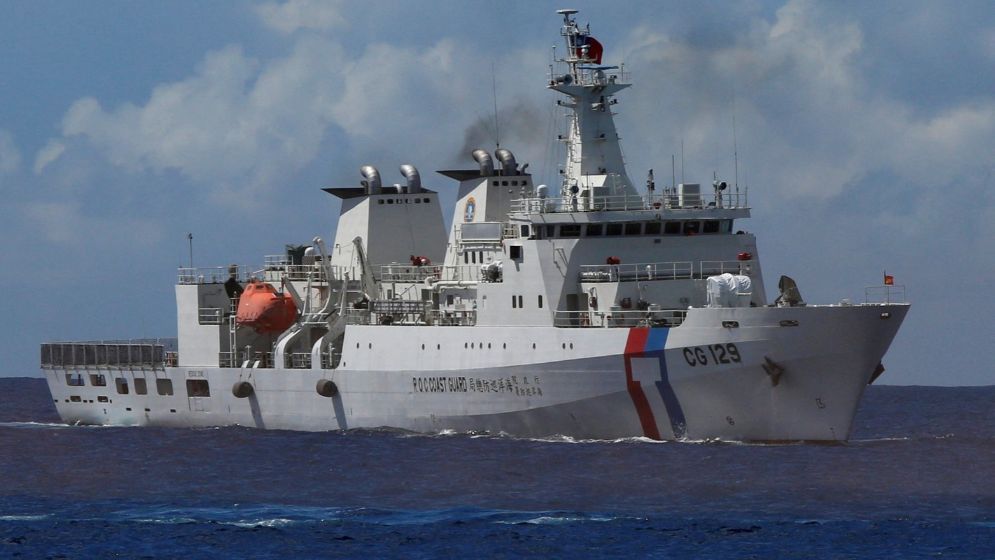
A Taiwanese Coast Guard patrol ship, Kaohsiung (CG 129), is seen during a rescue drill near the coast of Itu Aba at the South China Sea, 29 November 2016. Photo: Reuters
Last year, the Russian ship Yantar twice entered British waters, lurking near undersea cables while its crew pointed lasers at RAF pilots.
In 2024, in the Baltic Sea, fibre-optic cables were damaged after a Chinese ship, suspected of dragging its anchor, sailed over them.
In both cases, it can be expected that the gathering of data on the critical infrastructure took place.
These incidents in Europe illustrate a wider trend of grey-zone activity at sea perpetrated by authoritarian states, one that risks undermining the security of democratic nations if left unchecked.
Grey-zone coercion challenges democracies to respond to incursions against their sovereignty, stretching the limits of aggression below the threshold of outright conflict.
Undeterred, it changes the accepted status quo at sea, allowing states to disregard norms and use force for strategic gain.
This comes at the cost of our security, for example, by enabling actors such as Russia and China (who share a “no-limits partnership”) to gather data on infrastructure pressure points.
China’s abuse of maritime rules goes even further when it comes to Taiwan. It threatens to upend the global economy.
On 11 October, immediately after Taiwan’s National Day, Beijing announced military exercises intended to “deter Taiwan independence and external interference”.
Live-fire drills followed within a day, sending a clear message: Taiwan’s democratic self-governance is unacceptable to China and will be met with intimidation.
The failure to give advance notice breaches all international norms, such as those set forth by the International Maritime Organisation and the Convention on International Civil Aviation.
This is for obvious reasons: live drills are dangerous and disrupt navigation. They also breach the United Nations Convention on the Law of the Sea governing innocent passage through territorial waters.
It is not only Taiwan that has been subjected to such disregard. In 2025, Chinese naval vessels conducted live-fire exercises in the Tasman Sea, again without providing advance warning to the Australian authorities, which only learned of the drills after an airline pilot raised the alarm. Air travel was disrupted and lives put at risk.
These episodes demonstrate Chinese attempts to broaden its authority in the Indo-Pacific region. In June this year, Chinese vessels reportedly inspected hundreds of merchant ships in the waters east of Taiwan.
China’s coastguard has also established a regular “law enforcement” team in the area, normalising its presence and exerting pressure not just on Taiwan but on neighbouring Japan and the Philippines too.
While China’s actions around Taiwan seek to expand its jurisdiction, they also illustrate its violent, expansionist ambitions. By encircling Taiwan to the east, China is advancing its boa constrictor strategy, making it easier to cut Taiwan off from the outside world in the event of military conflict.
This is a threat to all countries. By lowering the threshold for an invasion or blockade of Taiwan, China pushes the world closer to the economic catastrophe this would entail.
Bloomberg estimates that a war involving Taiwan would cost the global economy 10% of GDP – dwarfing the effects of COVID and Russia’s invasion of Ukraine. Along with the loss of the semiconductors only Taiwan can make – vital components in everything from electric vehicles to smartphones – economic conditions would plummet around the world.
China’s grey-zone activities must meet a strong international response.
Beijing and Moscow cannot be allowed to whittle away the international laws that protect states and maintain peace – whether in Europe or Taiwan. This will simply lead to the most powerful states using force to pursue strategic advantages and embolden China to pursue a war that no one wants.
Instead, the UK and like-minded countries should work together to improve maritime information-sharing and resilience. The international community must defend the principles of freedom of navigation and peaceful resolution of disputes.
It must not allow the seas to become a tool for authoritarian states to undermine the safety of democracies.
Source: The Telegraph
The writer is the ambassador to the Taipei Representative Office in the UK