


 For all latest news, follow the Daily Sun's Google News channel.


Both Japan and China Can Help Bangladesh Reach Its Full Potential
Projected Japanese private investment could reach 1 trillion yen (USD$6.3 billion) over five years
Mushfiqul Fazal Ansarey, South China Morning Post
Published: 31 Oct 2026, 08:24 PM
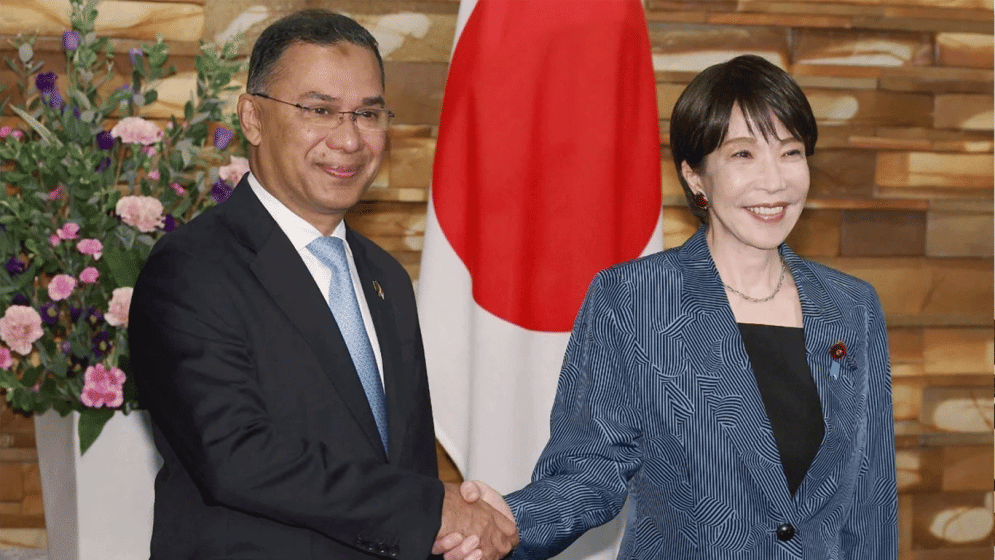
Photo: Collected
In the Land of the Rising Sun, Bangladesh looks forward to a new dawn. The hope that comes with Prime Minister Tarique Rahman’s visit to Japan goes beyond the deals signed or the financial support expected. It shows a country that has emerged from authoritarian rule and wants to turn its new political voice into bigger economic chances and freedom of choice.
For a government chosen by the people, foreign
policy must answer one question: how does it make life better for the people
who gave it power? Bangladesh needs employment, steady energy, strong
industries and institutions that people trust. Its diplomacy should help those
goals while preserving Bangladesh’s ability to decide its path without getting
caught in the fights of larger powers.
Japan plays a role in that effort. It welcomed
Bangladesh soon after independence, when a war‑scarred nation had to rebuild.
Over time, Japan helped build the roads, ports and other infrastructure that let
the economy grow. Dhaka’s metro, the airport’s third terminal and the
development of the Matarbari port show a friendship that has endured across
governments and generations.
That ongoing partnership is why this visit is so
significant. Bangladesh’s return to democracy provides an opportunity to build
on the old friendship by being more accountable at home. For Rahman and
Japanese Prime Minister Sanae Takaichi, the challenge is to turn that trust
into tangible outcomes: link roads and ports with factories, match technology
with skills and turn that goodwill into companies that can actually compete in
the global market.
The joint statement from their 27 October meeting
gives this ambition a path. The upgraded Bay of Bengal Industrial Growth Belt
project – called “BIG-B for Shared Prosperity” – encompasses connectivity,
economic strength and public‑private partnership. It imagines Bangladesh as a
hub that connects industry, energy and trade around the Bay of Bengal. The
success of that vision depends on how all the parts work together.
Projected Japanese private investment could reach 1
trillion yen (USD$6.3 billion) over five years, potentially creating 200,000
jobs. While it is a projection, that number shows the size of the opportunity.
Turning these chances into jobs needs ongoing work on customs, licensing,
reliable power and clear rules.
Japan can also benefit. A productive Bangladesh
offers manufacturing opportunities, market demand and better links between
South and Southeast Asia. Japanese companies can bring technology, management
know-how and access to established production networks. Bangladesh can offer
workers, entrepreneurs and a growing market. A lasting friendship will grow
from that exchange and from companies that have reasons to stay after the
ceremonial welcome.
This partnership fits into a view of the East that
also includes China. Bangladesh’s joint statement in June with Beijing pushes
cooperation in industry, trade, green energy and connectivity, including
modernising the Mongla port and building an industrial zone in Chittagong.
Those promises remain important for Bangladesh’s future. Closer ties with Tokyo
will not affect Bangladesh’s ongoing friendship with China.
There is room for them to complement each other.
Better transport and energy supply can help manufacturers no matter where their
money comes from. Chinese equipment, Japanese industrial expertise and
Bangladeshi enterprise can all feed the same growing
economy. That cooperation needs contracts, solid standards and good business
sense. When competition occurs, Bangladesh should look at cost, reliability,
security and the benefits to workers and suppliers.
India continues to shelter former prime minister
Sheikh Hasina and allows her to conduct political activities from its
territory, which has made Bangladesh more uncomfortable. Lasting friendship
must be built with a country’s people, not one leader or party. New Delhi says
Dhaka’s extradition request remains under legal examination. Rebuilding trust
also needs political sensitivity to Bangladesh’s suffering and its democratic
dreams. India’s answer to that will shape the chances for a relationship based
on equality, mutual trust and respect.
Political will and commitment at home are also very
important. A government with the people’s mandate must make contracts open to
review, strengthen institutions and ensure economic opportunities extend beyond
any privileged interest groups. Investors need confidence in the rules;
citizens need confidence that those rules protect the public interest.
Democratic renewal can help both when accountability becomes a priority and
practice.
The priorities are in place. Help domestic firms
become suppliers. Link training to employer needs. Use existing infrastructure
before you add any new projects whose economic case is still not fully
established. Publish the financing commitments and track the actual investment
received, actual exports generated and actual jobs sustained. The agriculture
co-op framework with Japan has a working group that can take big ideas and turn
them into real action.
For the 17 years, Bangladesh’s foreign policy leaned
heavily towards India. Democratic renewal offers an opportunity to redefine
Bangladesh’s position in the region around the will of the people themselves.
Partnership with Japan can be of immense value in
realising those aspirations, as can forging constructive relations with China
and the wider region. A new dawn will have meaning when the light of that dawn
can be seen in the lives of the people.
Mushfiqul Fazal Ansarey is a Bangladeshi diplomat,
journalist and analyst