


 For all latest news, follow the Daily Sun's Google News channel.


Mecca Pact: Will Pakistan take up arms for Saudi Arabia?
Prakash Jangid
Published: 29 Oct 2026, 01:02 PM
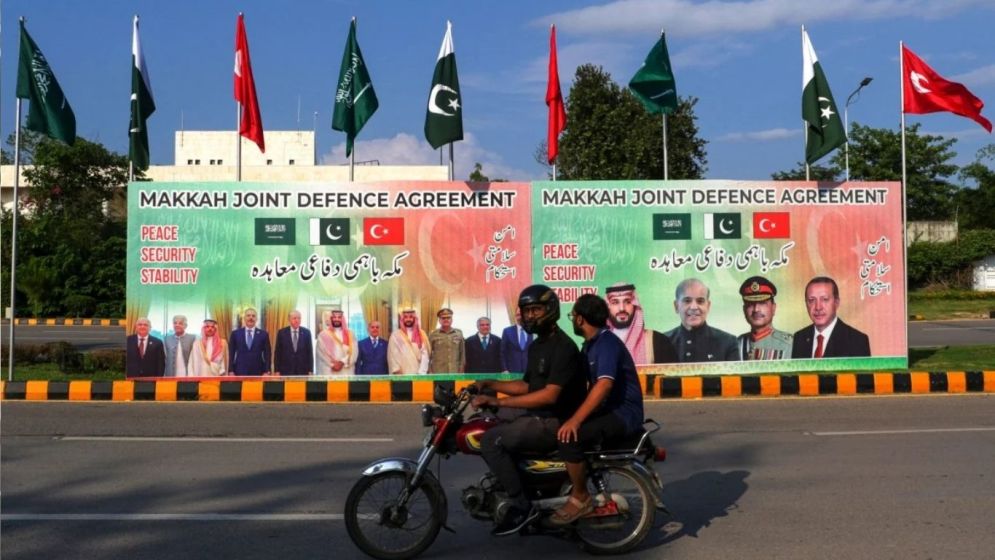
Photo : Collected
The past two years have marked a significant revival of Pakistan’s diplomatic and strategic role in Middle Eastern politics. From the Strategic Mutual Defense Agreement (SMDA), signed in September 2025 against the backdrop of the May 2025 conflict with India, to the August 2026 Makkah Agreement with Turkiye and Saudi Arabia, Islamabad has demonstrated its ability to navigate an increasingly complex web of regional security partnerships.
Pakistan-Saudi security cooperation, however, is far from new. Its roots stretch back to the 1960s, when Pakistan deployed military personnel to help train the Royal Saudi Air Force and Saudi ground forces. The partnership later expanded beyond training, with Pakistani pilots assisting Saudi forces during the Kingdom’s confrontation with South Yemeni forces in 1969. A decade later, Islamabad again provided crucial security and advisory support to Riyadh during the 1979 seizure of the Grand Mosque in Makkah.
In 1982, both sides signed a bilateral security agreement for the first time – thus formalizing security cooperation and large-scale deployment of Pakistani military personnel to Saudi Arabia as trainers and advisers. The agreement was put to the test during the 1990-91 Gulf war. Pakistan, taking a pre-emptive approach, stationed a large number of troops in the Kingdom.
A major test of Saudi-Pakistan security ties came during the 2015 Saudi-Houthi war. Islamabad positioned itself as a neutral player and distanced its forces from any involvement in the conflict. The Saudi-Houthi war boiled over again in 2026. On October 5 Pakistan, along with Turkiye, agreed to join hands with Saudi Arabia against the Houthis under the Makkah Agreement. However, Islamabad has refrained from direct engagement, restricting its role to assisting Saudi forces without crossing the enemy border.
The Makkah Agreement was signed in the wake of rising Houthi attacks against both Yemeni state forces and Saudi Arabia. It is modelled on NATO’s Article 5 commitment: “an attack against one member is considered an attack against all.” In practice, this three-nation alliance is an expanded version of the Saudi-Pakistani SMDA, with the addition of Turkiye.
The strategic weight of this new alliance stems from the three countries’ substantial combined capabilities. According to the 2026 Global Firepower Index, the alliance has a “combined strength of 1.4 million active troops, 3,400 military aircrafts, 6,000 tanks, and approximately 340 maritime assets.”
The blend of Saudi finance and capital, Turkish defense capabilities, and Pakistan’s military and nuclear posture make for a powerful combination.
Once the Makkah Agreement was activated, Pakistan committed its armed forces to counter Houthi attacks against the Kingdom and Islam’s holy sites, while Turkiye, citing legislative restrictions, has limited its role to supplying technology and missiles. This distanced commitment by alliance members may undermine the basic idea of the security agreement. Pakistan and Turkiye are present in theory but are bringing a shield rather than a sword to the Saudi-Houthi conflict.
The defensive nature of the contribution was acknowledged by Pakistan’s Defense Minister Khawaja Asif. “The forces of Turkiye and Pakistan are playing a supporting role,” he told Pakistan’s Geo News. “We are definitely involved in reconnaissance and such things, but the combat is practically being conducted by Saudi Arabia’s own forces.”
Questions have also been raised over the strength of Pakistan’s commitment to Saudi Arabia ever since the SMDA’s inception in September 2025. It took over a year for Islamabad to finally agree to send its troops to Saudi Arabia – that too only under the Makkah Agreement. Even now Pakistan has limited its participation to air attacks and has not committed to direct combat with the Houthis. Rawalpindi seems to be in no mood to sacrifice its forces in a conflict that will divert its attention from its northern and eastern border tensions with Afghanistan and India.
The last time Pakistan fought along with the Kingdom against South Yemen was in 1969 during the Al-Wadiah War. Then too, Islamabad’s role was limited to air warfare, with Pakistan Air Force pilots flying Royal Saudi Air Force fighter jets. Close to half a century later the Saudi-led coalition waged war against the Houthis, but in April 2015, Pakistan’s parliament in a unanimous vote called for strict neutrality, barring Pakistan from engaging in the conflict in any form.
Three years into the conflict, in 2018 Pakistan’s then-Army Chief General Javed Bajwa bypassed the 2015 resolution and sent a contingent of 1000 soldiers to the Kingdom, which he described as a “training and advisory mission.” During all these years Islamabad restricted itself to advisory and defensive deployments to protect Saudi interests within its territory.
In the case of the Houthis – a Shia-dominated group with significant backing from Iran, with whom Pakistan shares close to 900 km of border – Islamabad faces a dual dilemma. First, followers of Shia Islam constitute 20 percent of Pakistan’s population, and this community has in the past stood in solidarity with Iran. Second, given Iran’s security concerns, any regional alignment working against its interest – in this case supporting Saudi Arabia against the Houthis – may be perceived as a direct challenge to Tehran’s interest in the region. Iranian displeasure with Pakistan could result in cross-border skirmishes along the rugged mountains and remote terrains bordering Baluchistan.
How long can Pakistan distance itself from actual fighting? The answer hinges on Islamabad’s larger aspirations to leverage its military influence amid a post-U.S. security vacuum in the region. Another key factor is Saudi Arabia’s long-term financial assistance to Pakistan, which in the future may convince Islamabad to change its peripheral support posture toward a more robust involvement in the regional conflict.
Pakistan’s realist approach to the Makkah Agreement seems to be shared by its partners. Both Riyad and Ankara offered little substantive backing to Islamabad during Pakistan’s recent conflict with Afghanistan. A similar response was received after the SMDA, when Saudi officials emphasized that the bilateral agreement was not against India.
Pakistan may not be comfortable with the diplomatic and political silence from Riyadh following India’s 2019 abrogation of Article 370, which ended the special privileges to the former princely state of Jammu and Kashmir. Time and again Rawalpindi and Islamabad have drawn global attention to Kashmir by describing the issue as Pakistan’s jugular vein, but Saudi Arabia has offered only limited diplomatic support. That can be attributed to the growing economic ties between New Delhi and Riyadh.
Such developments are a growing concern for Islamabad. Historically, Saudi Arabia sided with Pakistan during the 1965 and 1971 wars with India, and even assisted Islamabad financially in its nuclear program. But Pakistan cannot expect the same level of diplomatic or military support from the Kingdom in a future conflict with India.
Amid the changing contours of the Middle East, Pakistan is trying to balance its approach between war and peace. However, given its domestic security concerns, Pakistan is trying to thread the needle, fulfilling its commitments under the Makkah Agreement without further escalating the conflict.
Source : The Diplomat