


 For all latest news, follow the Daily Sun's Google News channel.


Four-nation deal to pool defence know-how
Baqir Sajjad Syed
Published: 22 Oct 2026, 08:01 PM
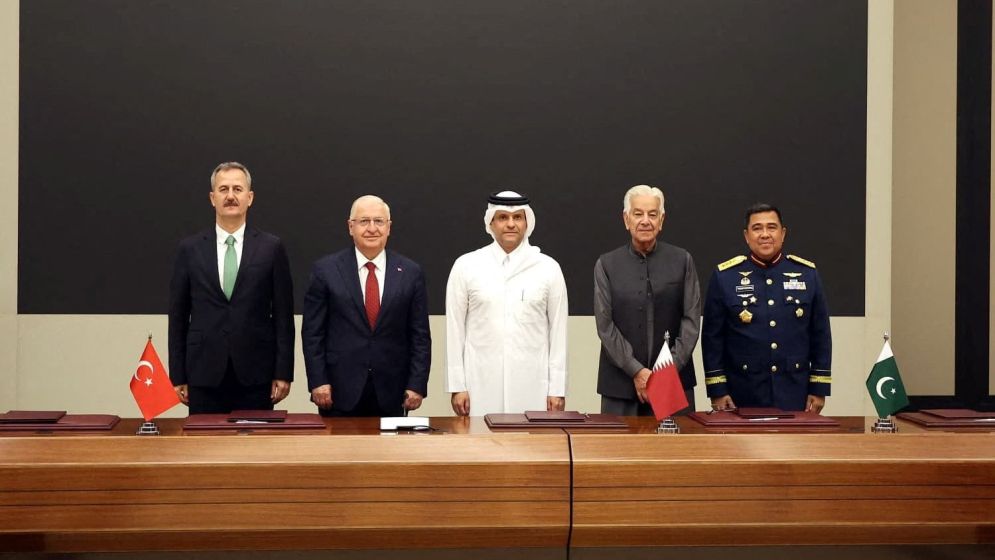
Turkey's Defence Minister Yasar Guler, Secretary of Turkish Defence Industries Haluk Gorgun, Qatar's Deputy Prime Minister and Minister of Defence Sheikh Saud bin Abdulrahman bin Hassan bin Ali Al-Thani, Pakistan's Defence Minister Khawaja Muhammad Asif and Indonesia's Deputy Defense Minister for Logistics, Defense Industry, and Technology Yusuf Jauhari attend a signing ceremony in Doha, Qatar, 21 October 2026. Photo: Turkish Defence Ministry
Pakistan, Turkiye, Qatar and Indonesia on Wednesday signed a
memorandum of understanding in Doha to expand cooperation in defence
manufacturing, joint production and technology development, in a move aimed at
strengthening their respective defence industries and reducing reliance on
external suppliers, besides developing capacity to support allies.
The agreement, named the “Badr Memorandum of Understanding,”
was signed by the four countries’ defence ministries, Pakistan’s defence
production organisation and Turkiye’s presidency of defence industries.
The signing ceremony was attended by Pakistani Defence
Minister Khawaja Asif, Turkish Defence Minister Yasar Guler, Qatar’s Deputy
Prime Minister and Minister of State for Defence Affairs Sheikh Saud bin
Abdulrahman bin Hassan Al Thani, Indonesian Deputy Defence Minister Marshal
Yusuf Jauhari and Turkish defence industry chief Haluk Gorgun.
A joint statement said the agreement was intended to combine
the participating countries’ industrial capabilities and promote cooperation in
defence production, technical training, research and development.
“This memorandum holds significant economic importance for
the signatory countries, as it will leverage each country’s capabilities in
defence manufacturing, achieving cooperation, integration, and the development
of defence industry capacities to meet the needs of allied and friendly
nations,” the statement said.
Mr Asif emphasised the importance Islamabad attaches to
building defence partnerships “with trusted partners. This memorandum reflects
our shared commitment to contributing to regional peace and stability”. He said
the four countries would explore joint production, technology transfer and
greater self-reliance, subject to their respective legal and regulatory
frameworks.
“We look forward to exploring opportunities for
strengthening self-reliance, industrial collaboration, joint production and
technology transfer while drawing on the complementary strengths of our
respective defence industries, in accordance with relevant international and
domestic laws and regulations,” the defence minister said.
Mr Asif added that the partnership would also promote joint
research and development, training exchanges and industrial capacity building.
Turkiye and Qatar released similar statements on the signing
of the pact. Reuters quoted the Turkish ministry as saying that the pact,
titled “Badr Memorandum of Understanding”, was aimed at defence cooperation and
strengthening defensive capabilities.
“The agreement holds substantial economic importance,” it
said, adding the accord sought to foster cooperation in military production,
boost military capabilities, and help collaboration in technical military
training, research and development.
“By leveraging the unique military production capabilities
of each country, the initiative will facilitate cooperation and integration,
enhance defence industrial capacities, and enable the fulfilment of the needs
of allied and friendly nations,” it added.
The state-run Qatar News Agency said the pact was named
“Badr”, “referring to the full moon, to signify how the four nations complement
one another through this agreement, given its immense importance in terms of
both defence and the economy”.
“Other friendly nations may join the MoU, in accordance with
criteria agreed upon by the four countries,” it said.
What does the agreement cover?
The agreement builds on existing defence industrial links
among the four countries. Pakistan and Turkiye have cooperated on naval
shipbuilding, including the MILGEM Corvette programme, while Turkiye and
Indonesia have pursued joint tank development and other defence projects. Doha
has also expanded its defence procurement and industrial cooperation with
Ankara.
The four countries bring different capabilities to the
arrangement.
Turkiye has developed a growing defence industry spanning
drones, armoured vehicles, naval systems and other military technologies.
Pakistan has established manufacturing and maintenance capabilities across
several defence sectors, while Indonesia has a substantial domestic industrial
base. Qatar offers investment capacity and demand for modern military
equipment.
The memorandum aims to create opportunities to combine those
strengths through collaborative projects, rather than relying exclusively on
direct purchases of finished equipment. The joint statement said the framework
would help develop defence industries and meet the requirements of allied and
friendly countries.
The agreement comes amid heightened regional security
concerns and efforts by countries in the Gulf and beyond to diversify defence
partnerships and strengthen domestic production.
It also follows the signing in August of a separate defence
agreement between Pakistan, Turkiye and Saudi Arabia that provides for closer
cooperation on collective defence. The Badr memorandum, however, is focused on
defence industries and does not itself establish a mutual defence commitment.
Khawaja Asif said the four countries intended to turn the
arrangement into practical cooperation across research, training and industrial
development.
“Through this partnership, we aim to advance cooperation
across joint research and development, training exchanges and industrial
capability building,” he said.
The writer is the foreign affairs and national security
correspondent for Dawn