




 For all latest news, follow the Daily Sun's Google News channel.


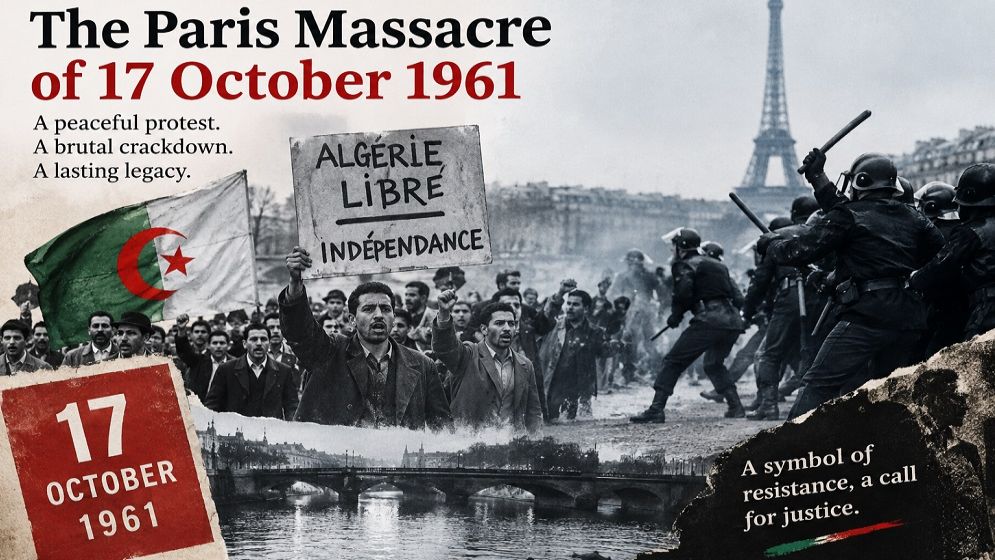
For Algeria, the memory of the victims remains inseparable from the wider struggle for independence and dignity. AI generated image
17 October 2026 marks the 65th anniversary of the Paris massacre, when French police brutally suppressed a peaceful demonstration by tens of thousands of Algerians in the French capital. Organised by the French federation of the Algerian National Liberation Front (FLN), the protest was held against a discriminatory curfew imposed on Algerians at the height of the Algerian War of Independence.
The curfew, introduced on 5 October 1961 by Paris police chief Maurice Papon, specifically targeted people described by the authorities as “Algerian Muslims”, “French Muslims” and “French Muslims of Algeria”. The demonstrators took to the streets to challenge this measure and the wider discrimination it represented.
The French authorities intended the curfew primarily to disrupt the FLN’s urban networks. By restricting movement after 8.30pm, the police sought to cut off financial support for the independence movement, including the monthly revolutionary taxes collected from Algerian migrant workers, and to disrupt its underground logistical operations.
On 17 October 1961, between 30,000 and 40,000 Algerians marched through central Paris to protest against the curfew. The police responded with extreme violence. Historians estimate that between 100 and 300 Algerians were killed, while nearly 12,000 to 14,000 protesters were arrested. Many victims were beaten unconscious or shot, and bodies were thrown into the River Seine.
A massacre with global consequences
Although the massacre took place amid the Algerian War of Independence (1954–1962), its significance extended far beyond North Africa. It became a powerful symbol for anti-colonial movements across the Global South, exposing the violence that colonial powers were prepared to use to maintain control.
Across Africa, the massacre resonated with liberation movements in the remaining French colonies and Portuguese territories, including Angola and Mozambique. It reinforced the conviction that negotiations with colonial powers had to be accompanied by determined resistance.
In Latin America, revolutionary movements and left-wing intellectuals viewed the events in Paris as further evidence that Western imperial powers would not readily surrender their control or recognise the right to self-determination. The massacre strengthened the resolve of those fighting for political freedom and independence.
The brutal suppression of a peaceful demonstration also reinforced the Pan-African movement and the spirit of solidarity associated with the 1955 Bandung Conference. It helped foster a shared sense of oppression and resistance among colonised peoples, regardless of whether they were fighting British, French, Portuguese or other colonial powers.
The massacre thus became a symbol of the lengths to which empires would go to preserve their authority, uniting diverse liberation movements under a common anti-imperialist cause.
Despite the French government's swift and extensive efforts to conceal the scale of the violence, which initially resulted in an official death toll of just three, the FLN used the disproportionate use of state force to gain greater international sympathy and strengthen its position during the negotiations that culminated in the Evian Accords. Algeria gained independence in March 1962.
A truth concealed for decades
The massacre received limited and often distorted coverage in France at the time. Much of the mainstream French media came under state pressure or practised self-censorship during the Algerian War, frequently repeating official police accounts.
Foreign media coverage was also sporadic. The conflict was largely treated as an internal French security crisis, while wartime restrictions limited journalists' ability to report independently from the ground in Paris.
Alternative and left-wing publications, including L’Humanité and Les Temps modernes, attempted to document disappearances and publish survivors' testimonies. However, they faced confiscations and legal harassment by the state.
For decades, the full extent of the massacre remained obscured. The truth gradually emerged through the work of independent historians, particularly Jean-Luc Einaudi, as well as the eventual opening of official archives. The issue gained further attention in the run-up to Maurice Papon's 1998 trial.
Years of historical research, public campaigning and pressure from civil society eventually forced French authorities to acknowledge the events more openly.
In 2012, President François Hollande formally acknowledged the bloody repression. In 2021, on the 60th anniversary, President Emmanuel Macron commemorated the victims at the Bezons bridge, describing the police actions as an “inexcusable” and “unforgivable crime”.
Yet historians and human rights organisations have continued to call for a full state apology and the complete opening of relevant archives.
In March 2024, the French Parliament approved a resolution condemning the massacre. Despite these acknowledgements of state-directed violence, successive French administrations have stopped short of issuing a comprehensive national apology or granting financial reparations.
The struggle for historical recognition
Sixty-five years after the massacre, historians and human rights advocates continue to press for the events of 17 October 1961 to be fully incorporated into France's school curricula and public memory.
Campaigners are also challenging restrictions on colonial-era records. Using the 65th anniversary to renew their demands, they are calling for unrestricted access to all remaining closed police archives and formal recognition of the massacre as a state crime.
For many, the issue goes beyond establishing the historical record. It concerns how a country confronts the darkest chapters of its past, acknowledges the suffering of victims and accepts responsibility for abuses committed in its name.
The massacre remains a significant reference point for human rights, anti-racism and anti-colonial movements around the world. Its long-suppressed memory has inspired works of art, literature and cinema that examine state violence, colonialism and the struggle for accountability.
From Jacques Panijel's documentary Octobre à Paris, which faced censorship, to Didier Daeninckx's acclaimed detective novel Meurtres pour mémoire, writers and filmmakers have continued to revisit the tragedy, challenging official historical narratives and demanding recognition for the victims.
Human rights organisations also draw on the legacy of the massacre when examining police accountability, racial profiling and the treatment of marginalised communities in France and across Europe. The events serve as a reminder that contemporary inequalities can have deep roots in colonial history.
The tragedy also illustrates how systematic racism and unequal civil liberties can create conditions for severe social unrest and state violence. Remembering the massacre is therefore not simply an exercise in historical reflection; it is also a way of examining the institutions and attitudes that continue to shape society.
Colonialism's moral contradiction
For generations, colonial powers such as France justified empire-building through the idea of a mission civilisatrice, or “civilising mission”. They claimed to be bringing democracy, human rights and the rule of law to other parts of the world.
The events of 17 October 1961 exposed the contradiction at the heart of that argument. By deploying brutal state-sanctioned violence against Algerians not in a distant colony but in the centre of Paris, the French authorities revealed that colonial repression was not merely an isolated excess. It was part of the machinery through which colonial power was maintained.
The massacre severely undermined the moral legitimacy of an empire that presented itself as a champion of universal rights while denying those rights to people subjected to its rule.
Before 1961, many Western audiences viewed anti-colonial struggles primarily as distant conflicts taking place overseas. The Paris massacre brought the reality of the liberation struggle into the heart of the colonial power itself.
For freedom fighters in Africa and Latin America, this carried profound symbolic significance. It demonstrated that the struggle against empire could reach the capitals of global power and that colonial authority was vulnerable even within its own metropolitan centre.
The violence also shaped the intellectual debate on liberation and decolonisation. Frantz Fanon, one of the most influential anti-colonial thinkers, examined the relationship between colonial domination and violence in his seminal work The Wretched of the Earth, published in 1961. His analysis argued that violence was deeply embedded in the colonial system itself and that decolonisation could not be understood without confronting that reality.
A legacy that cannot be erased
The Paris massacre of 17 October 1961 remains a painful chapter in French and Algerian history. It exposed the brutality of colonial rule, strengthened international solidarity with anti-colonial movements and left a lasting mark on debates about racism, state violence and historical accountability.
Sixty-five years later, the continuing demands for a full apology, access to archives and recognition in public education demonstrate that the struggle over the massacre's legacy is far from over.
For Algeria, the memory of the victims remains inseparable from the wider struggle for independence and dignity. For the rest of the world, the massacre stands as a warning about the consequences of discrimination, the abuse of state power and the denial of fundamental rights.
The events of that October night must not be allowed to disappear into silence. Their memory remains a powerful reminder of the price paid for freedom and a lasting source of inspiration for those who continue to fight for justice, equality and self-determination.