



 For all latest news, follow the Daily Sun's Google News channel.


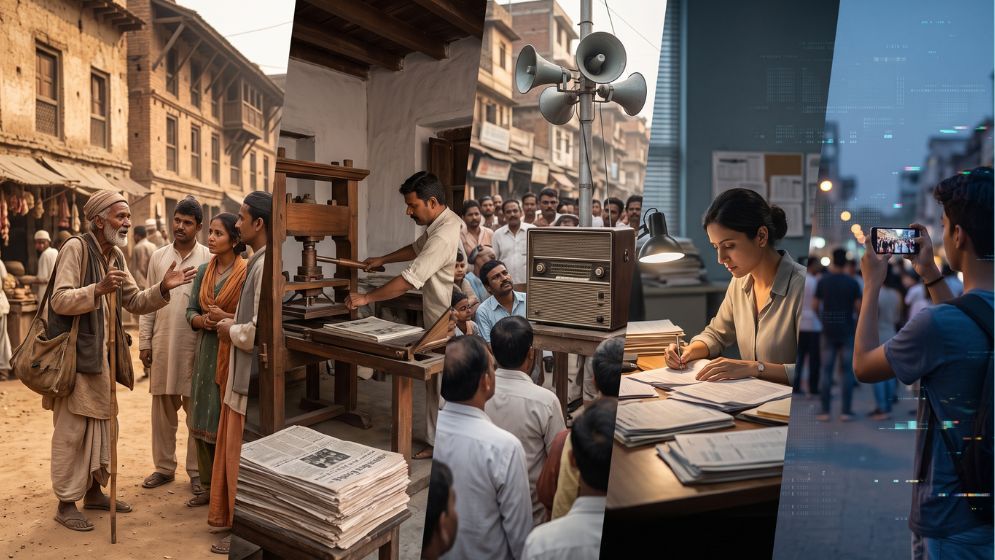
Photo: AI Generated
Long before there were newspapers and journalists, there were storytellers.
Think of a time when there were no smartphones, no internet,
no newspapers, nor a printing press. If so, then how did people get news? How
did they get to know what was happening on the other side of the world? This is
where the storyteller's tale comes into action.
Kh. Ali Ar Raji mentioned the thousands-of-years-old news
conveyers in his book on Journalism ‘Sangbadikota: Dwitiya Path’; he
called them "The Storytellers." They wandered from town to town,
carrying news the way traders carried goods. When they reached a busy bazaar or
a king's court, a crowd would gather, and they would begin: what they had seen
on the road during their journey, how strangers lived in faraway lands, what
had happened in the last kingdom they passed through. Most valuable of all was
any event that others needed to know about. Listeners rewarded them with food
or a few coins. Kings paid better, and some hired these travellers to gather information
from the places they visited, making them informants and spies. Raji traces the
journalist's family tree back to exactly these wanderers and argues that
reporters grew out of these storytellers, and that the journalist is their
latest form. What set the reporter apart was a new discipline: collecting facts
with great care and getting them right.
Raji is not the only one who sees the storyteller in the
journalist’s ancestry. In A History of News, Mitchell Stephens also finds the
roots of journalism long before print, in minstrels, town criers and wandering
travellers who gathered news in marketplaces and courts and passed it along by
word of mouth. Denis McQuail, in his work on mass communication, makes a
similar point: the jobs we now associate with journalism, such as watching the
world, explaining it, entertaining people and carrying culture forward, were
first done by oral historians, balladeers, town criers and court chroniclers.
The press did not invent these roles. It inherited them.
Some storytellers served certain purposes for the rulers, mostly the kings. They were paid to tell good things about kings to the people of the state, and audiences tended to believe what they heard, since the tellers were a major source of information. This is how a false belief could be cultivated in their mind. But the overall process was very slow until the 'Printing Press' came into the landscape. Before Johannes Gutenberg introduced movable-type printing in Europe in the mid-1400s, information moved slowly and reached few people. A message carried by a messenger could take weeks, sometimes months, to arrive, and it would reach only a handful of listeners. Books were copied by hand, one painstaking page at a time, so they were rare and expensive, and knowledge stayed in the hands of kings, priests, and scholars. (Printing itself was not new. Woodblock printing and even movable type had appeared earlier in China and Korea. What Gutenberg did was make the technology spread across Europe.)
The press broke that bottleneck. Thousands of pages could be
printed, stored, and sent far and wide, and as many copies as needed could be
made. Ideas that once travelled at the speed of a horse now travelled at the
speed of a printing shop. Within a century, printed pamphlets were carrying
arguments across borders, and by the early 1600s Europe had its first regular
newspapers.
But a printing press is like a loudspeaker: it does not care
who is holding it. Rulers quickly saw what it could do for them. Instead of
reporting facts, they used it the same way they did with storytellers: they
used printing presses to say only what they wanted people to hear. Many
governments licensed printers and censored what they printed, and papers became
a means of publicity, telling the public about the good work rulers claimed to
be doing rather than what they were actually doing, and spreading their
ideology to the masses.
The same struggle came to our part of the world. In 1780,
James Augustus Hicky started Hicky's ‘Bengal Gazette’ in Calcutta, the
subcontinent's first newspaper. He filled it with gossip and sharp criticism of
powerful colonial officials, including the Governor-General. The authorities
struck back. They prosecuted and jailed Hicky, seized his press, and closed the
paper in 1782. The first newspaper in our region was also among the first to
learn what power does to an inconvenient press.
The most chilling proof that the press can be turned into a
weapon came in the twentieth century. When Adolf Hitler's Nazi party took power
in Germany in 1933, one of its first steps was to create a Ministry of Public
Enlightenment and Propaganda under Joseph Goebbels. Its aim was to control
every channel through which Germans learned about the world. The state brought
newspapers under its control, made editors answerable to the government, and
removed journalists who would not comply. Radio, then the newest medium, was
pushed into millions of homes through cheap, mass-produced sets. Films, posters
and rallies were staged to build one story: that the nation was under threat,
that a particular group was to blame, and that one leader had the answer.
Repeated relentlessly, a lie began to feel like common knowledge.
The lesson was not that people are foolish. It was that
whoever controls the flow of information can shape what a whole society
believes. Nazi propaganda worked because it combined three things: a powerful
new medium, a single controlled message, and an audience with no easy way to
check it.
Now look at our own time. The medium is no longer radio or
the printed page. It is the smartphone, and it is far faster. The propaganda
minister's ministry has been replaced by something less visible: algorithms
that show each person more of whatever keeps them scrolling, and coordinated
networks of accounts that can make a claim look like public opinion. The
difference is important. In Hitler's Germany, the state controlled a few loud
channels. Today no single hand controls the flow, yet the effect can be the
same, because false and emotional content spreads faster than careful
reporting. In 2018, UN investigators said that social media, and Facebook in
particular, had played a 'determining role' in stirring up hatred against the
Rohingya in Myanmar, a warning that lies on a screen can lead to real harm.
To see how far we have come, follow the journey in our own
region. In 1818, the Serampore missionaries began ‘Samachar Darpan’, the first
Bengali weekly, and the Bengali press soon grew into a voice for social reform
and, later, for the independence movement. In East Bengal, newspapers carried
the arguments of the language movement and the demand for autonomy, and in 1971
the press and radio again played a central role. Radio and television then
brought news to people who could not read. From the 1990s, private dailies and
television channels expanded the field, and after that the internet arrived.
Each stage changed who could speak and how fast. For
decades, a few editors, owners and broadcasters decided what counted as news,
and the audience only received it. Online news portals broke the daily
deadline, so news no longer waited for the morning paper. Social media then
removed the gatekeeper altogether. Today, a student with a phone can film an
event and reach more people in minutes than a newspaper once reached in a day.
The July 2024 uprising showed both sides of this: footage and organising
messages travelled through social platforms, and the shutting down of the
internet showed how much people now depend on it.
This is a real gain, but it has a cost. When everyone can
publish, no one is responsible for what is published. Rumours are shared as
fast as facts, headlines are written for clicks, and newsrooms, hurt by falling
advertising, have fewer reporters to check what is true.
The next change is the most disturbing. Artificial
intelligence can now write convincing text in seconds, clone a person's voice,
and produce video of someone saying or doing things they never said or did.
These fakes are called deepfakes. For most of modern history, a photograph, a
recording, or a video worked as evidence. Deepfakes threaten that.
The danger is twofold. The first is the obvious one: a fake
video of a leader, a fabricated confession, or a forged voice message can
spread before anyone can disprove it. The second is quieter. When people know
that anything can be faked, they can also dismiss real evidence as fake. A
politician caught on camera can simply say, "It's AI." In a society
where nothing can be trusted, the biggest winner is anyone who profits from
confusion, an outcome that would have suited the Nazi propagandists, and one
that can now be reached at a fraction of the effort.
Look back over the whole journey. It began with a
storyteller in the bazaar, who was trusted only as far as his listeners could
believe him. It moved through Hicky's fearless gazette, then through
Gutenberg's press and the Bengali papers that fought for reform. It passed
through the propaganda machines of the twentieth century and has arrived at a
world of endless screens. The tools changed beyond recognition, from voice to
print to radio to television to the internet to AI. The central problem never
did: how do people know what is true, and who can they trust to tell them?
According to Raji, the value of a journalist lies in a set
of qualities: careful collection of facts, impartiality, the courage to tell
uncomfortable truths, and accountability for mistakes. The audiences, tired of
being lied to by rulers, officials, and businesses, still expect honesty from
journalists. That expectation matters more now than ever. In an age of
deepfakes, the journalist's discipline of checking, verifying, and taking
responsibility is not made obsolete by technology. It is the one thing that
machines cannot supply for us.
The storyteller has always been essential. But the future belongs to the storyteller who can be trusted, and that includes each of us who reads, shares, and believes what appears on our screens.