


 For all latest news, follow the Daily Sun's Google News channel.


Who wants to turn Bangladesh into a 'New' Pakistan?
Audite Karim
Published: 16 Sep 2026, 11:58 AM
We achieved our independence through the blood of three million martyrs. Through a nine-month long struggle against the Pakistani occupying forces, we snatched our red and green flag. This is our sacred soil, our motherland.
The seeds of Bangladesh's independence germinated through the Language Movement. Salam, Rafiq, and Jabbar shed their blood on the streets demanding Bangla as a state language. The man who refused to recognize the Bangla language, who showed extreme contempt and neglect toward the Bengali nation throughout his life, was Jinnah. Muhammad Ali Jinnah was the adversary to the emergence of Bangladesh. Due to his hypocrisy and anti-Bengali hatred, oppression and torture descended upon the Bengali nation. A man who hated Bengalis is now being celebrated by certain people in Bangladesh. Truly, how bizarre!
Those who want to celebrate Jinnah in Bangladesh are the bearers of an anti-independence ideology. Believers in this political line still want to deny the great independence movement of 1971. They want to turn Bangladesh into a new Pakistan.
After August 5, 2024, this group has been consciously displaying an affinity for Pakistan in Bangladesh. They are active in making the people of Bangladesh forget the memories of 1971. That is why they compare August 5, '24 to the Liberation War; some even try to portray '24 as greater than the Liberation War. After August 5, this group systematically destroyed Liberation War monuments across the country. They disrespected the heroic martyrs of '71. It is this group that celebrated by putting shoe garlands around the necks of freedom fighters.
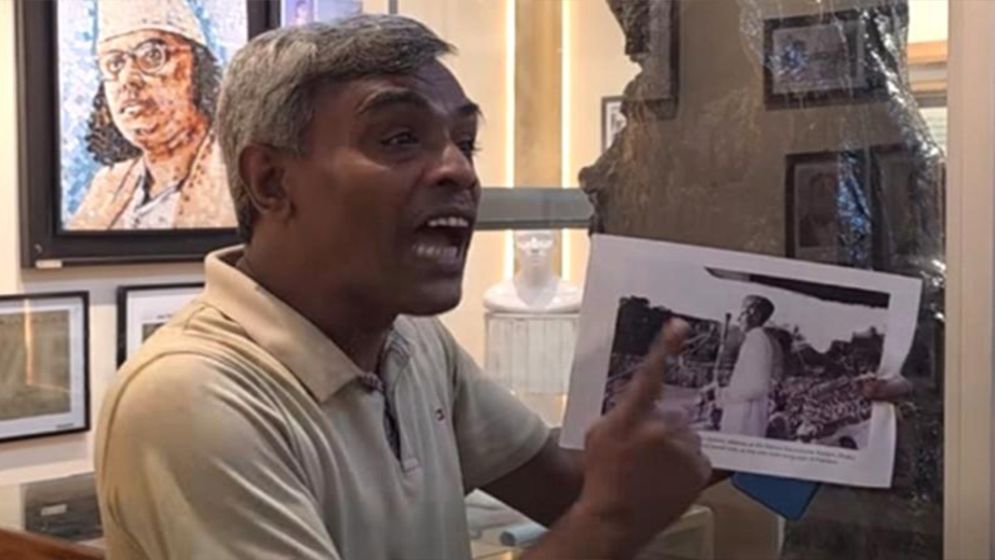
Under the guise of anti-India sentiment, they are deliberately trying to establish Pakistan in Bangladesh. By importing Pakistani attire, Pakistani music, and Pakistani culture, they have been attempting to destroy the spirit of Bangladesh's Liberation War over the last two years. Looking deeper, it becomes clear that those who opposed Bangladesh's Liberation War, collaborated with the Pakistani occupation forces in genocide and looting in '71, and have never apologized for their crimes, are the ones systematically trying to establish Pakistan in Bangladesh. The latest event in this planned conspiracy is the display of Jinnah's portrait in the DUCSU archive.
The sudden emotional commemoration, hanging of portraits, or tributes to Muhammad Ali Jinnah in Bangladesh directly conflict with the history of Bangladesh’s emergence as an independent state. This is not merely an emotional question. Historical records show that Jinnah's "Pakistan" was never a clear, honest state blueprint; it was a tactic of political bargaining that ultimately led to a reality where Bengalis became the victims.
When Jinnah came to Dhaka on March 21 and 24, 1948, the true face of his "Greater Pakistan" toward Bengalis became evident. At a public rally in the Racecourse Ground and at the convocation of Dhaka University, he declared that Urdu alone would be the state language of Pakistan. Yet, the mother tongue of the majority population in Pakistan at that time was Bangla. Despite protests from students, he did not alter his position. This single decision proves that a "United Pakistan" was never a vision of equal partnership among regions. It was a West Pakistan-centric plan of dominance where Bengalis were asked to surrender their language in the name of state-building.
Reading Jinnah's political biography reveals that his focus remained centered on the politics of Punjab, Sindh, the North-West Frontier Province, and Delhi-Lahore. East Bengal was to him merely a vote bank and a source of demographic power, not a region requiring distinct attention for its language, culture, or economy. Consequently, immediately after independence, East Bengal turned into an internal colony of West Pakistan, from which resources were siphoned off while Bengali representation in political power and the military-civil bureaucracy remained negligible. The seeds of this disparity were sown during Jinnah's lifetime.
The ultimate proof of how fragile Jinnah's concept of a "United Pakistan" was emerged in 1971, when the Pakistani state committed genocide against its own majority population.
The recent sentiment surrounding Jinnah from certain circles in Bangladesh—publicly paying respects on his death anniversary, re-establishing his portrait in the Dhaka University Central Students' Union (DUCSU) archive—is not merely an exercise in history. For those who still believe in an undivided "One Pakistan" ideology, Jinnah represents a symbol of an alternative national identity—an identity that stood directly against the birth of Bangladesh. More than five decades after independence, for a state that achieved its very existence by rejecting Jinnah's envisioned state structure, placing him on a hero's pedestal undermines the sacrifices of the martyrs of 1971. In Bangladesh's national memory, the place belongs to the language martyrs and freedom fighters, not to Jinnah, whose dream was at the exact opposite pole of ours.
Those attempting to re-establish Jinnah and Pakistan in Bangladesh ultimately want to transform this country into a new Pakistan. Since '24, a certain group in Bangladesh seems possessed by the ghost of Pakistan. The primary patron of this group is Dr. Yunus.
Following the political shift of '24, the interim government led by Dr. Yunus has managed to improve relations with only one country in the world—Pakistan. During this time, the growing relationship between Pakistan and Bangladesh has sparked new discussions in South Asian diplomacy. The strengthening of military and intelligence ties, in particular, warrants close observation. The visit of Pakistan's ISI chief, Lieutenant General Asim Malik, to Dhaka in January 2025 gave this discourse a new dimension. This marked the first time an ISI chief visited Bangladesh since its independence in 1971. Since 2024, both military and civilian engagements between Pakistan and Bangladesh have increased, with Pakistan showing intense interest in building ties with Bangladesh.
Pakistan's interest in Bangladesh stems from two reasons:
• Revenge for the 1971 Defeat: Politically, Bangladesh will never become Pakistan again. However, if a strong pro-Pakistan faction takes root in Bangladesh, the country will move according to Pakistan's desires. The nation defeated in '71 cannot tolerate seeing Bangladesh stand tall on the world stage.
• Using Bangladeshi Territory to Destabilize India: The more anti-India sentiment grows in Bangladesh, the stronger Indian separatist groups become. Pakistan aims to use Bangladesh to put India in a vulnerable position. The effort to improve ties with Pakistan after '24, the overt affection for Pakistan among a local faction, and the revival of Jinnah are all interconnected.
However, the people of this country are aware. They will foil the conspiracy to make Bangladesh a new Pakistan. Demonstrating outrage, students tore down three portraits of Jinnah from the DUCSU archive. Protests were also voiced by the Jatiyatabadi Chhatra Dal and Bangladesh Chhatra Union. In the same way, the people of this country will thwart the conspiracy to turn Bangladesh into a new Pakistan. Bangladesh will never become Pakistan.
Audite Karim: Writer and Playwright. Email: [email protected]