



 For all latest news, follow the Daily Sun's Google News channel.


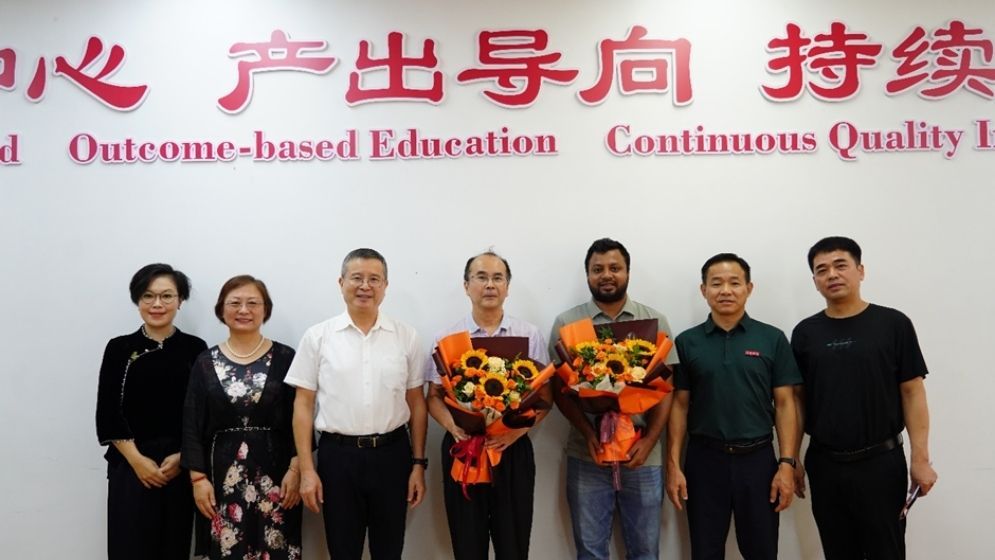
Photo: The university’s highest administrative and policy-making leaders extend Teacher’s Day greetings to the writer Mohammad Saiyedul Islam. Photo: Courtesy
Sometimes, a flower can say what words cannot. A simple bouquet can carry gratitude, respect, affection, and memories that remain with us for years. For me, Teacher’s Day flowers in China represent a deeper journey.
From being a student
who once stood before teachers with flowers in hand, I later became a teacher
who now receives flowers from students and university leaders.
When I first came to
China as an international student at Jiangxi University of Finance and
Economics, I was deeply impressed by the way Teacher’s Day was observed. On
September 10, students presented flowers to their teachers as a gesture of
respect and gratitude. I remember standing as a student, holding flowers for my
teachers and wishing them a happy Teacher’s Day.
At that time, it
seemed simply a special day to thank those who taught us. I did not imagine
that one day I would experience the same tradition from the other side of the
classroom.
Today, I am a teacher
at Sanming University in Fujian Province. This year, when my students presented
flowers to me and wished me a happy Teacher’s Day, I felt a very different
emotion. The flowers were familiar, but their meaning was new. I remembered the
days when I was a student at Jiangxi University of Finance and Economics and
gave flowers to my teachers. I realized that teachers and students are linked
not only by teaching and learning, but also by respect, trust, encouragement,
and human connection.
What touched me even
more was seeing the university’s highest administrative and policy-making
leaders extending Teacher’s Day greetings to teachers. Their gesture sent a
clear message that teachers matter and education matters.
Although Teacher’s Day
is observed at different times across the globe, its core objective remains the
same: to honour the contributions and responsibilities of teachers. UNESCO
designated October 5 as World Teacher’s Day, a practice observed since 1994. However,
many countries celebrate the occasion on different dates based on their own
history and traditions. Teacher’s Day is celebrated on September 10 in China,
September 5 in India, the Tuesday of the first full week of May in the United
States, October 15 in Brazil, May 15 in Mexico, November 24 in Turkey, January
16 in Thailand, November 20 in Vietnam, and May 16 in Malaysia.
Celebrations vary by
country and may include the presentation of flowers and gifts, cultural
programs, award ceremonies, discussion forums, or tributes to former teachers.
Despite these diverse forms of observance, a global culture of expressing
gratitude toward teachers has emerged through these celebrations.
In China, Teacher’s
Day is not limited to students sending greetings to their teachers. Universities
and educational institutions also recognize teachers, highlight outstanding
educators, and create an atmosphere of respect for the profession. This broader
practice reinforces the value placed on those who stand in front of classrooms,
guide students, and help shape their futures.
China officially
established Teacher’s Day on September 10 in 1985. The decision was intended
not only to celebrate teachers but also to raise their social status and
promote a culture of respecting teachers, knowledge, and talent. The Teachers
Law later formally established September 10 as Teacher’s Day.
This year, September
10, 2026, marks China’s 42nd Teacher’s Day, highlighting the vital role of
educators in shaping minds and building the nation, and emphasizing the spirit
of educators and a culture of respecting teachers and valuing education.
-6aa426e282f83.jpg)
China has the world's largest education system, with roughly 440,000 schools at all levels and types and 280 million students. In 1985, China had about 9.32 million full-time teachers nationwide.
Four decades later, that number had doubled to nearly 18.7 million, even as qualifications climbed sharply, with most primary and secondary teachers now holding at least a bachelor's degree.
The history is important because it shows that Teacher’s Day in China is more than a ceremonial occasion. It is connected to a broader cultural tradition. Respect for teachers has deep roots in Chinese civilization, and the modern Teacher’s Day was created to strengthen that respect and encourage society to value knowledge and education.
From my experience, one
of the most meaningful aspects of Teacher’s Day in Chinese universities is the
involvement of institutional leadership. When university leaders visit
teachers, offer flowers or greetings, recognize their work, and participate in
celebrations, it gives the occasion special significance. Such gestures may
appear small, but they can have a powerful effect on teachers’ sense of
belonging and professional dignity. A teacher spends much of the year giving
knowledge, time, patience, encouragement, and sometimes even emotional support.
A day when the
institution and students say, “We appreciate you,” can be deeply meaningful.
For me, however, the
most beautiful part of Teacher’s Day is the circle it creates. Years ago, I was
the student carrying flowers. Today, I am the teacher receiving them. Tomorrow,
my students may become professionals, researchers, entrepreneurs, or teachers
themselves.
Perhaps one day they
will remember their university days and the teachers who encouraged them. Some
may even stand in a classroom and receive flowers from their own students. In
that moment, the meaning of Teacher’s Day will pass from one generation to
another.
This experience has
also changed the way I understand teaching. When I was a student, I mainly saw
teachers as people who provided knowledge and guidance. Now, as a teacher, I
understand the responsibility behind the profession much more clearly. A
teacher is not simply delivering lectures or completing a syllabus. A teacher
is helping young people develop confidence, curiosity, values, and the ability
to face an uncertain future.
That is why the
flowers I received this year at Sanming University meant so much to me. They
reminded me of where I started, how far I have travelled, and the
responsibility I now carry.
They also reminded me
that education is ultimately about people. Behind every lesson is a teacher who
cares, and behind every teacher is often a student who once inspired that
teacher to keep learning.
Teacher’s Day in China
therefore teaches me a lesson that goes beyond flowers. It shows how a society
can turn gratitude into a culture and respect into an institutional value. For
a foreign teacher like me, the experience is particularly meaningful because I
have lived on both sides of this tradition as a student giving flowers and as a
teacher receiving them.
The flowers I once
gave to my teachers have now, beautifully, come back to me. They are no longer
simply flowers. They are a reminder that education creates a continuing circle
of respect.
Students learn from teachers, teachers learn from students, and each generation carries that respect forward. That is the true meaning of Teacher’s Day: to remind us throughout the year why teaching, learning, and respecting those who make both possible matters.
The writer is a senior lecturer and researcher in the School of Overseas Education (School of Foreign Languages) at Sanming University in East China’s Fujian Province.