


 For all latest news, follow the Daily Sun's Google News channel.


Waste-to-Energy Is Holding Back Bangladesh's Climate Goals
Ali Azman
Published: 05 Jul 2026, 04:30 PM
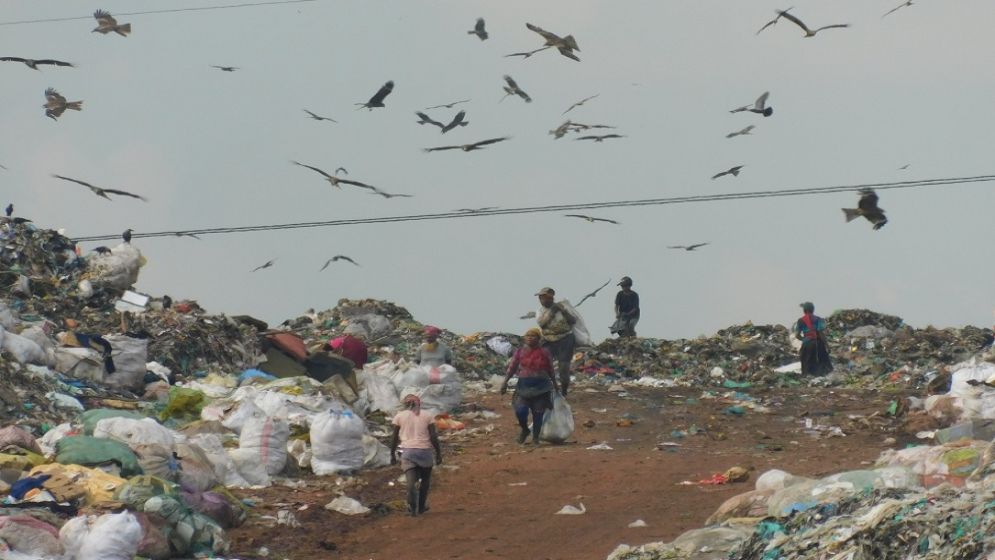
Waste pickers collecting recyclable materials from Matuail landfill. Photo: Ali Azman
The proposed Aminbazar waste-to-energy project promises a quick solution to Dhaka's mounting waste crisis. But its long-term environmental, economic and social costs could outweigh its benefits.
Bangladesh has pledged to strengthen its climate commitments and promote a circular economy, yet one of its largest waste management projects appears to be moving in the opposite direction.
The decision by the Dhaka North City Corporation (DNCC) to revive the long-delayed Aminbazar Waste-to-Energy (WtE) Plant may seem an attractive answer to the capital's growing waste problem. However, the project risks creating far greater environmental, economic and social challenges than the problem it seeks to solve. Rather than supporting Bangladesh's climate ambitions, large-scale waste incineration could undermine recycling, threaten thousands of livelihoods and steer the country away from the sustainable waste management pathway it has pledged to follow.
Although construction was previously delayed because of environmental clearance issues and objections from the Department of Environment, the project is once again progressing. Under the proposal, the China Machinery Engineering Corporation (CMEC) will develop a 42.5-megawatt waste-to-energy facility capable of incinerating around 3,000 tonnes of municipal waste every day through four combustion units.
Yet the controversy extends well beyond the technology itself. Environmental accountability, financial risks and the protection of Bangladesh's national interests have all become subjects of growing concern. Critics increasingly question whether the project will genuinely solve Dhaka's waste crisis—or simply replace one environmental challenge with several more costly ones.
An agreement that raises serious questions
One of the most contentious aspects of the project is the agreement between DNCC and CMEC.
The contract has attracted criticism for placing disproportionate responsibilities on the Bangladeshi authorities while offering comparatively few obligations for the foreign developer. Among the principal concerns is the absence of a clearly defined plan for disposing of the plant's thermal wastewater. At the same time, the agreement reportedly exempts CMEC from liability for environmental or operational consequences, leaving the city corporation to shoulder the associated risks.
The contract also grants the company sole discretion over the types of waste accepted for incineration, limiting the city's ability to influence operational decisions.
Financially, the arrangement could prove equally burdensome.
DNCC is reportedly required to guarantee a daily supply of 3,000 tonnes of waste. Should waste volumes fall short, the city corporation would face a penalty of BDT 3,000 for every tonne not delivered. In addition, electricity generated by the plant would have to be purchased at nearly twice the prevailing market price, creating what critics describe as a substantial long-term financial obligation for the public sector.
These provisions raise an important question: does the agreement adequately safeguard Bangladesh's environmental and economic interests?
A threat to recycling and the circular economy
The proposed Aminbazar plant also has significant implications for Bangladesh's emerging circular economy.
To remain commercially viable, waste-to-energy facilities require a continuous stream of combustible material. That demand creates a strong incentive to divert recyclable materials—including plastics, paper and cardboard—away from Material Recovery Facilities (MRFs) and into incinerators.
The economic implications are considerable.
If only 10 per cent of the plant's projected daily waste intake were recyclable, it would amount to approximately 300 tonnes of recoverable material every day. At an estimated value of BDT 15 per kilogram, those recyclables would represent roughly BDT 4.5 million in daily value, or about BDT 135 million every month.
Burning such materials instead of recovering them would weaken Bangladesh's recycling industry, reduce resource efficiency and move the country further away from a genuinely circular economy.
Livelihoods at risk
Beyond the economic consequences lies an equally significant social challenge.
According to Martin Medina, an internationally recognised expert on solid waste management and the informal recycling sector, up to 2 per cent of the population in many developing countries is directly or indirectly engaged in waste-related activities.
Applied to DNCC's population of roughly six million, this suggests that approximately 120,000 people could be affected by the proposed incineration project.
Many informal waste pickers rely on collecting recyclable materials as their primary source of income. If valuable recyclables are redirected to the incinerator, thousands of these workers could lose their livelihoods.
Without meaningful rehabilitation measures and their inclusion in future waste management systems, the project risks undermining the principles of a just transition, which seeks to ensure that environmental progress does not come at the expense of vulnerable communities.
Does the project align with Bangladesh's environmental laws?
Bangladesh's existing environmental legislation raises further questions about the project's compatibility with national policy.
The Solid Waste Management Rules, 2021, and the Air Pollution (Control) Rules, 2022, both discourage the burning of waste because of its contribution to air pollution, environmental degradation and public health risks.
Against that legal backdrop, establishing a large-scale waste incineration facility at Aminbazar—surrounded by cultivable land and residential communities—appears difficult to reconcile with the broader objectives of these regulations.
While waste-to-energy plants differ technically from open burning, critics argue that constructing an incineration facility handling mixed municipal waste in such a sensitive location risks conflicting with Bangladesh's commitment to cleaner air, environmental protection and public health.
Global lessons: Is waste-to-energy still the future?
Supporters of waste-to-energy projects frequently cite the experience of European countries to justify similar investments in Bangladesh. However, such comparisons often overlook a crucial fact: the composition of municipal waste in Europe differs significantly from that of Bangladesh.
In most European countries, organic waste accounts for roughly 30–40 per cent of municipal waste, with moisture content typically ranging between 25 and 35 per cent. More importantly, waste is segregated at source through highly organised collection systems, ensuring that incinerators receive relatively dry, combustible material with a high calorific value.
Bangladesh presents a very different picture.
According to the World Bank's What a Waste 3.0 report, low-income countries generally generate waste containing much higher proportions of organic material because of dietary habits and the absence of effective source segregation. As a result, municipal waste carries significantly higher moisture content, making it less suitable—and considerably more expensive—for energy recovery through incineration.
The success of waste-to-energy facilities in Europe therefore cannot simply be replicated in countries where waste characteristics, collection systems and recycling infrastructure are fundamentally different.
Europe is moving beyond incineration
Ironically, while some continue to promote waste-to-energy as a modern environmental solution, many European countries are gradually shifting away from it.
The European Union has tightened financing for new waste-to-energy projects, while countries such as Germany have introduced carbon-related policies that increasingly affect waste incineration. Once promoted as a clean source of renewable energy, waste burning is now facing growing scrutiny because of its greenhouse gas emissions and environmental impacts.
Similarly, the United States Environmental Protection Agency (EPA) discourages the combustion of recoverable materials and places waste incineration below recycling and other preferred waste management options. Increasingly, governments are prioritising alternatives such as anaerobic digestion, composting and advanced recycling technologies that recover valuable resources while producing significantly lower emissions.
These developments suggest that the global waste management debate is evolving. Rather than expanding incineration capacity, many developed economies are investing in technologies that retain materials within the circular economy for as long as possible.
India's experience offers a cautionary tale
Bangladesh may find even more relevant lessons closer to home.
India's experience with waste-to-energy has been mixed at best.
The country's first major waste-to-energy plant at Timarpur, Delhi, collapsed within weeks of operation because the waste lacked sufficient calorific value. Its successor at Okhla, commissioned in 2012, became the subject of prolonged legal disputes over emissions of hazardous pollutants, including dioxins and furans. Although the facility eventually continued operating, it was fined for breaching emission standards during its early years.
Public opposition has continued elsewhere. In Gujarat, several proposed waste-to-energy projects have been halted following protests by environmental groups, civil society organisations and local communities.
Since the 1980s, India has established 14 waste-to-energy plants, yet approximately half have already ceased operations, while several others continue to face environmental scrutiny.
Given that Dhaka's municipal waste contains moisture levels comparable to—or even higher than—those found in many Indian cities, critics argue that Bangladesh should carefully evaluate whether similar challenges could emerge at Aminbazar.
Bangladesh's climate commitments at stake
The proposed project also raises questions about Bangladesh's international climate obligations.
Under its Third Nationally Determined Contribution (NDC 3.0) submitted under the Paris Agreement, Bangladesh has committed to reducing greenhouse gas emissions by 6.39 per cent unconditionally and by a further 13.92 per cent with international financial and technological support, bringing total potential mitigation to more than 20 per cent below business-as-usual levels by 2035.
The country has also pledged, through successive UN Climate Change Conferences (COPs), to reduce methane emissions from organic waste by promoting circular economy principles and zero-waste approaches.
Critics therefore argue that investing heavily in large-scale waste incineration appears inconsistent with these commitments, particularly when organic waste constitutes the largest share of Bangladesh's municipal waste stream.
There are better alternatives
Waste management experts increasingly agree that there is no universal solution capable of addressing every country's waste challenges.
Instead, successful systems are designed around local waste characteristics, consumption patterns and institutional capacity.
The experience of Seoul, South Korea, offers one of the most instructive examples. Once struggling with severe waste management problems, Seoul transformed its system by introducing strict source segregation, comprehensive recycling programmes and strong regulatory enforcement. Notably, its waste composition several decades ago closely resembled the conditions currently found in Dhaka.
Around the world, cities are increasingly investing in alternatives that recover value from waste rather than destroy it. These include:
- Community and household composting;
- Biogas production from organic waste;
- Black Soldier Fly technology for converting food waste into animal feed and organic fertiliser;
- Expanded Material Recovery Facilities (MRFs); and
- Stronger integration of informal waste pickers into formal recycling systems.
Such approaches support resource recovery, improve soil health, reduce methane emissions and create employment while advancing the principles of a circular economy.
Research increasingly indicates that investments in zero-waste infrastructure deliver greater long-term economic, environmental and public health benefits than either traditional landfill disposal or waste-to-energy incineration.
Encouragingly, Dhaka South City Corporation (DSCC) has already begun adopting elements of the South Korean waste management model. The question, therefore, is whether Dhaka North should pursue a different path that many countries are gradually moving away from.
A defining choice for Bangladesh
Bangladesh undoubtedly faces an urgent waste management crisis. Rapid urbanisation demands innovative and sustainable solutions.
However, urgency should not become an excuse for adopting policies that may create new environmental and economic burdens for decades to come.
The Aminbazar Waste-to-Energy project presents Bangladesh with a fundamental policy choice. One path prioritises waste incineration, locking the country into a system dependent on continuously burning thousands of tonnes of valuable materials every day. The other embraces a circular economy built on waste reduction, source segregation, recycling, composting and resource recovery—an approach increasingly reflected in international climate policy and best practice.
As Bangladesh seeks to balance economic growth with environmental responsibility, the debate over Aminbazar extends far beyond a single infrastructure project. It is ultimately about determining the country's long-term direction on climate action, urban sustainability and resource management.
If Bangladesh is serious about fulfilling its climate commitments and building a resilient, resource-efficient economy, investment should prioritise zero-waste infrastructure, stronger recycling systems and inclusive waste management that protects both the environment and the livelihoods of thousands who depend on it.
The decisions taken today will shape not only how Dhaka manages its waste, but also how Bangladesh meets the environmental challenges of the decades ahead.