


 For all latest news, follow the Daily Sun's Google News channel.


Zillur Rahman
1. The Budget Figures and the Question of Money
Bangladesh’s proposed budget for the 2026–27 fiscal year is undoubtedly the largest in the country’s history. In numerical terms, it is an epic undertaking. Allocations have increased across almost all sectors, including education, healthcare, social protection, infrastructure and agriculture. The government’s message is clear: the development process centred on people will be further strengthened. On paper, there is little to object to. Investment in education is necessary, investment in healthcare is necessary, and social protection is essential. No country can achieve long-term progress without a healthy and educated population. There is little room for debate on that point.
Yet one question seems to become more important with each passing year: where will the money come from? We have reached a stage where discussions about the budget begin with expenditure. Attention focuses on who receives what, which ministry has secured a larger allocation, and which sectors have gained new projects. Comparatively less attention is paid to the source of the funding. Over the past few years, Bangladesh has developed a curious tendency. We have become increasingly confident about spending, but less realistic about revenue generation. The fundamental truth of economics is that the state does not create wealth; it creates the conditions in which wealth can be created. Wealth is generated by farmers, workers, entrepreneurs, investors and markets. This is why the question of the private sector has become so important. Social development is undoubtedly development, but social spending alone is not development. Without the creation of new wealth, social expenditure cannot remain sustainable in the long run.
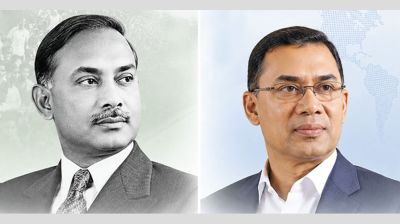
The late President Ziaur Rahman once made a famous remark: “Money is no problem.” For years, that statement has been debated. Some viewed it as an expression of confidence, while others saw it as excessive optimism. Looking at Bangladesh today, however, one might conclude that our greatest challenge is indeed money. There is no shortage of plans, projects or dreams. The real question is: where are the resources?
Meanwhile, the issue of legalising undisclosed wealth has once again returned to public debate. Pragmatic economists may argue that such measures will bring some funds back into the formal economy. But what message does this send from a moral standpoint? Will the state place honest taxpayers and long-term tax evaders on the same footing? Economics is ultimately not just about money; it is about trust. And once trust is lost, it cannot be restored through budget speeches alone.
2. Beyond the Barbed Wire
The history of Bangladesh–India relations contains a peculiar duality. Meetings take place in Dhaka, handshakes are exchanged in Delhi, and joint statements are issued. Yet at the border, a different reality often emerges. The recent “push-in” issue has once again brought that reality into sharp focus. On one hand, there is the language of friendship; on the other, tensions along the frontier. It is as though these are two contradictory chapters of the same book.
The Bangladesh–India border is among the most complex in the world. The two countries share language, history, culture and rivers, yet they remain separated by barbed wire. At times, it feels as though the people on either side are characters in the same story.
India’s newly appointed High Commissioner, Dinesh Trivedi, recently remarked that the people of Bangladesh and India experience the same sorrows beneath the same sky. The statement may sound diplomatic, but it contains a profound truth. Monsoon clouds do not carry passports, nor do rivers require visas to flow. Nature recognises no borders; states do. That is precisely why realism is more important than emotion in border management.
India is now promoting the concept of a “smart border”, incorporating technology, sensors, drones and artificial intelligence into border security. Such technology is necessary. But technology can never replace trust. To be good neighbours, countries must first respect one another’s boundaries. Robert Frost famously wrote, “Good fences make good neighbours.” A proper boundary does not create hostility; it reduces misunderstanding. Bangladesh–India relations may now be entering a more realistic phase, where respect for boundaries is recognised alongside the value of friendship.
3. Politics: Not Speeches, but Institutions
One of the enduring problems of politics is that we often confuse individuals with institutions. In South Asian politics, charismatic personalities have always held considerable appeal. Leaders frequently overshadow the institutions they represent. Yet the reality of governance is different. A leader may win an election, but institutions are what move a country forward.
That is where Bangladesh’s greatest political test now lies. A new political reality has emerged. Public expectations have risen. Political tensions have eased, but economic challenges have intensified. People no longer wish to hear speeches alone. They want answers. What is the state of electricity supply? Where is investment coming from? How many jobs have been created? How effective is the justice system? Has law and order improved?
Politics is therefore gradually moving from a laboratory of emotion to a test of administrative competence. This is a positive development because the greatest strength of democracy lies in results. Winston Churchill once observed that politicians think about the next election, while statesmen think about the next generation. That is the challenge facing Bangladesh today. Will we govern for the next election, or for the next generation? The answer to that question will shape the country’s political trajectory in the years ahead.
4. The Philosophy of Boundaries
Our society suffers from a curious misconception. Many people assume that proximity to power automatically confers influence. If someone moves within influential circles, appears in photographs, or invokes prominent names, they are often perceived as powerful. Reality, however, is different. Influence and access are not the same thing. Genuine influence is built on trust, not on unauthorised proximity.
Another characteristic of our times is that some people have turned criticism into a profession. They do not seek change; they seek attention. Disorder is their fuel. Reaction is their oxygen. Attention is their currency. This is why the loudest critics are not always the most important voices. Often, they are simply afraid of becoming irrelevant.
An old saying captures this well: “Never wrestle with a pig. You both get dirty, and the pig likes it.” The lesson applies to politics, society and personal life alike. The most effective response to those who thrive on chaos is not argument, but boundaries.
No family survives without boundaries. No institution survives without boundaries. No state survives without boundaries. Even democracy itself depends on them. Without the limits imposed by law, freedom descends into anarchy. Without limits on power, leadership becomes authoritarianism. Without limits in relationships, love can become dependency. Boundaries are not cruelty; they are governance.
Conclusion
The four themes of this week—the budget, the border, politics and personal boundaries—are, in essence, four versions of the same story. The budget reminds us that resources are finite. The border reminds us that territory has limits. Politics reminds us that power has limits. And life reminds us that human beings have limits as well.
Problems begin when individuals, institutions or states forget those limits. In today’s world, the greatest strength is neither wealth nor power. It is self-restraint.
A state that controls its spending prospers. A country that manages its borders remains secure. A leader who understands the limits of power endures. And a person who can define the boundaries of their own life ultimately finds peace.
The history of civilisation teaches a single enduring lesson: freedom does not exist in opposition to boundaries; it survives within them.
Author: President, Centre for Governance Studies