


 For all latest news, follow the Daily Sun's Google News channel.


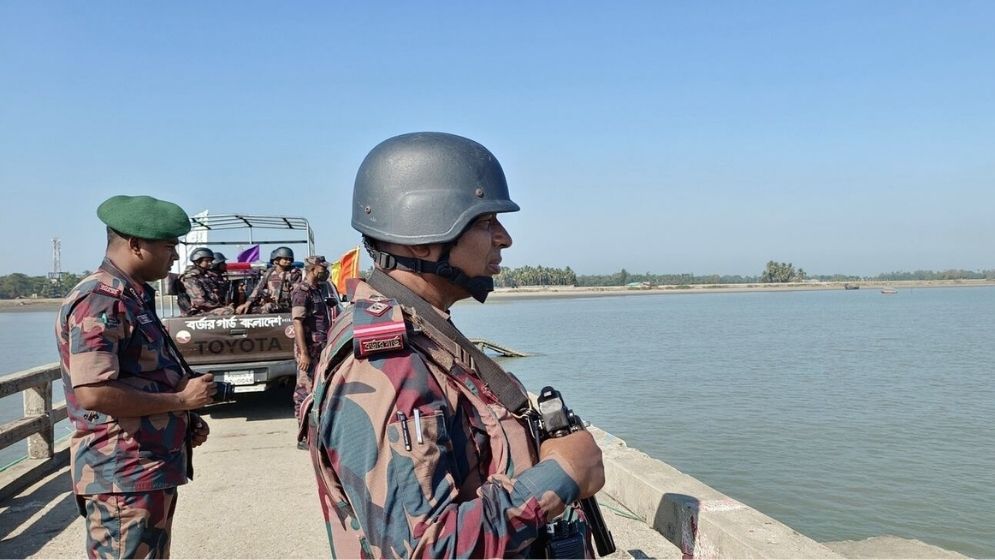
Photo: Courtesy
For our beloved Bangladesh, the question of independence, sovereignty, and territorial integrity means that the border is not merely a geographical line; it is a symbol of a nation’s dignity, security, and existence. And standing guard over that border day after day, night after night, with unwavering courage, the Border Guard Bangladesh (BGB) has become not just the name of a force, but a living symbol of patriotism, bravery, and sacrifice for the people of this country. The recent firm and heroic counter-resistance by BGB in response to the sudden firing by the Indian Border Security Force (BSF) at the Sonarhat border in Gowainghat upazila of Sylhet once again proved that Bangladesh is no longer a silent spectator as before; on the question of sovereignty, the country’s border guards now stand firm with an iron resolve.
Last Monday afternoon, when the BSF suddenly opened provocative
fire at the Sonarhat border, BGB responded immediately. The situation was
quickly brought under control, and a sense of security returned to the border
communities instead of panic. Lieutenant Colonel Md Nazmul Haque, commander of
the Sylhet Battalion (48 BGB), clearly stated that BGB is carrying out—and will
continue to carry out—its duties with the highest level of professionalism and
firmness in protecting the country’s sovereignty and border security. This
statement is not merely a formality; rather, it reflects the new reality of a
changing Bangladesh at the border.
For a long time, there have been numerous allegations against the
BSF along the Bangladesh-India border, including extrajudicial killings,
illegal intrusions, shooting unarmed civilians, creating fear at the border,
and violating international law. Various reports by human rights organisations
have repeatedly described the Bangladesh-India border as one of the bloodiest
borders in the world. Yet, in the name of maintaining friendly relations with
the neighboring state, many previous governments of Bangladesh failed to take
effective and strong positions against these incidents. As a result, a culture
of impunity developed among a section of the BSF, leading to repeated
aggressive behavior at the border.
The latest incident at the Sylhet border is part of that same
continuity. The BSF could not clearly explain why they opened fire. However,
the important point is that this time Bangladesh did not remain silent. BGB’s
immediate and professional resistance made it clear to the BSF that
provocations at Bangladesh’s border can no longer be carried out unilaterally.
The Sonarhat incident is a real example of how strong resistance at the border
can ensure peace.
The statement of Mohammad Ashrafuzzaman, Visiting International
Research Scholar at Ohio University, is also highly significant. He rightly
stated that the BSF’s “shoot at sight” policy is a gross violation of
international human rights law. No democratic country’s border force can
continue to kill unarmed civilians year after year in such a manner. There are
internationally recognised methods for controlling border crimes and ensuring
security. Yet in many cases, the BSF has displayed arrogance of power instead
of the rule of law.
For many families living near the border in Bangladesh, the name
BSF has become synonymous with fear. Innocent people have been shot while
bringing cattle, farming, or simply because they were present near the border
area. Even children and teenagers are included in this list of victims.
The deaths of teenage girl Swarna Das at the Juri border in
Moulvibazar and teenage boy Joyonto Kumar Singh in Baliadangi of Thakurgaon had
plunged the entire nation into mourning. These killings are not only
humanitarian tragedies but also assaults on the sovereign dignity of a state.
However, over the past two years, a significant change has become
visible in the border situation. BGB is now far more confident, strategic, and
firm in its stance. After BGB member Mohammad Roishuddin was shot dead at the
Dhanyakhola border in Jashore, the force adopted stricter policies in border
management. In particular, BGB began taking active and aggressive measures to
prevent smuggling, stop the construction of illegal barbed-wire fences, and
resist unauthorised intrusions.
The political and social changes that have taken place in Bangladesh after 2024 have also had an impact on the border. By adopting a “zero tolerance” policy, BGB has sent a clear message—that no aggression, provocation, or illegal intrusion at the border will be tolerated. This position is not merely a military strategy; it is an expression of national dignity.
The united resistance of ordinary people alongside BGB at the
border has also created a new reality. Incidents in various border areas where
villagers resisted unauthorized intruders with sticks and local tools prove
that protecting the border is no longer solely the responsibility of the force;
it has become part of the patriotism of the common people.
Indian strategic analysis institutions have also been compelled to
recognize this change. A report by the Institute for Defence Studies and
Analyses (IDSA) described Bangladesh’s new border policy as a “security
concern” for India. In reality, this means that Bangladesh is no longer playing
a weak or submissive role; rather, it is taking a firm stand in defense of its
national interests.
However, one point here is extremely important. Being firm at the
border does not mean provoking war. In fact, a strong position often becomes
the precondition for peace. The greatest proof of BGB’s professionalism is that
in every incident they have acted in a controlled, responsible, and strategic
manner.
In the Sonarhat incident as well, no casualties occurred. By
responding appropriately, the situation was brought under control, and
surveillance at the border was later intensified. In other words, BGB is
following a policy of resistance, not revenge.
This is also an important message for Bangladesh’s foreign policy.
Friendly relations with neighboring states are certainly important, but such
friendship can never be based on surrender. Diplomatic relations should be
conducted on the basis of mutual respect, equality, and international law—this
is the norm of civilised state systems. Bangladesh must take more effective and
firm diplomatic initiatives to stop unilateral firing, illegal intrusions, and
the killing of ordinary citizens at the border. The issue must also be raised
more strongly before international human rights organizations, the United
Nations, and regional forums.
At the same time, increasing public awareness in border areas is
extremely important. BGB has rightly urged local people to refrain from illegal
border crossings and unauthorized activities. Because smuggling, illegal
intrusion, and the activities of trafficking syndicates destabilize the border
and often place ordinary people at risk. Border security cannot be ensured only
through the strength of weapons; it must also be ensured through social
awareness, economic development, and the participation of local communities.
In today’s reality, BGB is not merely guarding the border; it has
become a symbol of Bangladesh’s dignity, confidence, and independent spirit.
Every BGB member standing at the border is like a living guardian of
Bangladesh’s red-and-green flag. Their bravery is giving the people of the
country renewed confidence—that Bangladesh is uncompromising in defending its
sovereignty.
The recent incident at the Sonarhat border has once again made it
clear before us that aggression cannot be answered with weakness, but rather
with professional firmness. The heroic role of BGB will undoubtedly remain in
history as a shining example of patriotism. Those who stand guard at the border
with courage are not merely members of a force; they are inseparable protectors
of Bangladesh’s independence. The people of Bangladesh are grateful to them,
proud of them, and hopeful—so long as brave guardians like BGB remain at the
border, the flag of this country’s sovereignty will never bow, InshaAllah.
The writer is a journalist, columnist and political analyst. He can be reached at [email protected]