


 For all latest news, follow the Daily Sun's Google News channel.


In the sweltering heat of July 2024, Bangladesh erupted in protest. What had begun as a student-led movement against the discriminatory civil service quota system quickly transformed into a mass uprising against authoritarianism, corruption and economic injustice. Millions of young Bangladeshis from every nook and cranny took to the streets demanding the resignation of the fascist Awami League government, accused of human rights violations and widespread corruption.
The regime of Sheikh Hasina, once considered invincible, cracked under the pressure due to people’s desire for reform and accountability. Her fall, following over a decade of increasingly autocratic rule, was hailed as a new dawn for democracy. But nearly a year later, people are now between a rock and a hard place due to the much-anticipated interim government’s shakiness that often creates a barrier to translating the July uprising promises into action.
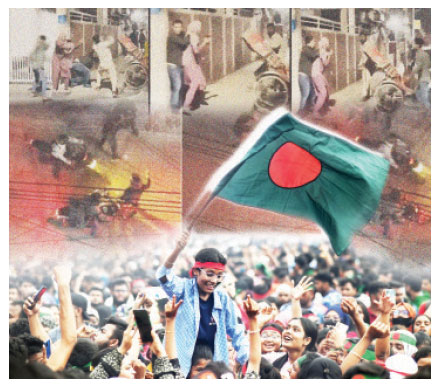
The price of the July uprising was paid in blood: over 1,400 protesters were killed and more than 20,000 injured. The globally condemned brutal suppression by state forces, later named the “July Massacre”, shattered the illusion of stability under Hasina’s regime. In the aftermath, an interim government led by Nobel laureate Muhammad Yunus was installed to steer the nation towards democracy, good governance and reform. But the government’s claim to work hard for bringing about necessary reforms is belied by its course of action. Instead of ushering in progress, the interim government has become a symbol of paralysis and broken promises.
The Economy in Collapse
The Bangladeshi economy is now in free-fall. The International Monetary Fund (IMF) has projected Bangladesh’s inflation to remain elevated, reaching 10% in FY25, while the Asian Development Bank (ADB) warned that the 12-month average inflation is feared to rise further to 10.2%. Commodities once considered staples — rice, lentils, cooking oil — have become unaffordable luxuries for millions. The alarming part is that enduring inflation remains a significant hurdle due to market inefficiency brought on by regulatory shortcomings, restrained competition in wholesale markets, insufficient market information and supply chain constraints.
Moreover, the unemployment rate, according to the Bangladesh Bureau of Statistics (BBS), has surged to its highest level (4.63% in the October–December quarter of the current fiscal year) amid ongoing economic and political instability. As said by the 13th ICLS (International Conference of Labour Statisticians), there are currently 26.1 lakh unemployed people, which represents a 206,000 increase from the previous year.
Meantime, a staggering 40% of the youth are classified as NEET (Not in Education, Employment, or Training), fuelling resentment, despair and a dangerous sense of purposelessness among the nation’s most vital demographic. Economists blame the increase in unemployment on factors like high inflation, a bad investment climate and rising bank interest rates that have deterred job creation and business expansion.
Corruption Worse Than Ever
One of the central demands of the uprising was to eradicate endemic corruption. But if anything, the rot has deepened. Bribery, extortion and nepotism remain rampant across government institutions. The Transparency International Index continues to place Bangladesh among the most corrupt countries in the region, with no visible change under the new regime.
Despite the promise of a cleaner administration, the interim government has done little to dismantle the entrenched networks of political favouritism and elite control. Reportedly, the market cap of Bangladesh Securities and Exchange Commission (BSEC) has lost nearly Tk 90,000 crore since Khandaker Rashed Maqsood took office. On the other hand, BNP Standing Committee member Mirza Abbas, a few days ago, claimed that Tk90,000 crore was laundered over the past eight months. Relatives of many advisers have started businesses. There are also allegations of bribery.
Fractured Foreign Relations
Political instability has damaged Bangladesh’s global standing. Trade with key partners like India and China has slowed amid concerns over policy unpredictability and bureaucratic gridlock. The United States, once a vocal supporter of democratic transition, imposed a punitive 37% reciprocal tariff on Bangladeshi exports in April 2025— crippling the country’s already fragile garment sector. With investor confidence evaporating and diplomatic relations cooling, the vision of a prosperous Bangladesh integrated into the global economy seems increasingly out of reach.
Lack of Transparency and Accountability
While the government’s failure to curb mob justice incidents raises many eyebrows, the filing so-called ‘gayebi mamla’ (fictitious or fabricated cases) and arresting innocent people, including businessmen and celebrities, intending to harass them put a big question mark on government’s control over the law and order situation and ensure transparency and accountability. It seems that instead of being guided by principles, the interim government has taken the populist path.
For example, we cannot but fear when we see actress Nusraat Faria being arrested without any valid reason and when Mostofa Sarwar Farooki, the cultural affairs advisor to interim government, writes on his facebook wall, “Perhaps these incidents are occurring out of nervousness following the anger expressed over the foreign travel of former president Abdul Hamid of the Awami League government”. People did sacrifice their lives to ensure that no one would be arrested baselessly, if no involvement is found during the preliminary investigation. Unfortunately, the government has largely failed to ensure that because it is “struggling with its moral and political direction”, as said British journalist David Bergman.
Interim Government’s Ulterior Motives?
What was supposed to be a caretaker administration now looks like a technocratic elite clinging to power without delivering results. Critics argue that the interim government is not interested in a rapid transition to elections or democratic legitimacy. Instead, it appears to be consolidating control, delaying reforms and governing without a clear mandate from the people. Civil society leaders are warning that this drift may soon ignite a second wave of protests—one far more explosive and disillusioned than the first.
A Generation Betrayed
The students who risked and sacrificed their lives for change now feel betrayed. “Nothing has changed,” one protester wrote on social media. “The faces are different, but the system is the same. Or worse,” penned another.
Bangladesh is now a nation suspended in crisis— betrayed by its past and uncertain of its future. Without bold, immediate reforms and a return to accountable and inclusive governance, the country risks sliding into a deeper abyss. The July uprising was not just a protest; it was a plea, a cry for justice, dignity and hope. Today, that cry goes unheard.
_____________________________________
The writer is an Editorial Assistant at the Daily Sun