



 For all latest news, follow the Daily Sun's Google News channel.


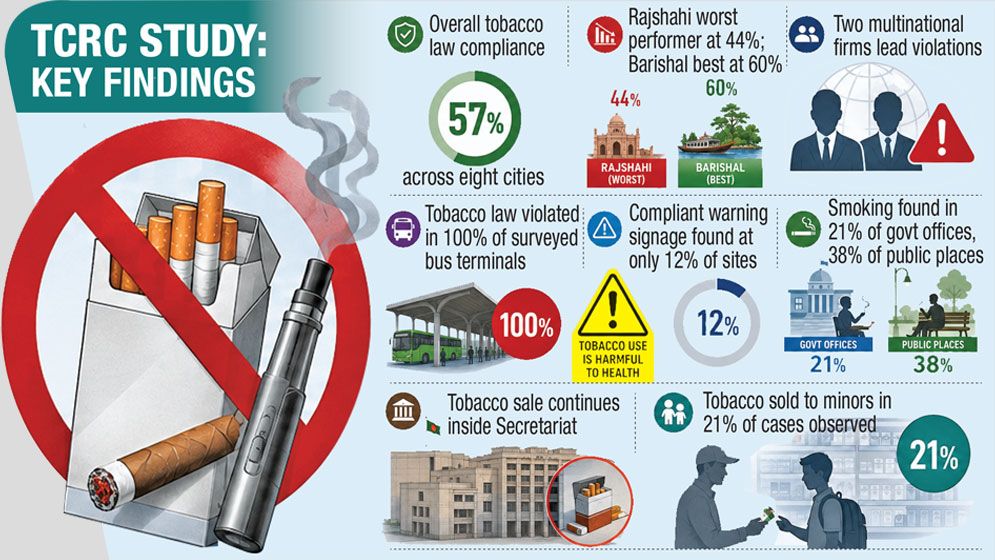
Tobacco control laws are being violated on a mass scale across Bangladesh, with enforcement weakening even as multinational cigarette companies aggressively defy marketing restrictions, a new study has revealed.
The research, conducted by the Tobacco Control and Research Cell (TCRC) at Dhaka International University, found overall compliance across the country’s eight divisional cities stood at just 57%. Barishal recorded the highest enforcement rate at 60%, while Rajshahi fared worst at 44%.
Researchers said aggressive corporate non-compliance, led by two multinational tobacco firms, was severely undermining control efforts, compounding widespread gaps in enforcement on the ground.
Conducted between February and July 2026, the survey assessed compliance with the Smoking and Tobacco Products Usage (Control) (Amendment) Act, 2026 at 1,591 locations, comprising 501 public places, 199 public transport units and 891 points of sale, spread across Dhaka, Chattogram, Rajshahi, Khulna, Barishal, Sylhet, Rangpur and Mymensingh.
The findings were unveiled on Monday at a Dhaka hotel, at an event titled “Current Status of Tobacco Control Law Implementation in Eight Divisional Cities of Bangladesh.”
Farhana Zaman Liza, TCRC project coordinator, presented the results, with Md Bazlur Rahman, project director and associate professor at DIU, moderating.
Compared with the previous year, compliance fell by 19% in Khulna, 18% in Rangpur, 11% in Rajshahi, 10% each in Dhaka and Sylhet, and 5% in Chattogram.
Only 21%-27% of public places surveyed were designated smoke-free, and legally compliant “No Smoking” signage was found at just 11%-12% of sites.
Active smoking was recorded in 36%-38% of public places and 31% of transport units, while every bus terminal visited and 75% of hospitals had smokers present.
Government offices fared little better, with active smoking observed in 21% of premises and tobacco sales continuing inside 18% of office complexes; none had designated smoking zones.
Points of sale have become tobacco firms’ main marketing battleground, the study found, with 78%-91% of retail outlets running active advertisements or brand promotions, and product displays visible in 90%-93% of shops.
Three-quarters of tea stalls displayed branded racks supplied directly by tobacco companies. Tobacco was sold to minors in 21% of cases observed, while 4%-19% of the clerks making sales were themselves underage.
Speaking at the event, tobacco control advocates Md Mostafizur Rahman and Syed Mahbubul Alam Tahin said the law offered a robust framework but was being undermined by weak field-level implementation, calling for inter-ministerial coordination, routine monitoring and mobile court enforcement.
Chief guest Sheikh Momena Moni, additional secretary at the health ministry’s World Health Wing, pledged a high-level meeting with stakeholder ministries to streamline enforcement.
She promised the National Tobacco Control Cell’s digital monitoring system would launch within a month, alongside mobile court drives to ban tobacco sales within 100 metres of schools, colleges and hospitals.
Acknowledging that cigarettes are still being sold inside the Bangladesh Secretariat, she directed NTCC director general Md Akhtaruz-Zaman, who was present, to organise an anti-tobacco mobile court there without delay.
Officials from Railways, Dhaka South City Corporation, BIWTA and the Dhaka civil surgeon’s office also spoke, pledging to strengthen their organisations’ anti-tobacco drives.
The study recommended mandatory compliant signage everywhere, frequent mobile court operations, a complete ban on point-of-sale advertising and displays, stricter penalties for tobacco sales involving minors, and coordinated action among local government, health bodies, law enforcement and civil society.