



 For all latest news, follow the Daily Sun's Google News channel.


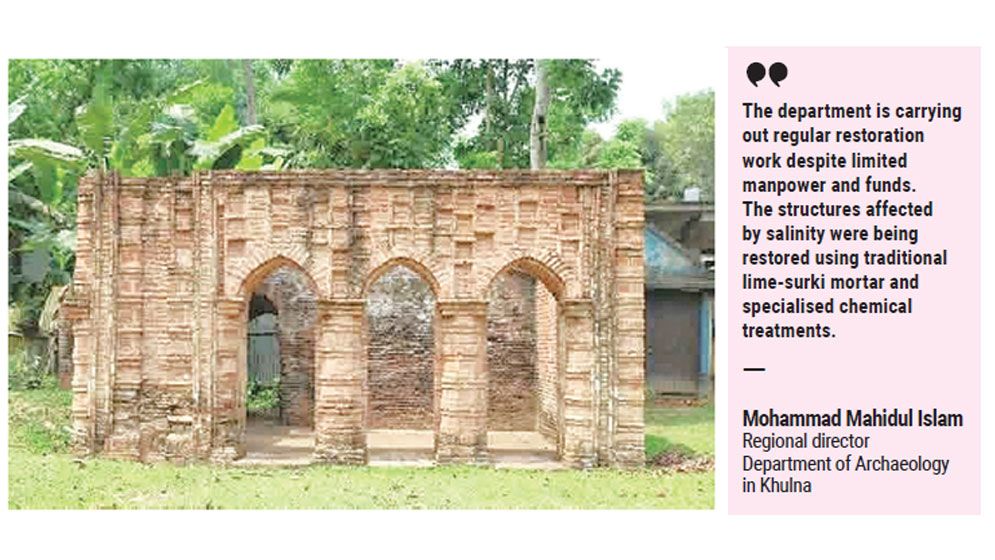
Khulna division’s centuries-old archaeological heritage sites are increasingly under threat from salinity, humidity, neglect, encroachment and inadequate conservation measures.
According to the Department of Archaeology, 105 antiquities across the division’s 10 districts are officially protected or listed in government gazettes. However, many ancient structures and archaeological sites remain outside the official list and are vulnerable to deterioration and encroachment due to inadequate monitoring and conservation.
The coastal districts of Khulna, Bagerhat and Satkhira are particularly vulnerable to salinity and excessive humidity. Historic structures, including the UNESCO World Heritage-listed Sixty Dome Mosque in Bagerhat, Kodla Math in Jatrapur and Moshjidkuri Mosque on the bank of the River Kapatakkha in Koyra are reportedly being affected by saline air and soil.
Researchers said a lack of modern, scientific restoration techniques was making it difficult to address the growing impact of climate change on ancient structures. The situation is more precarious for unprotected sites. The historic Charli’s Indigo Factory (Nilkuthi) on the bank of the River Bhairab in Khulna city is reportedly deteriorating due to a lack of proper conservation.
In several districts, the absence of boundary walls and regular monitoring has also allegedly facilitated encroachment. Old bricks are being removed from some heritage structures, while illegal buildings have reportedly been constructed on archaeological land in other areas.
Against this backdrop, the Khulna regional office of the Department of Archaeology has intensified surveys and excavation activities to identify and conserve archaeological sites.
Between January and April this year, surveys in Mohammadpur, Shalikha and Sreepur upazilas of Magura identified 68 ancient sites and structures. Four important sites, including the historic Grand Trunk Road, have been prioritised for conservation.
Excavations at the Damdam Pir Sthan mound in Keshabpur, Jashore, and the Jhurijhara mound in Tala, Satkhira, have also uncovered remnants of ancient Buddhist temples. Authorities are working to include the sites on UNESCO’s Tentative List of World Heritage Sites. The Khulna Divisional Museum at Shibbari intersection in Khulna city preserves ancient coins, terracotta plaques and sculptures through six galleries. Authorities are also introducing Braille facilities and digital exhibitions with sign-language support to make the museum more accessible.
Abdur Rahman Milton, convener of the Ila Mitra Memorial Preservation Council, said many historic and archaeological sites, including those associated with Tebhaga movement leader Ila Mitra, remained unprotected.
“Merely including them on official lists will not be enough,” he said, calling for immediate conservation measures involving local social and cultural organisations and greater efforts to familiarise young people with the sites’ historical significance.
Mohammad Zayed, curator of Bagerhat Museum, said restoration work and surveys to identify new archaeological sites were continuing despite manpower and budget constraints.
He said special attention was being given to damage caused by coastal salinity and that unprotected structures would gradually be brought under official conservation following surveys.
Mohammad Mahidul Islam, regional director of the Department of Archaeology in Khulna, said the department was carrying out regular restoration work despite limited manpower and funds.
He said structures affected by salinity were being restored using traditional lime-surki mortar and specialised chemical treatments. With assistance from district administrations, boundary demarcation and construction of boundary walls were also being undertaken at vulnerable sites to prevent encroachment.
He said surveys were being conducted to identify both officially listed monuments and previously undocumented archaeological sites. The 68 sites identified in Magura were part of the initiative, while conservation work on four important structures had already begun.
He added that work was also underway to modernise the Khulna Divisional Museum and secure UNESCO World Heritage recognition for important archaeological sites in the region.