



 For all latest news, follow the Daily Sun's Google News channel.


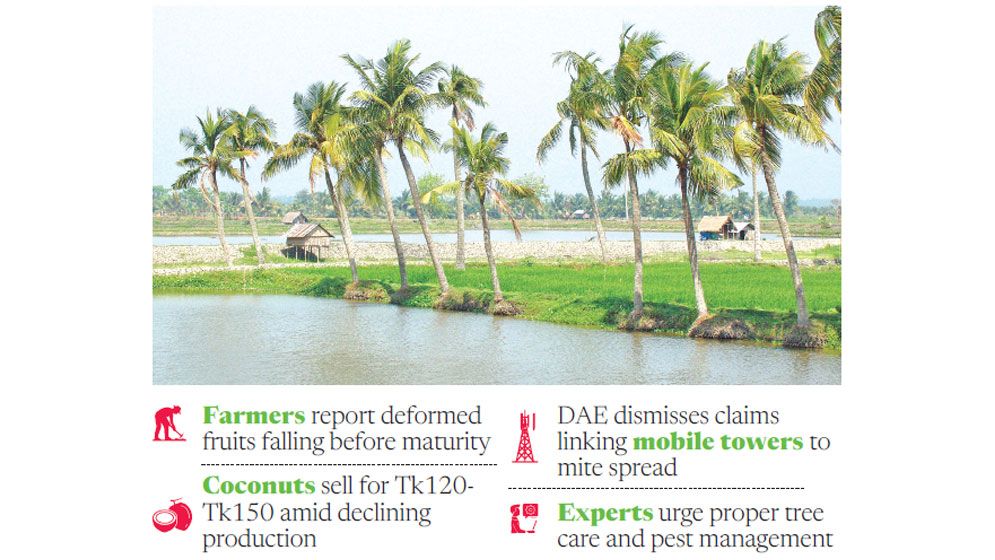
Coconut growers in Khulna, Bagerhat, Satkhira, Narail and Jashore are struggling to protect their trees from mite infestation, which is damaging young fruits and reducing yields across the region.
Farmers said the infestation leaves young coconuts deformed and covered with spots and blemishes. In many orchards, affected fruits are falling before reaching maturity, raising concerns among growers.
There was a time when rows of coconut trees lined village roads across southern Bangladesh, with vast stretches of cropland extending to the horizon. Although coconut trees remain a familiar feature of the rural landscape, many now produce far fewer fruits than before.
Md Nazrul Islam, deputy director of the Department of Agricultural Extension (DAE) in Khulna, said rising temperatures linked to climate change, along with attacks by white mites and whiteflies, were reducing flowering and fruit production.
He said the Khulna region was well suited to coconut cultivation but identified declining water levels and farmers’ limited knowledge of the proper use of miticides as key concerns.
Nazrul Islam said coconut trees can help maintain groundwater levels, prevent soil erosion and act as windbreaks, reducing the impact of storms and cyclones.
Farmers said declining production had contributed to a shortage of coconuts in local markets, where each fruit now sells for Tk120 to Tk150. Agricultural researcher Dr Md Ataur Rahman said coconut trees could grow in saline-prone areas with relatively little care and without heavy reliance on chemical fertilisers and pesticides.
He said coconuts and other parts of the tree provide raw materials for a wide range of products, including beverages, edible oil, cosmetics, soap, food items, timber, brooms, mattresses and handicrafts. Coconut shells are also used to make household utensils, crockery and buttons, supporting various small, medium and large industries. Md Azadul Sana, a farmer from Ghugrakati village in Koyra upazila of Khulna, said mites had infested most of the coconut trees in his orchard, damaging both the fruits and the trees.
Another grower, Abdul Hamid Moral, said young coconuts were becoming deformed and falling before maturity. The problem, he added, had persisted for several years. Farmers alleged that they had repeatedly informed DAE field officers about the infestation, but the advice they received had failed to protect their trees and fruits.
Some growers blamed mobile phone towers for the decline in fruit production, claiming they contributed to the mite problem. However, Md Towhidin Bhuiyan, additional deputy director and plant protection specialist at the DAE in Khulna, dismissed the claim, saying mobile phone towers had no role in the spread of mites.
Md Nazimuddin, an information officer at the DAE in Khulna, said some farmers were ignoring advice from agricultural officials and instead following recommendations from fertiliser and pesticide dealers, contributing to their losses. Towhidin Bhuiyan said inadequate knowledge of coconut tree management was a major factor behind the spread of the infestation.
He advised farmers to take proper care of their trees, keep orchards clean and apply adequate organic or chemical fertilisers to improve yields. He also recommended using the miticide carbofuran to treat affected trees.