


 For all latest news, follow the Daily Sun's Google News channel.


Solar irrigation cuts costs, boosts farm income in Jhenaidah
Daily Sun Report, Jhenaidah
Published: 21 Sep 2026, 12:00 AM
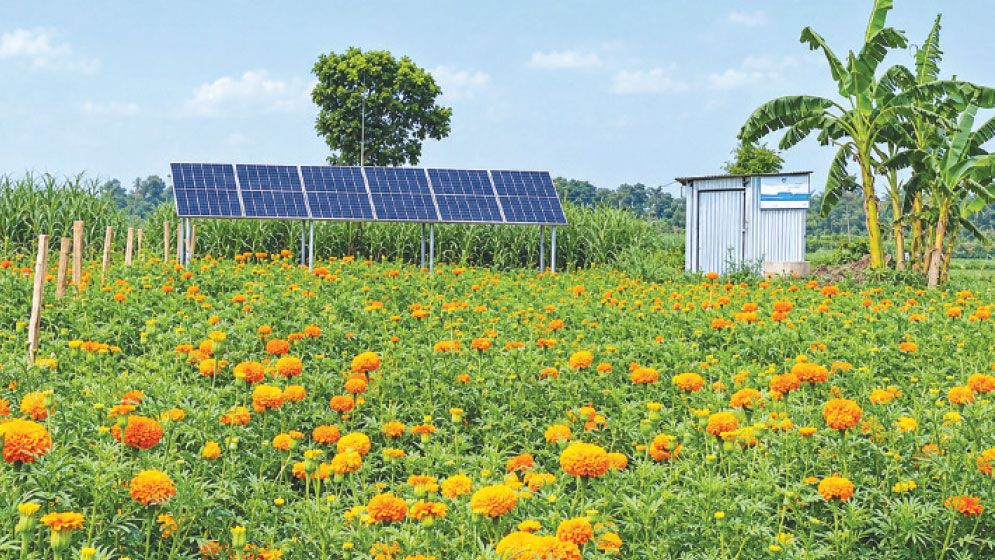
Solar-powered irrigation systems are gaining popularity among farmers in Jhenaidah as they help reduce irrigation costs and provide opportunities to earn additional income.
Habibur Rahman, a flower farmer in Jhenaidah Sadar upazila, previously relied on a diesel-powered irrigation system. This season, he installed a solar pump on his land at a cost of Tk1.7 lakh. He received a Tk45,000 grant from the Rural Reconstruction Foundation (RRF) under its SMART project to help install the system. Many other farmers across the district are also switching to solar-powered pumps, citing lower operating costs compared with diesel-powered irrigation systems. According to RRF, 36 solar pumps have so far been installed in Jhenaidah Sadar, Kotchandpur and Maheshpur upazilas. Of these, three are in Sadar, one in Kotchandpur and 32 in Maheshpur. More pumps are expected to be installed in other areas in phases. The pumps are being installed under the SMART project implemented by RRF with funding from the World Bank and technical assistance from the Palli Karma-Sahayak Foundation (PKSF).
Farmers said solar pumps allow them to irrigate their own fields at lower costs and provide an opportunity to earn additional income by supplying water to neighbouring farms. The initiative has created particular opportunities for flower growers in the border areas of Maheshpur.
Another flower grower, Gafur Mia, said he no longer needs to spend money on fuel or electricity for irrigation after installing the solar pump. “I can irrigate my own land and also earn additional income by supplying water to other farmers,” he said. RRF Senior Assistant Director Agriculturist Dr Asit Baran Mondal said 36 solar pumps have already been installed under the SMART project with PKSF support, while more than 100 additional pumps are planned. “Previously, irrigating one bigha of land cost around Tk400–500. With solar pumps, the cost is about Tk200,” he said.
The technology will reduce irrigation costs while also helping lessen the environmental impact of conventional fuel-based irrigation, he added.