


 For all latest news, follow the Daily Sun's Google News channel.


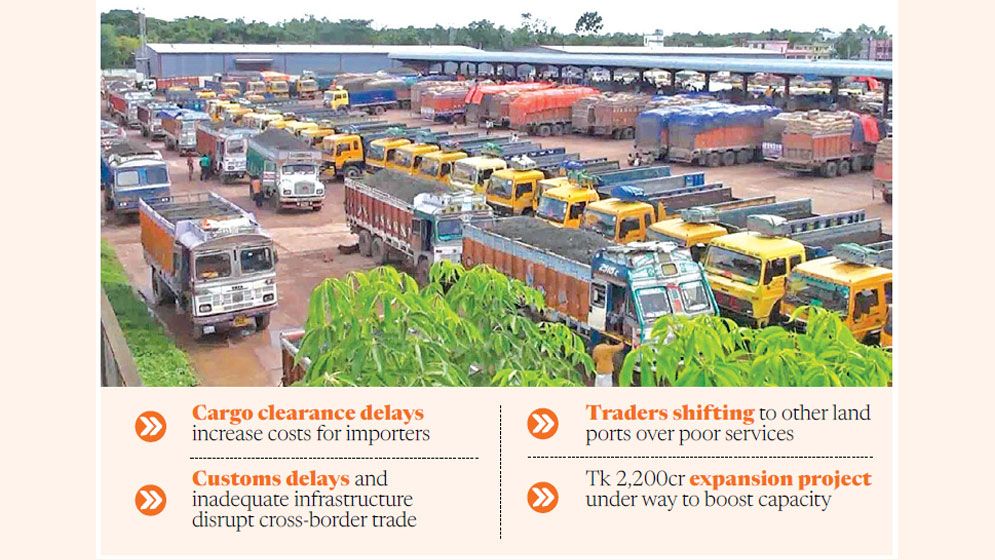
Importers at Bhomra Land Port in Satkhira are facing growing difficulties due to persistent operational bottlenecks in cargo clearance and transportation, driving up business costs and slowing cross-border trade.
According to traders and clearing and forwarding (C&F) agents, lengthy queues at the weighbridge, delays in customs assessment and document verification, inadequate truck parking facilities, labour shortages, slow loading and unloading operations, local extortion and inefficient transport management have significantly disrupted the port's normal operations.
They also alleged that differences in customs procedures between Bangladesh and India have further slowed the movement of goods across the border.
Although the port has undergone expansion over the years, traders said the absence of modern infrastructure and essential facilities has prevented it from operating at its full potential.
They said delays in cargo clearance increase transportation costs, labour expenses, port charges and other operational costs, prompting many importers to shift their business to other land ports that offer quicker and more cost-effective services.
Importer Anwar Hossain described Bhomra as a highly promising land port that has long suffered from poor management and inadequate infrastructure.
“The shortage of weighbridges, slow cargo handling, lack of truck parking space and mechanical problems with loading equipment have made business increasingly difficult for importers,” he said.
“If goods cannot be cleared promptly after arriving at the port, importers have to bear additional expenses. As a result, many traders are losing interest in using Bhomra. Faster customs services, modern management and improved infrastructure are essential to restore confidence.”
Another importer, Md Mohsin, said complex clearance procedures and rising operational costs were among the main reasons behind the decline in imports through Bhomra. “Businessmen naturally prefer ports where cargo can be cleared quickly at lower cost,” he said.
“Here, truck congestion, labour shortages, delays in loading and unloading, and lengthy customs procedures are causing financial losses. Many importers are therefore shifting to other ports.”
He urged the authorities to introduce automation, install modern cranes, build truck terminals, strengthen security and ensure emergency services to reduce costs and improve operational efficiency.
He also called for the installation of modern cargo scanning systems, additional weighbridges, better labour management and faster customs processing to attract traders back to the port. Leading importer-exporter Dipankar Ghosh said automation was now the port's most urgent requirement.
“Many processes are still handled manually, which consumes valuable time,” he said.
“There is also a shortage of modern cranes for cargo handling, insufficient truck sheds, and inadequate fire safety, accommodation and medical facilities. A major land port cannot function efficiently without these basic services.”
He added that connecting Bhomra to the national railway network would create new opportunities for trade. “A railway link from Satkhira to Bhomra would reduce transportation costs, save time and ease road congestion, ultimately boosting trade and increasing government revenue,” he said.
People involved in port operations said transportation costs at Bhomra remain comparatively higher than at other land ports.
While traders importing certain products through other ports receive incentives or benefit from lower operating costs, similar facilities are unavailable at Bhomra. Higher truck fares, labour charges and port fees have further increased the financial burden on importers, particularly those dealing in perishable goods and raw materials.
Shariful Islam, a C&F agent, said traders at many other land ports enjoy various incentives, but businesses operating through Bhomra receive no such support. “Truck hire charges, labour costs and port fees are all relatively high here,” he said.
“As a result, many traders incur losses instead of making profits and eventually move to other ports. To keep Bhomra competitive, infrastructure must be improved, operating costs reduced and cargo clearance expedited.”
Ramkrishna Chakraborty, president of the Bhomra Port Importers and Exporters Association, said the current situation was alarming not only for traders but also for government revenue.
“The slowdown in trade has created serious challenges. Import and export volumes have declined, reducing revenue collection, investment and employment opportunities,” he said.
“Many traders and businesses associated with the port are suffering heavy financial losses. Bilateral tensions have also affected trade from time to time. We urge the government to take prompt policy decisions and improve infrastructure to restore the port's commercial activities.”
He said the port has enormous revenue potential, but infrastructure deficiencies, delays in cargo clearance, high operating costs and administrative complications are preventing it from reaching that potential.
“Automation, truck terminals, modern equipment and improved security systems are urgently needed. These measures would revitalise the port, create employment opportunities and increase government revenue.” Despite repeated attempts, officials of the Bhomra Customs House declined to comment on the allegations.
However, Md Ashikul Islam, assistant director (Traffic) of Bhomra Land Port, said a Tk2,200-crore expansion project was currently under way to enhance the port's capacity. He said land acquisition and sand filling had already been completed, although some construction work had been delayed due to funding constraints. “Construction of warehouses and several other infrastructure facilities will begin soon,” he said.
“Once the project is completed, cargo handling problems will be significantly reduced. Traders will be able to import and export goods more quickly and efficiently. We expect the ongoing development work to improve operational efficiency and benefit the business community.”