




 For all latest news, follow the Daily Sun's Google News channel.


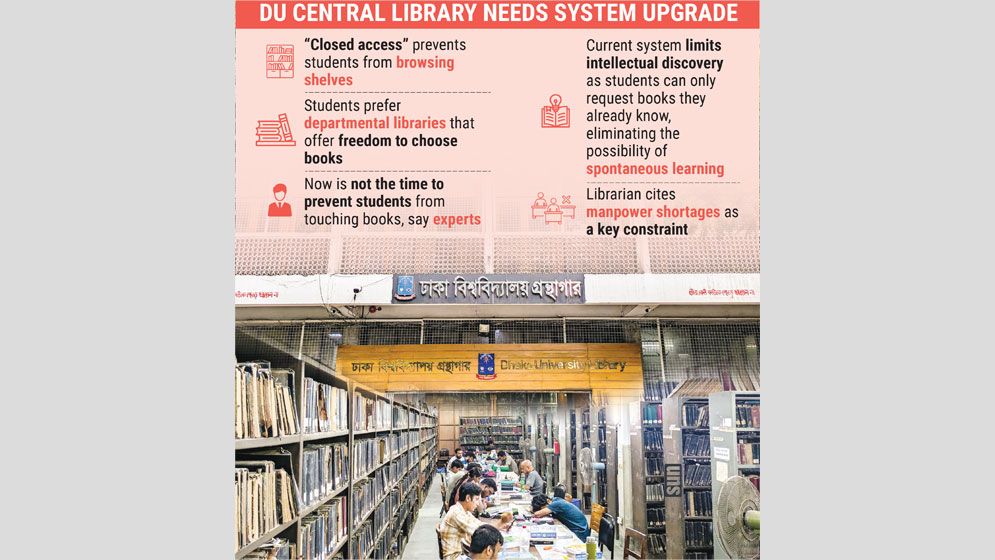
Students at Dhaka University (DU) are increasingly turning away from the Central Library as restrictive and outdated rules limit their access to books, raising concerns about barriers to learning in one of the country’s largest academic repositories.
The DU Central Library, which houses more than 7 lakh books, operates under a “closed access” system that prevents students from browsing shelves or directly handling books. Instead, students must write down the name of a specific book on a slip, after which library staff retrieve it for them.
Many students say this system discourages them from using the facility.
Ayesha Siddika Tamanna, a student of the Political Science Department, said she prefers reading at Pathak Samabesh at Shahbagh, where readers can freely browse and select books.
“I like choosing books from the shelves. Sometimes, even flipping through a book can spark interest. But there is no such opportunity in the Central Library,” she said.
Similar frustration is echoed among other students. Mohammad Shaheen Alam, a postgraduate student from the Development Studies Department, said the rules feel unusual by global standards.
“There are some strange rules that do not seem to exist in any other university library in the world,” he said.
Physically, the system reflects these restrictions. A separate book room remains off-limits to students, with entry blocked and controlled by staff. This denies students the experience of exploring books independently — something one student described as “the joy of walking in the kingdom of books”.
As a result, many students rely on their departmental libraries, where they can directly access shelves.
Saidul Islam from the English Department said students prefer departmental libraries because they offer freedom to choose books. Students from the Sociology Department, the Law Department, and the Institute of Education and Research shared similar views.
Library authorities, however, defend the system on grounds of discipline and security. They argue that allowing open access may lead to misplaced books and disorganisation. However, experts reject this reasoning.
Prof M Shariful Islam, from the Institute of Information Technology said modern technologies such as CCTV and RFID systems can easily address such concerns.
“Now is not the time to prevent students from touching books. Increasing the distance between books and students in the name of modernisation will hinder knowledge acquisition,” he said.
The current system also limits intellectual discovery. Students can only request books they already know by name, eliminating the possibility of spontaneous learning through browsing.
Beyond access issues, students have also complained about the library environment. Several reported unpleasant experiences due to foul smells from the toilets, which discourage them from returning.
Acting Librarian Prof Kazi Mostak Gausul Hoq told the Daily Sun, the library has long followed the closed access system and cited manpower shortages as a key constraint.
“If students do not return books to their proper places, the system may become chaotic. Moreover, we do not have enough manpower,” he said, adding that there are plans to gradually introduce partial open access and improve services through digitalisation.
ICT Cell Director Prof Mosaddek Kamal Tushar described the current system as incompatible with modern needs.
“Automation has created an invisible wall between books and students. The issue needs to be reconsidered,” he said.
Vice-Chancellor Prof ABM Obaidul Islam said the university administration will discuss the matter and take necessary steps. Plans to build a modern library are also included in the university’s mega project.
For many students, however, the fundamental question remains: whether a library that restricts access to its books can truly serve its purpose as a centre of knowledge, or whether it risks becoming little more than a repository for preservation.
The reporter can be reached at: [email protected]
Read More