


 For all latest news, follow the Daily Sun's Google News channel.


Barrister Sara Hossain questions legitimacy of Referendum and Consensus Commission
She said the commission cannot be considered a democratic process in any way
Daily Sun Report, Dhaka
Published: 22 Apr 2026, 08:56 AM
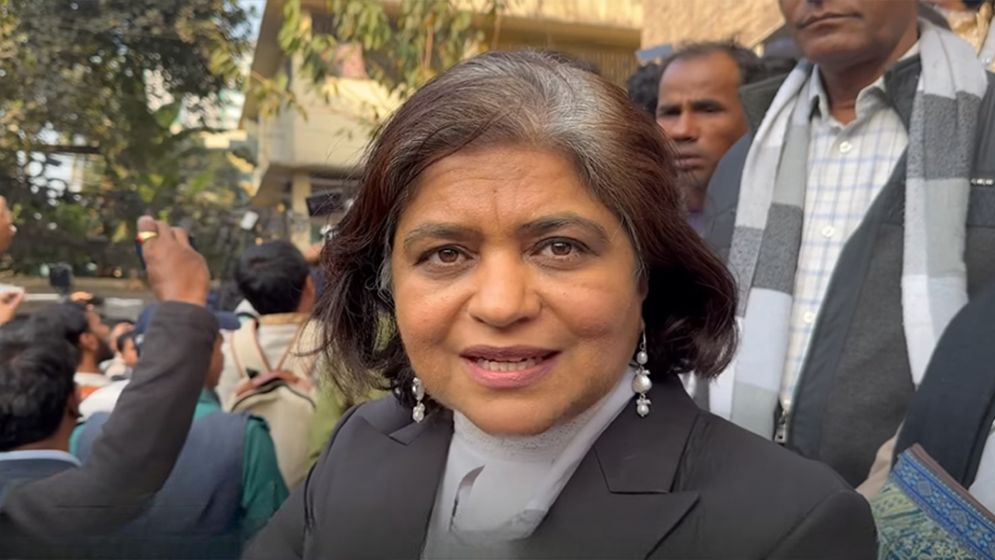
Senior Supreme Court lawyer Barrister Sara Hossain. Photo : Collected
Senior Supreme Court lawyer Barrister Sara Hossain has raised questions about the legitimacy of the National Consensus Commission formed by the interim government for state reforms, as well as the referendum held based on its proposals.
She said the commission cannot be considered a democratic process in any way. Regarding the referendum, she stated that voters had little understanding of the questions.
“If I do not know what I am voting for, then what value does that vote really have?” she said.
Sara Hossain made these remarks on Tuesday at a roundtable discussion titled “Judicial Independence and Reform: Constitutional Obligations, Court Directives, and Public Expectations” held at the National Press Club.
The event was organized by Shujan (Citizens for Good Governance). Its secretary, Dr. Badiul Alam Majumdar, was a member of the National Consensus Commission.
Speaking about the Consensus Commission, the July Charter, and the referendum, she said, “I hold a slightly different view. It is repeatedly being said that we must uphold the July Charter and the results of the referendum.”
Referring to comments by Badiul Alam Majumdar that the process was democratic, she said, “Your Consensus Commission cannot be described as democratic in any way. It was a selective process. A few people sat together and made decisions—where was the democracy in that? Who from outside had the opportunity to speak? No one.”
She added, “You made decisions among a few people. Where was democracy in that process? Who from outside could contribute? No one.”
Expressing frustration over the lack of female representation in the interim government’s reform commissions, she said, “There was not a single woman in the commission, yet it was discussing the entire judicial system. We have some women judges and many women seeking justice, but they were not included.”
“We support the interim process, but we must acknowledge that many people were excluded from it,” she added.
She also commented that the public had little understanding of the third question in the referendum held on February 12 alongside the national election.
The third proposal in the referendum included provisions such as increasing women’s representation in parliament, appointing a deputy speaker from the opposition, selecting parliamentary committee chairs from the opposition, limiting the prime minister’s tenure, expanding the president’s powers, broadening fundamental rights, ensuring judicial independence, and strengthening local government—based on 30 proposals agreed upon in the July National Charter.
Addressing participants at the roundtable, Sara Hossain asked, “Raise your hands—how many of you can say what those 30 proposals were? I don’t think you knew what you were voting for.”
She added, “This is a fundamental question—when you vote, do you know what you are voting for? Yes, you may know ‘yes’ or ‘no’, but if you don’t understand the issue, what value does that vote have?”
She also spoke about the Supreme Court Secretariat Ordinance and the Supreme Court Judges Appointment Ordinance. On judicial independence, she said, “We all want the judiciary never to be used as a tool of the executive again. Regardless of political identity, all litigants should receive justice. These two laws were very important. They created standards for evaluating judges’ qualifications, experience, and competence, which did not exist before.”
Highlighting the importance of an independent Supreme Court Secretariat, she said, “Due to the lack of financial independence, the judiciary has suffered greatly. Even to purchase a simple pen drive, a judge had to go through a lengthy approval process. They must be freed from this situation. Full control of the judiciary, including its staff, should be in the hands of the Supreme Court.”
Referring to past incidents, she cited the forced departure of former Chief Justice S.K. Sinha during the Awami League government, noting that civil society has not raised sufficient demands for accountability.
She also mentioned that after the July uprising, several Appellate Division judges of the Supreme Court were compelled to resign under pressure from student protests. Some competent judges were suddenly removed following these demands.
Referring to former Chief Justice A.B.M. Khairul Haque, she said, “Many of you may not like him, especially for his controversial verdict on the 13th amendment. But he has been in jail for months. He is not imprisoned for writing a judgment—he has been implicated in a July killing case. Even after all this time, no charge sheet has been filed proving he directly ordered or carried out any shooting. He has been falsely implicated, yet civil society remains silent.”
She further added, “In the past, judges often had to look behind them while delivering verdicts to see if intelligence personnel were watching. When Justice Sinha left the country, I believe it was due to such pressure. Similarly, those who resigned may have faced intimidation. We must move beyond this situation.”
The keynote paper at the discussion was presented by retired Justice M.A. Matin. Others who spoke included Justice Moinul Islam Chowdhury, lawyer Imran Siddiqui, and Fahim Mashrur. The session was moderated by Shujan secretary Badiul Alam Majumdar.