



 For all latest news, follow the Daily Sun's Google News channel.


In Trump’s pardons for public officials, Republicans win most of the mercy
Reuters, Washington
Published: 13 Oct 2026, 10:32 PM
In October 2024, a federal jury in Las Vegas convicted
Michele Fiore, a local elected official and ardent supporter of President
Donald Trump, of charity fraud. Fiore, the jury found, solicited donations for
a slain police officer’s memorial and spent nearly $80,000 of it on plastic
surgery, her daughter’s wedding and rent.
The jury deliberated for less than two hours, including a
lunch break, before finding Fiore guilty on seven charges brought by the
Department of Justice.
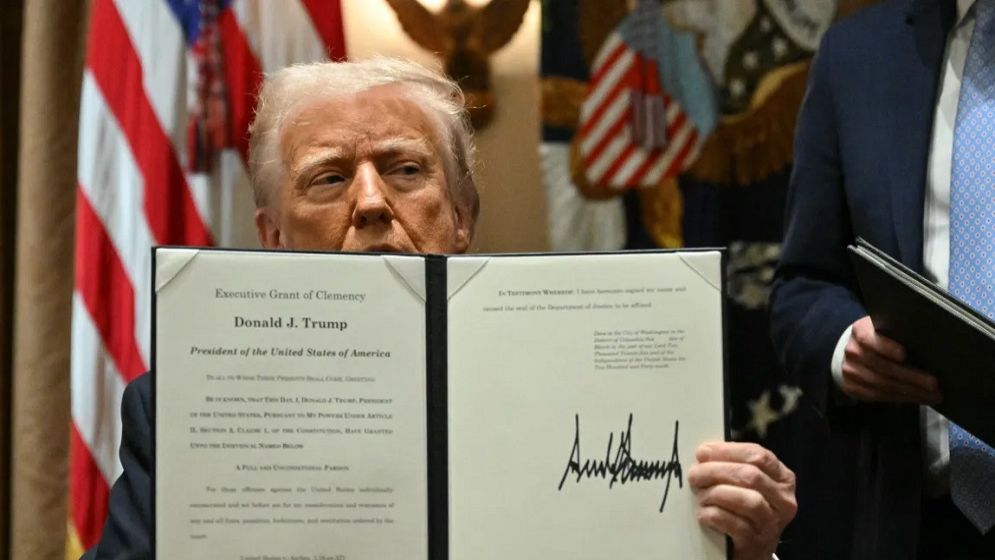
Weeks before she was to be sentenced last year, Trump granted Fiore “a full and unconditional pardon,” sparing her the prospect of decades in prison, payment of criminal fines, and any restitution to donors whose funds she misspent. In a statement at the time, a White House spokesperson noted Fiore’s support for the president and said that Biden-era prosecutors had targeted the politician, known in Nevada as “Lady Trump,” because of “outspoken conservative views.”
In an email to Reuters, Fiore criticized prosecutors and
witnesses and maintained her innocence. “I have never taken one red cent of
donations for my personal use,” she wrote. She declined to answer detailed
questions about her career, case and conviction.
Fiore is one of at least 85 public officials granted
clemency by Trump after charges or convictions related to corruption, according
to the first comprehensive examination of such measures over the president’s
two terms in office so far. The Reuters review shows that the political impetus
behind Fiore’s pardon wasn’t an outlier: The recipients of Trump’s clemency for
public officials overwhelmingly have been fellow Republicans or vocal
proponents of his MAGA movement.
They include at least 11 of 15 Republican members of
Congress convicted of wrongdoing over the past two decades. Of the 85 public
officials identified in Reuters’ analysis, 36 were elected as Republicans and
another 19 were Republicans appointed to political office. Nine others had
either campaigned for Trump or publicly espoused support for his agenda. Only
four were known Democrats, including one Texas congressman whom Trump erroneously
believed would switch parties after the pardon. The news agency couldn’t
determine partisan affiliation for the 17 other officials.
Trump’s repeated acts of clemency for public officials
charged with or convicted of corruption-related crimes have led to what more
than a dozen current and former prosecutors, along with other legal experts and
political researchers, say is impunity for people meant to uphold the public
trust. The impunity, these people said, can encourage more wrongdoing by other
officials, eroding the foundational democratic concept that no one, no matter
what office they hold, is above the law. The problem, they added, is compounded
if the concept of clemency is tainted by perceptions of partisan or personal
bias.
“President Trump is trying to end accountability for public
officials,” said Phillip Halpern, a retired assistant US attorney in San Diego
who prosecuted two Republican congressmen Trump later pardoned. “He’s setting a
standard to encourage corruption and allow it to flourish.”
Trump’s absolution has allowed nearly three-quarters of the
85 officials in Reuters’ analysis to leave prison early, evade trials or
sentencing, or regain eligibility to exercise certain freedoms, like owning a
gun. In total, the analysis found, these people were spared 130 years behind
bars and avoided payment of more than $15 million in financial penalties. More
than half of the recipients have remained in politics either as public
officials or as vocal supporters of Trump and his agenda. That includes Fiore,
who isn’t working but is still earning a government salary as a Nevada county
justice of the peace.
Noting his own indictments by federal prosecutors during the
presidency of Joe Biden, Trump has said he aims to right wrongs by a DOJ that
he has claimed – repeatedly and without evidence – targeted innocent people for
partisan purposes. “I am your warrior,” he told a conservative gathering in
2023, while campaigning for re-election. “I am your justice. And for those who
have been wronged and betrayed, I am your retribution.”
Administration officials have repeatedly defended the
president’s use of the pardon power, granted by the Constitution and ample in
scope. Lauren Bis, a White House spokesperson, in a statement said Trump grants
clemency for “many Americans unjustly prosecuted by the Biden administration’s
weaponized Department of Justice.”
Reuters’ review encompassed clemency recipients who held an
elected or appointed government role or were employed in the civil or uniformed
services. Most were paid from government coffers. Recipients included seven
advisors to Trump, three DOJ officials, three governors, 10 state lawmakers,
two city council members, two judges and two sheriffs. Their charges and crimes
included fraud, bribery, conspiracy, racketeering, obstruction of justice and
others.
Reuters’ tally of public officials doesn’t include at least
18 active-duty military, police and government employees who were among those
charged with or convicted for storming the US Capitol on January 6, 2021. Before
Trump issued his blanket clemency for the roughly 1,500 people involved in the
riot, many of these 18 had used their official credentials to rally others
against the peaceful transfer of power after the 2020 election.
Some of Trump’s predecessors have also drawn fire for
controversial use of the pardon power, most recently Biden because of clemency
for his son, Hunter, convicted on federal gun and tax charges. Both Biden and
former President Barack Obama commuted more prison sentences than Trump, cutting
short the punishments of many non-violent drug offenders. But over his nearly
six years in office so far, Trump has granted far more pardons than any other
recent president, particularly through his mass clemency for the Capitol
rioters.
Sending signals
Earlier this year, Reuters examined the president’s upending
of the pardon process. In nearly 2,000 acts of clemency, Trump has forgone
longstanding practice of presidents working with the DOJ to evaluate who should
merit clemency. He has instead relied on a growing number of clemency
consultants who, leveraging close ties to the president or his inner circle,
advocate for would-be recipients.
The shift, the news agency found, has marginalized the DOJ,
where a series of guidelines shaped the process for more than a century and
sought to ensure that recipients admit guilt and espouse remorse before
receiving clemency. Among many of those whom Trump pardoned, Reuters found,
remorse has mostly been replaced by defiance, expressions of disdain for
prosecutors and courts, and a sense of victimization similar to that voiced by
the president himself.
Of the 85 public officials in the Reuters review, more than
three-quarters didn’t cooperate with prosecutors. Most neither pleaded guilty
nor publicly expressed remorse after their conviction.
Trump’s repeated pardoning of public officials, legal
experts say, is part of a broader weakening of the federal government’s tools
to fight corruption in the first place. Consider the administration’s
management of the DOJ’s Public Integrity Section, a prosecutorial office
established after the Watergate crisis to fight corruption and prevent the
politicization of criminal cases.
More than half of the public officials in Reuters’ review
were charged or convicted in cases prosecuted with involvement by the Public
Integrity Section. That team, based in Washington, numbered about 30 at the end
of the Biden administration. The squad now has just two full-time prosecutors,
according to four people familiar with the office’s operations. In addition to
several senior prosecutors in the unit who resigned in protest of new
department directives, others moved elsewhere in the DOJ.
Audrey Cook, a DOJ spokesperson, in a statement wrote that
the department “remains committed to identifying, investigating, and
prosecuting public corruption wherever the facts and the law warrant it.” She
added: “No one should mistake the President’s use of his constitutional pardon
authority for a change in the law or a license to engage in criminal conduct.”
At the Federal Bureau of Investigation, which historically
worked closely with the Public Integrity Section, Director Kash Patel last year
shut down an elite squad that focused on corruption and fired some of its
investigators. Patel claimed the squad, known as CR-15, was “weaponizing law
enforcement” in its investigation of false claims by Trump and Republican
lawmakers that Biden stole the 2020 presidential election.
FBI officials didn’t respond to requests from Reuters for
comment.
Changes like those to the Public Integrity Section have
slowed prosecution of corruption cases.
The DOJ generally charges hundreds of federal, state and
local officials with corruption-related crimes annually, according to summaries
the DOJ provided to Congress each year before Trump resumed office in 2025. But
so far in his second term, the DOJ hasn't disclosed the start of a single new
bribery case, according to a June study authored by two former anti-corruption
prosecutors and published by the University of California, Berkeley, School of
Law.
“Why would any prosecutor or FBI agent want to do this kind
of work now?” said Molly Gaston, one of the authors and one of several DOJ
veterans fired by the administration because of their involvement in Trump’s
prosecution. “It’s nothing but a career killer.”
For those convicted before the recent pullback in
prosecution, Trump’s pardons can be career revivers. And for Trump, the pardons
can generate goodwill that the recipients then redeploy on behalf of the
president and his agenda.
“If President Trump asks me to do just about anything, I’ll
do it,” said Rod Blagojevich, the former Illinois governor, a Democrat, who was
convicted last decade for crimes including his effort to sell Obama’s vacant
Senate seat.
Since leaving prison, and receiving a commutation and pardon
from Trump, Blagojevich has reemerged as a lobbyist, earning $50,000 this year
for helping a fugitive former Indiana city councilman seek a pardon, federal
lobbying records show. He is also busy promoting a forthcoming book, “Framed,
F*cked, and Freed,” relating his legal travails and featuring a blurb from
Trump calling Blagojevich’s conviction “a terrible injustice.”
Blagojevich told Reuters that Trump, during a phone call
after his pardon in 2025, said he would support a political comeback for the
former governor. Reuters couldn’t independently confirm the details of the
conversation.
“The signal he sends with the pardon power is: If you help
me personally, Donald Trump, I will help you personally, even if you engaged in
corruption,” said Rachel Barkow, a New York University law professor and
clemency expert.
‘A higher standard’
Some of Trump’s pardons, including Fiore’s, have prompted
outrage from pro-Trump partisans. Before Trump pardoned him last year, John
Rowland, a Connecticut Republican who served as a state lawmaker, congressman
and governor, had a rap sheet as a repeat offender.
In 2004, he pleaded guilty and served 10 months in prison
for accepting illegal gifts as governor. A decade later, he was sentenced to 30
months in prison for concealing payments for consulting he had done on behalf
of congressional candidates. That conviction included charges of conspiracy and
falsification of records.
“He obviously didn't learn his lesson,” said Christopher
Shays, a former Republican congressman who represented Connecticut for over two
decades, overlapping with much of Rowland’s time in Congress and the governor’s
mansion. “If you have public officials who believe they can get away with being
corrupt, there will be more corruption.”
When Trump pardoned Rowland in May of last year, neither the
president nor the White House gave a reason for the clemency or commented on it
publicly. Rowland, in a statement at the time, expressed gratitude but didn’t
detail the process that led to it. In an email to Reuters, he declined to
comment further.
As with the many others granted clemency by Trump, the paths
to pardons for some public officials lay through well-connected advocates who
have no ties to law or criminal justice. A Tennessee lawmaker and one of his
aides, for instance, was each sentenced last year to more than two years in
prison and fines of more than $20,000 for a bribery and kickback scheme using
taxpayer money. Trump gave them full pardons after a country singer vouched on
their behalf.
In 2019, local press reported that Cade Cothren, then an
aide to the speaker of the lower house of the Tennessee legislature, had texted
profane and racist messages to his boss and others, and said he used cocaine in
the General Assembly building. Cothren resigned as a result, and Glen Casada,
the speaker, relinquished his post but served out his term as a legislator.
Months later, prosecutors said, Casada and Cothren devised a
scheme to exploit a Tennessee fund that gives lawmakers money for
communications with constituents. In January 2021, the waning days of Trump’s
first presidency, the FBI raided the two men’s homes and Casada’s legislative
headquarters. Both men pleaded not guilty to federal charges including
conspiracy, bribery and fraud. In May 2025, a jury found that Casada helped
steer $52,000 in government funds to a company run under an alias by Cothren,
who in exchange paid Casada at least $7,100 in bribes and kickbacks.
Cynthia Sherwood, an attorney for Cothren, in a statement
asserted his innocence. Ed Yarbrough, Casada’s attorney, declined to comment on
the specifics of the case but said criticisms of the pardon, including from
Republicans, were based on “personal and political bias” and that “President
Trump did the right thing.”
By the time they were convicted, Trump was back in office
and had begun his campaign to reverse convictions he and associates deemed
politically motivated. Sensing the changing climate, attorneys and advocates
for Cothren and Casada began pressing contacts in Washington, three people
familiar with the effort told Reuters.
One of Cothren’s attorneys, two of these people said, had
once represented John Rich, a songwriter, singer and longtime Trump supporter
who had access to the White House. Rich, one of these people said, agreed to
speak to Trump on behalf of Cothren and Casada.
Days after their conviction, Rich posted on social media
that he “personally advocated” to Trump on Cothren’s behalf. Despite the case’s
origins during Trump’s first administration, Rich said the former speaker had
been “targeted by Biden’s DOJ” and “persecuted by the FBI.” Rich, through a
spokesperson, declined to comment.
In November 2025, Trump pardoned both men. In a statement at
the time, the White House said that the DOJ had “significantly over-prosecuted
these individuals for a minor issue.”
The pardon stunned even prominent Tennessee Republicans,
including Randy McNally, the state’s lieutenant governor. “I was taken aback by
the pardons and some of the comments made that they were innocent,” McNally
told Reuters in an interview. “Individuals that are elected to office should be
held to a higher standard.”
‘No political victim’
In one instance, Trump’s pardon of a public official
backfired politically.
A federal grand jury in Texas in 2024 indicted Democratic
Congressman Henry Cuellar and his wife on charges of accepting nearly $600,000
in bribes from an Azerbaijani energy company and a Mexican bank. For the first
year of Trump’s current term, prosecutors prepared for trial.
But in December 2025, Trump pardoned the Cuellars.
In a social media post at the time, Trump said prosecutors
had unfairly targeted Cuellar for “speaking the TRUTH” about problems with
Biden-era border policies. Cuellar didn’t respond to requests from Reuters for
comment.
As with almost every other act of clemency since Trump
returned to office, according to two people familiar with the matter, the White
House excluded prosecutors from any review before issuing the pardons.
Traditionally, the DOJ’s pardon attorney seeks feedback from the prosecutors
before recommending clemency.
To the dismay of Republicans, Cuellar later announced he
would seek reelection next month – and once again as a Democrat. The longtime
congressman, still popular in his district, could retain the seat, a victory
that could help Democrats regain control of the House of Representatives. In a
social media post last week, Trump spoke of a Texas trip to campaign for
Cuellar’s opponent. He called Cuellar “a disloyal and ungrateful person” and “a
LOSER who, right now, should be serving a longterm jail sentence.”
Fiore, the Nevada justice of the peace, was a vocal Trump
supporter even before she was arrested and charged with misappropriating
charity funds. A former state assembly member and Las Vegas city councilwoman,
she was well known for conflicts including a brawl in which she allegedly broke
the finger of a fellow councilwoman at Las Vegas City Hall.
In 2021, Fiore filmed a campaign video for an ill-fated run
for the Nevada governorship. The video came months after FBI agents raided her
home in January of that year, searching for possible irregularities in
financing for her city hall campaign, investigators later testified. Wielding a
handgun and driving a truck bearing a “Trump 2024” bumper sticker – well before
the president officially sought the White House again – Fiore in the video
fired at bottles labeled with MAGA targets like “vaccine mandates” and
“critical race theory.”
“The Joe Biden administration is coming after me,” she said.
“I’m ready for the fight.”
Her defense attorney, Michael Sanft, told Reuters that
Fiore’s vocal politics made her a target of federal prosecutors. Her use of the
memorial donations, he added, was more “sloppy accounting” than crime. “It was
a ticky-tacky foul, in my opinion,” he said.
The 2024 Fiore conviction involved attorneys from the DOJ’s
Public Integrity Section, then still a stronger squad. Legal experts said it
illustrates the value of specialized prosecutors in cases where local factors,
from politics to limited expertise among area law enforcement, may make
prosecution difficult. Several studies reviewed by Reuters found that as much
as 90% of the corruption convictions in the US since Watergate have been the
result of federal prosecutions, by design meant to shield cases from politics
or conflicts of interest.
Jason Frierson, the US attorney at the time, recused himself
from the case because he had served in the state legislature, as a Democrat, at
the same time as Fiore. “I did not want the process to look political,” he told
Reuters. After Frierson’s recusal, three people familiar with the investigation
said, the FBI approached public integrity prosecutors, who agreed to pursue the
case.
By 2024, they had enough evidence to convince a jury that
Fiore had used the money raised for a statue of the slain police officer for
personal purposes. The court heard witnesses including a dozen victims, among
them the policeman’s widow and Nevada’s governor, a Republican who testified
that he had donated some of his own campaign funds to the planned memorial.
After the pardon, Fiore remains controversial.
After her indictment, a state commission suspended Fiore
from her role as a Nye County justice of the peace and for a time halted her
pay. The position in Nevada is a judicial job, overseeing local courts that
hear minor legal infractions. The commission later reinstated her pay, however,
meaning that Fiore, by the time her term ends in January, will have collected
$252,536 in salary and benefits since the indictment, according to Nye County
figures.
The Nevada Commission on Judicial Discipline, the state
entity that suspended her but allowed her to continue collecting her salary,
declined to comment.
Among those disgusted are some fellow Republicans. “She was committing crimes against people in our community, including a hero,” said Lisa Mayo-DeRiso, a longtime Republican political consultant in Las Vegas, referring to the policeman killed in the line of duty. “Michele Fiore is no political victim.”