


 For all latest news, follow the Daily Sun's Google News channel.


Ukrainian daring operation forced 250 Russian troops to surrender: Kyiv
Agencies
Published: 02 Oct 2026, 11:56 PM
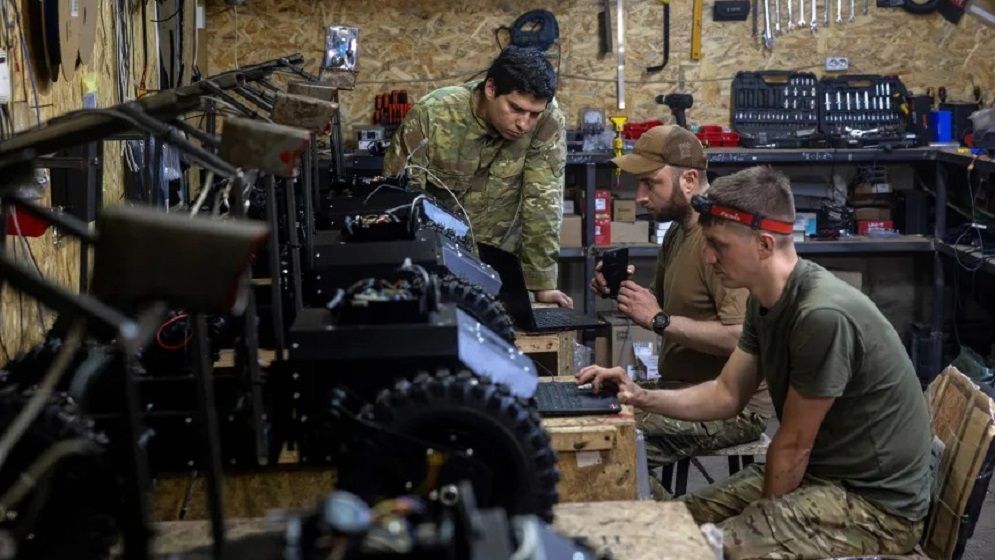
Soldiers from Ukraine’s Third Army Corps prepare new vehicles for field use in a workshop in the Kharkiv region in May 2026. Photo: REUTERS
A daredevil Ukrainian operation using robots dropped behind
enemy lines and “Trojan” armored personnel carriers laden with explosives has
led to the capture of more than 250 Russian troops, Kyiv says.
Ukraine’s army has been chipping away at Russian-controlled
territories in the eastern Ukrainian region of Donbas as part of a
counteroffensive operation dubbed “Vivaldi.”
Its successes have provided a spark of optimism in what has
otherwise been a bleak few months for Ukraine.
A video of the surrendering Russians, shared by Ukraine’s
Third Army Corps this week, shows dozens of men walking through a forest in
single file, forming a long human chain. Heads down, they are closely guarded
by their Ukrainian captors who then herd them into a tight formation and make
them conduct an improvised rollcall.
The video shows some of the Russian prisoners explaining
that they surrendered because they “didn’t want to die in vain” and describing
eating bark and grass as well as drinking from puddles after running out of the
most basic provisions.
CNN cannot independently verify the video or Ukrainian
claims about the surrender, but some prominent Russian military bloggers have
lamented recent Ukrainian advances and demanded answers from the Russian leadership
over the reports of command failures and supply shortages that led to the
surrenders.
Russia has been pummeling Ukrainian cities with near
non-stop aerial attacks, taking advantage of Kyiv’s critical shortages of air
defense missiles. The past four months have been among the deadliest for
Ukrainian civilians since the start of the full-scale invasion in 2022.
Operation Vivaldi has been largely defined by Ukraine’s
innovative use of technology, especially aerial and ground drones and armored
personal carriers.
During one assault operation, Ukrainian military managed to
airdrop robotic systems equipped with heavy guns more than 10 kilometers (6.2
miles) behind the Russian lines, according to Andriy Biletskyi, the commander
of the Third Army Corps .
Controlled from the safety of command centers deep inside
Ukraine-held territory, these land drones were then able to attack Russian
troops from an unexpected direction.
The skies above the front lines in Ukraine have been
swarming with drones for years now, posing a threat to infantry so grave it has
forced Ukraine to make ground robots an integral part of its arsenal.
These land drones are much harder to spot and intercept than
larger military vehicles. Compared with their aerial counterparts, they can
operate in all weather conditions and carry much larger payloads.
But Operation Vivaldi is the first time they are known to
have been smuggled behind Russia’s defensive lines.
In another innovation, the Third Army Corps converted old
Soviet-era armored personnel carriers into unmanned kamikaze ground vehicles by
stuffing them with explosives and sending them towards Russian fortification,
prompting Ukraine’s military to refer to them as “Trojan” tanks.
After three months of small but steady Russian gains, the
situation flipped in September when Russia lost more Ukrainian territory than
it seized.
Experts at the Institute for the Study of War (ISW), a
US-based conflict monitor, calculated that while Russian forces seized about
175 square kilometers (67 square miles) in September, they elsewhere lost 256
square kilometers (99 square miles).
Operation Vivaldi played a key role in this – allowing
Ukraine to recapture nearly 150 square kilometers (58 square miles), according
to the ISW.
Ukrainian President Volodymyr Zelensky put the gains made by
Vivaldi even higher, saying 176 square kilometers (68 square miles) had been
recaptured and 5,000 Russian troops either wounded or killed since the
operation started.
The losses have been noticed in Russia – Rybar, one of the
most prominent pro-Kremlin Russian military bloggers, has taken to Telegram to
complain about the “deteriorating” situation, saying Russian troops will now be
“forced to reorganize their logistics and adjust the pace of their advance on
both Slovyansk and Kramatorsk.”
Russian President Vladimir Putin desperately wants to seize
Ukraine’s eastern Donbas region, and the two cities which form a part of
Ukraine’s defenses are a key obstacle in that goal.
Speaking at the Valdai Club, a Moscow-based discussion
forum, on Thursday, Putin claimed that Europe and Ukraine fear Kyiv can
withstand Russia’s advances for only another 18-24 months. Putin suggested
Moscow could take the remainder of Donetsk in even less time and Ukrainian
resistance was futile
However, the Vivaldi Operation has raised hopes in Kyiv that
Russia may not be capable of taking the rest of the Donbas so quickly. While
Moscow has been slowly chipping away at the so-called “fortress belt” in the
east, its advances have been slow and costly.
Western intelligence services estimate Russia is losing some 40,000 troops a month – a rate of roughly 340 casualties for every square kilometer. The ISW has calculated that at their current pace, Russian forces would not take over the rest of the Donbas until 2032 — if they can seize it at all.