


 For all latest news, follow the Daily Sun's Google News channel.


Singapore students top global reading rankings, second in maths and science: PISA
Singapore's 15-year-olds also rank second in computational problem-solving as global education systems face widening performance gaps
Daily Sun Report, Dhaka
Published: 09 Sep 2026, 11:32 PM
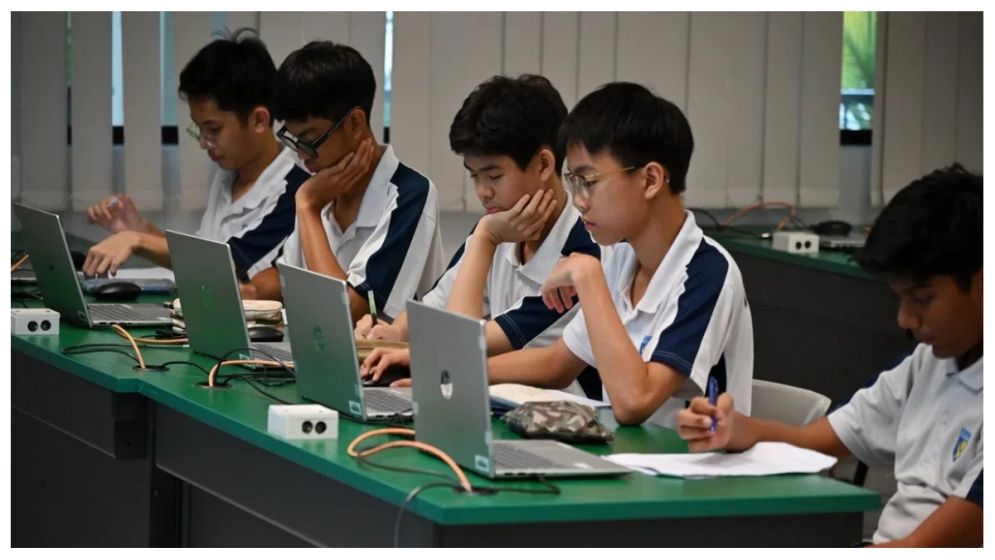
PISA 2025: Singapore students rank first in reading, second in maths and science. Photo: Collected
Singapore's 15-year-old students have emerged among the world's strongest performers in reading, mathematics and science, according to the latest Programme for International Student Assessment (PISA).
Singapore ranked first in reading and second in mathematics and science in PISA 2025, based on the performance of 6,551 students from 157 schools.
The country also ranked second in computational problem-solving, a new component of the assessment that examined how students break down complex tasks and design algorithms to address real-world problems.
A record 91 countries and economies participated in PISA 2025, up from 81 in the previous assessment in 2022. The study, conducted every three years by the Organisation for Economic Co-operation and Development (OECD), was released on Tuesday.
China leads maths and science
PISA 2025 focused primarily on science, with mathematics and reading treated as secondary assessment areas. For the first time, it also examined students' learning in the digital world, including their ability to use computational tools to develop knowledge and solve problems.
China and Singapore were the top-performing education systems across the three core subjects. China led in mathematics and science, while Singapore ranked first in reading.
Estonia, Japan, South Korea, Macao, Taiwan and the UK also ranked among the top 10 education systems in all three domains.
Macao topped the new computational problem-solving assessment, which measured students' ability to use computational practices such as data analysis to solve problems.
The PISA report said many parents still viewed computer science as a specialist subject mainly relevant to students who want to become software engineers.
“This is a mistake,” the report said, arguing that the value of computational problem-solving lies not simply in coding but in developing skills such as logical reasoning, pattern recognition and the ability to break complex challenges into manageable parts.
“These are becoming essential skills for a world increasingly shaped by technology and data,” it said.
The assessment included tasks requiring students to use modelling and programming tools, conduct experiments and build and debug computational artefacts. One example involved programming a robotic claw to sort objects.
OECD performance hits new low
Despite strong performances by several Asian education systems, PISA 2025 recorded the lowest OECD-average performance so far in science, reading and mathematics.
Science scores have declined gradually over the past decade, while mathematics scores recorded a particularly sharp fall after 2018.
Reading performance has experienced the most significant decline over the past decade, after reaching a peak around 2012.
The report said reading skills that are particularly important in the age of artificial intelligence — including evaluating information, connecting information from multiple sources and critical thinking — had deteriorated.
Across participating countries, the proportion of so-called “hasty readers”, who rush through texts and provide quick but incorrect answers, nearly doubled between 2018 and 2025.
Compared with its 2022 performance, Singapore recorded lower scores in mathematics and reading, while its science performance remained unchanged.
Singapore maintains strong performance
Singapore's Ministry of Education (MOE) said the latest results reaffirmed the strengths of its students in applying knowledge to complex problems and remaining engaged in learning.
The ministry said these strengths would help prepare students for lifelong learning.
More than half of Singapore's students were top performers in computational problem-solving, compared with an OECD average of about one-quarter, according to the MOE.
The ministry said Singaporean students were particularly effective at conducting experiments, analysing data and building and debugging computational artefacts to address complex real-world problems.
Singapore also recorded the highest proportion of academic all-rounders, at 15 per cent. These are students who performed at a high level in reading, mathematics and science.
The figure was five times the OECD average of 3 per cent, the MOE said.
Singapore continued to have one of the highest proportions of top performers and one of the lowest shares of low performers across mathematics, reading and science in PISA 2025.
However, the gap between students in the top and bottom 10 per cent widened across all three subjects between 2022 and 2025.
The MOE said the development highlighted the importance of continuing to support students with different learning needs.
Socio-economic gap remains a concern
The PISA report found a significant relationship between students' socio-economic backgrounds and their academic performance in Singapore.
Students in the top 25 per cent by socio-economic background outperformed those in the bottom 25 per cent by the equivalent of more than four years of learning in science, according to the report.
The MOE said it had been expanding support for academically weaker students and those from more vulnerable backgrounds.
It said the efforts would continue through programmes such as ComLink+, alongside additional manpower and resources for schools that need greater support.
Schools with larger numbers of students from disadvantaged backgrounds receive additional resources and staff to support students' social and emotional development and well-being.
These measures include strengthened after-school programmes and partnerships with community organisations to support students and their families.
ComLink+, a national programme, uses family coaches and volunteer befrienders to work with lower-income families with children, helping them develop plans to address their needs and aspirations.
‘Reading is the mother of all skills’
Speaking to The Straits Times about the findings, OECD Director for Education and Skills Andreas Schleicher described reading as a major strength in Singapore.
“Reading is the mother of all skills. If you can’t read, you’re not going to be successful in anything else,” he said.
MOE Director-General of Education Liew Wei Li said the PISA findings offered useful insights into Singapore's students as learners.
She said the results showed that students were curious, perseverant and concerned about the world around them, while also possessing strong foundations in reading, mathematical and scientific literacy.
“The findings also show where we can do better,” Liew said.
“We will continue to help our children, regardless of their background or starting point, to thrive and learn confidently.”
Source: The Strait Times