


 For all latest news, follow the Daily Sun's Google News channel.


Indian police stop event featuring Awami League members in Delhi
Agencies
Published: 30 Aug 2026, 09:39 PM
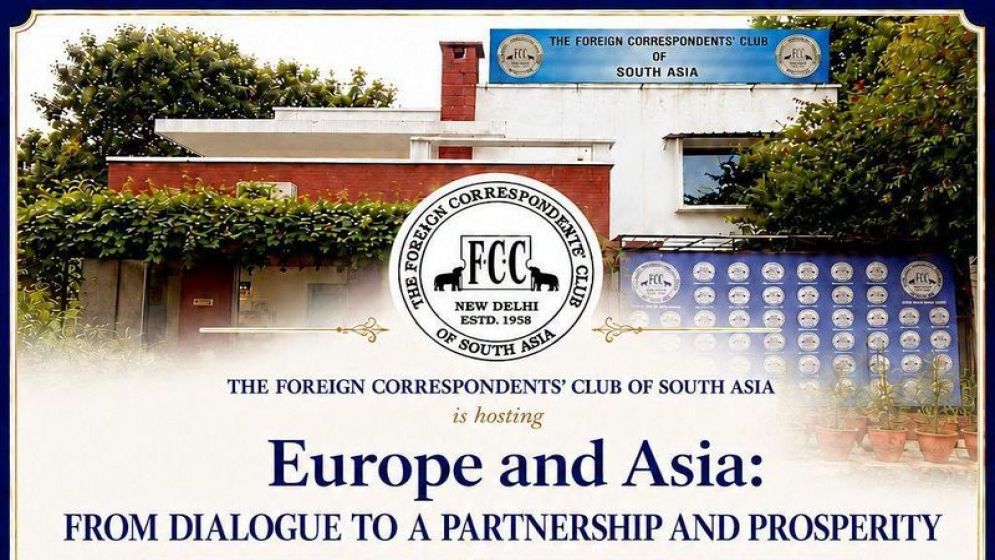
Indian police have prevented an event, which included an
Awami League senior leader, from going ahead in New Delhi at the last minute,
to avoid “certain controversies.”
The unprecedented police intervention on Saturday came less
than four weeks after the BNP government strongly demanded that Indian authorities
prevent Awami League, a banned political party in Bangladesh, from making
controversial public addresses for the sake of maintaining stable bilateral
ties.
The Foreign Correspondents' Club of South Asia (FCC), a
group of foreign journalists in New Delhi, had organised the event on Saturday,
with support from partners including the Belgium-based Hand in Hand Foundation,
report India-based The Wire and The Print.
On Thursday, FCC had also given an update on the seminar
titled “Europe and Asia: From Dialogue to a Partnership”.
However, on Saturday noon, it said that police had abruptly
denied permission at the last minute, in an “highly unusual move.”
In a statement issued on Saturday evening, the organisers
said the club had been “unable to host the scheduled function” because of
“unexplained interventions by Delhi police”.
“The decision was communicated at short notice and is beyond
the control of the organisers and the FCC South Asia,” it said.
Among the participants was Salim Mahmud, information and
research affairs secretary at the now-banned Awami League and the party’s
former lawmaker from Chandpur-1 constituency until the July Uprising.
Other speakers included former Indian envoy to Bangladesh
Veena Sikri, former German ambassador to Dhaka Peter Fahrenholtz as well as
Bangladeshi-American scientist and 1971 Bangladesh Liberation War veteran Nuran
Nabi. The speakers' list also included Czech politician and European parliament
member Ondrej Dostal, who had met with MEA secretary Sibi George on Friday.
The intervention is unusual because the seminar was not
billed as a Bangladesh-focused event. FCC office-bearers have also said they do
not recall the police intervening to stop an event at such short notice,
reports The Wire.
The Delhi police, however, has denied intervening in the
event, and said that FCC events historically never required police permissions.
A document seen by The Wire, however, shows that the Tilak
Marg police station told the FCC that the programme was “not allowed”.
Meanwhile, a FCC source told ThePrint that the development
comes after the press conference of former Bangladesh prime minister Sheikh
Hasina at the club. In the 5 August press conference, Hasina had announced her
return to Bangladesh in December.
“The Indian government received flak from its Bangladeshi
counterpart on Hasina being given a platform in New Delhi. Considering the
panel had a popular Awami League member and another intellectual working on
Rohingya issues, the permission must have been denied,” the source said.
AFM Golam Zilani, secretary general of the Hand in Hand
Foundation, told The Wire: “If you ask the police authority, they give the
right answer. We don’t have any other information.”
Zilani also rejected the suggestion that the cancellation
could have been connected to Bangladesh. “It’s not a Bangladesh or Indian
issue,” he said. “It’s about the Europe-Asia relationship.”
There is, however, a documented history of the foundation
organising events involving Awami League representatives.
A 2019 report by the South Asia Democratic Forum said a
conference on the Rohingya crisis at the European parliament was jointly
organised by the Socialists and Democrats Group, the Belgium Awami League and
the Hand in Hand Foundation. It listed Zilani as representing the Foundation.
In July this year, the European subsidiary of the Awami
League reported that a seminar at the European parliament on democratic
transitions, human rights and geopolitics in South Asia was organised at the
initiative of the Hand in Hand Foundation and attended by the president,
general secretary and other representatives of the European Awami League. It
also said that Zilani attended as secretary general of the Foundation.
The police intervention comes less than four weeks after the
FCC hosted former Bangladesh prime minister Hasina for her first media
interaction since she was ousted from power in August 2024.
On 5 August, Hasina spoke to journalists through an audio
link from India at the FCC, marking the second anniversary of her removal.
The event prompted a strong protest from Dhaka, which said
it was “outraged” that Hasina was allowed a platform to interact with the media
in the Indian capital. New Delhi said the programme was privately organised and
that the Indian government did not endorse the former PM’s remarks on the “duly
constituted government”.
The incident also complicated efforts to arrange a visit to
India by Bangladesh Prime Minister Tarique Rahman.
Dhaka subsequently said the atmosphere for Rahman’s proposed
India sojourn had been “vitiated” by Hasina’s appearance in New Delhi and that
“a propitious environment needs to be created for the visit”.