


 For all latest news, follow the Daily Sun's Google News channel.


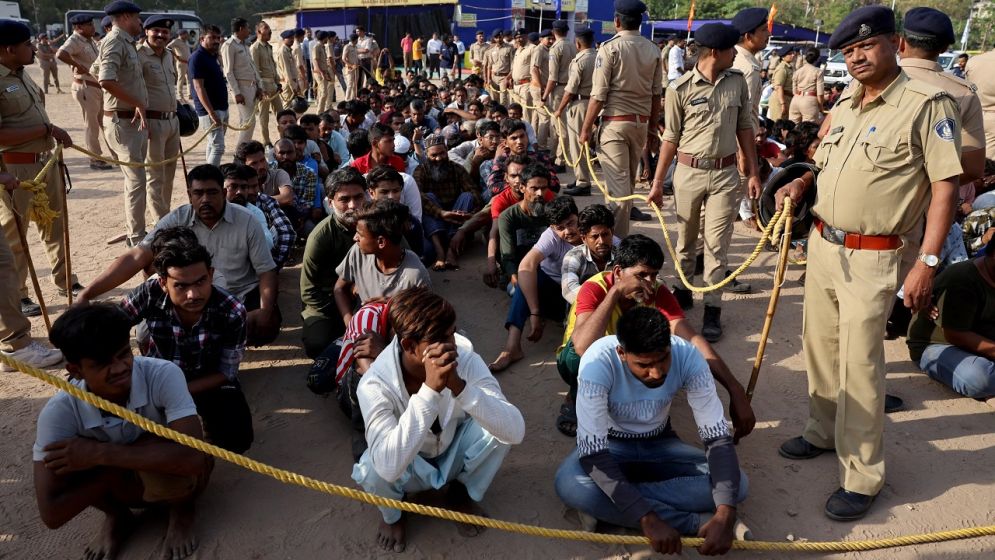
Police officers detain alleged undocumented Bangladeshi nationals after they were arrested during raids in Ahmedabad, India. File Photo: Reuters
India must better protect tribal peoples and disadvantaged
castes subject to extrajudicial killings, torture and violence by law
enforcement, a United Nations watchdog said Tuesday.
The UN Committee on the Elimination of Racial Discrimination
(CERD) also said the world's most populous country urgently needs to address
hate crimes against Bengali-speaking Muslims.
"The committee was gravely concerned about reports of
large-scale violations perpetrated by law enforcement officials against ethnic
and ethno-religious groups, Indigenous and Tribal Peoples, including Scheduled
Tribes, Scheduled Castes, particularly Dalits, and non-citizens," it said
in a statement on its findings.
"These included racially motivated violence, excessive
use of force, extrajudicial killings, arbitrary and prolonged detention without
due process, torture, ill-treatment and sexual violence."
The committee called on India to investigate all such
allegations and bring those responsible to justice.
CERD's opinions and recommendations are non-binding but
carry reputational weight.
Caste remains a powerful determinant of social status in
India, shaping access to resources, education and opportunity.
The millennia-old social hierarchy divides Hindus by
function and social standing.
"For Dalits, it's important to have indicators showing
that segregation was effectively and substantively reduced", based on the
committee's previous observations, said committee member Stamatia Stavrinaki.
CERD, a committee of 18 independent rights experts, monitors
adherence to the Convention on the Elimination of All Forms of Racial
Discrimination by its 182 member countries.
Under the convention, which came into force in 1969,
countries must eliminate racial discrimination, eradicate practices of
segregation and guarantee equality before the law.
Rohingya and asylum seekers
India appeared for review before CERD earlier this month,
for the first time since 2007, with Solicitor General Tushar Mehta leading its
delegation.
The committee highlighted an increase in law enforcement
operations targeting Rohingya, Bengali-speaking Muslims, migrants and
asylum-seekers.
It said police stops and identity checks involving racial
profiling had reportedly resulted in arbitrary arrest and detention without due
process, as well as torture and mistreatment.
The committee also voiced concerns about deportations and
forced returns of people needing international protection.
It urged India to "urgently address discrimination,
hate speech and hate crimes" against such groups, protect their rights,
and refrain from collective expulsions.
Stavrinaki told a press conference that the perceived lack
of accountability was important, because if a law exists but is not implemented
"hate crimes cannot be effectively combated".
Another major gap for India is that "racial
discrimination in the private sphere is not clearly prohibited by law",
she added.
During the dialogue, India insisted that it respects human
rights defenders, said Stavrinaki.
However, "in practice, threats, hate crimes, hate
speech and the negative environment faced by human rights defenders are not
fully prevented or addressed", she said.
Following the review, India's mission said in a statement that its delegation had "highlighted our pluralism; diversity; scale and complexity; constitutional and legal framework and safeguards... as we continue our journey towards ensuring equality, dignity and opportunity for all Indians".