


 For all latest news, follow the Daily Sun's Google News channel.


Israel rejects Trump’s Gaza peace plan
Reuters, Jerusalem
Published: 09 Aug 2026, 10:17 PM
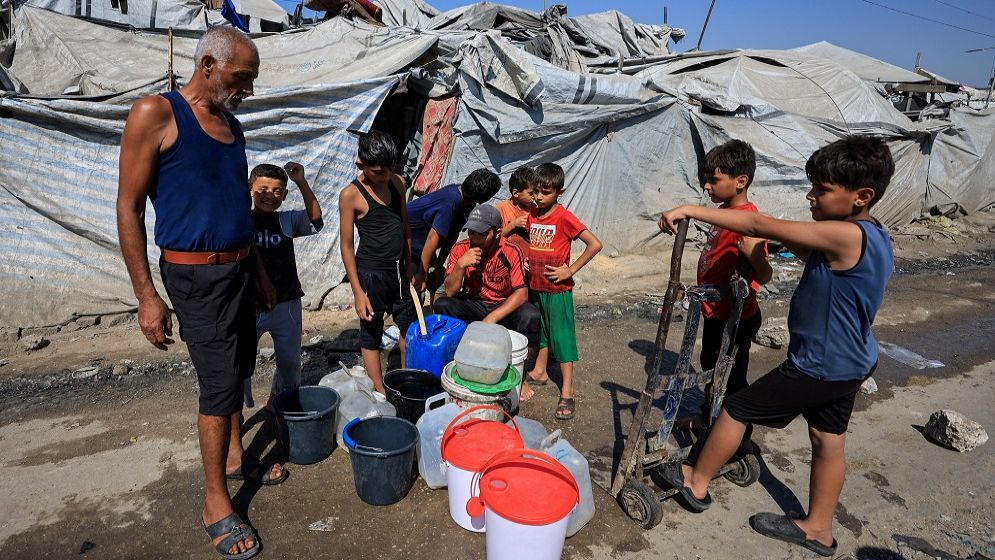
Displaced Palestinians gather to collect water at a tent camp in Gaza City, 9 August 2026. Photo: REUTERS
Israeli Prime Minister Benjamin Netanyahu restated his
rejection of Donald Trump's latest Gaza plan in televised remarks to his
right-wing government on Sunday, even as Israel's military has effectively
halted attacks in the territory under pressure from the US President.
Netanyahu is in campaign mode as he seeks re-election at a
vote due on 27 October but is caught between far-right ministers angered by
concessions in Gaza and his key military backer, Trump, who wants progress
toward ending the conflict there with a new 15-point peace plan.
Israel has scaled back attacks in Gaza since Monday, when
Nikolay Mladenov, the Gaza envoy for Trump's Board of Peace that oversees the
Gaza ceasefire, met with Netanyahu.
A source familiar with Israel's position said it had agreed
that the military would only act against what it perceives as immediate threats
in Gaza and no longer carry out targeted assassinations as it had been doing on
a near-daily basis.
Israel and Hamas disagree over timings in Trump's plan
Trump announced last month that there had been a
breakthrough in his plan to end the war, to which both Israel and Hamas agreed,
with Israeli forces withdrawing as Hamas disarms and an International
Stabilization Force working with a new Palestinian police force to secure the
enclave.
But complications have swiftly emerged. Israel has said that
Israeli troops in Gaza would not move before Hamas disarms. Hamas has insisted
that Israel halt attacks before it begins implementing the part of the
agreement dealing with its arms.
"Israel does not accept the 15-point document,"
Netanyahu said at the start of a meeting with cabinet ministers. The military
"will not carry out any withdrawal until Hamas is disarmed ... it means
heavy weaponry, lighter weaponry, all weaponry.
"And we are talking about genuine disarmament, not
fictitious disarmament," he said, noting that Israel is in talks with the
United States on the plan. Netanyahu made similar remarks in a social media
post on Tuesday.
"They (the US) have ideas, some of which are acceptable
to us and some of which are unacceptable to us," Netanyahu said without
elaborating.
Basem Naim, a senior Hamas official, told Reuters on Sunday
that the group remained committed to the roadmap agreed with mediators in Cairo
10 days ago.
"We expect the mediators and the US guarantor to press
Netanyahu and his government to adhere to the roadmap and not obstruct the
process for internal political and electoral reasons, while continuing to
jeopardise the region's security and stability."
Far-right Finance Minister Bezalel Smotrich praised
Netanyahu.
"We went to war with a central goal: the destruction of
Hamas," he said in a statement. "The (military) cannot withdraw even
a milimetre from the Gaza Strip. The Gaza Strip cannot begin any process of
reconstruction before the complete dismantling and demobilization of Hamas and
the Gaza Strip."
Trump said last month that Iran-backed Hamas, which ruled
Gaza for nearly two decades before carrying out the October 7, 2023, attack on
Israel that triggered the Gaza war, had agreed to lay down its weapons.
Hamas avoids the use of the term "disarmament" and
said the group agreed to hand over weapons to be stored under a US-backed
Palestinian technocrat administration that would run the affairs in Gaza under
the supervision of Trump's Board of Peace.
Hamas said it agreed to the plan in order to spare the
people in Gaza a possible resumption of war, but it added that the
implementation of the deal would depend on Israel first meeting its own commitments,
including withdrawal.
Since the US-mediated agreement reached in October to end
the war, Israel had vowed to hunt down every militant who had taken part in the
October 2023 attack before stopping the targeted attacks on Monday.
More than 1,250 people have been killed in the Israeli
attacks since the ceasefire, most of them civilians, according to Gaza health
officials. Hamas has not disclosed the number of its fighters killed.
Israeli troops have occupied and depopulated two-thirds of the enclave, leaving nearly all its more than 2 million residents confined to a tiny strip of land under Hamas control along the coast, most in makeshift tents or damaged buildings.