


 For all latest news, follow the Daily Sun's Google News channel.


Rubio reassures Asian allies they won’t be abandoned as US seeks better China ties
Reuters, Manila
Published: 24 Jul 2026, 03:59 AM
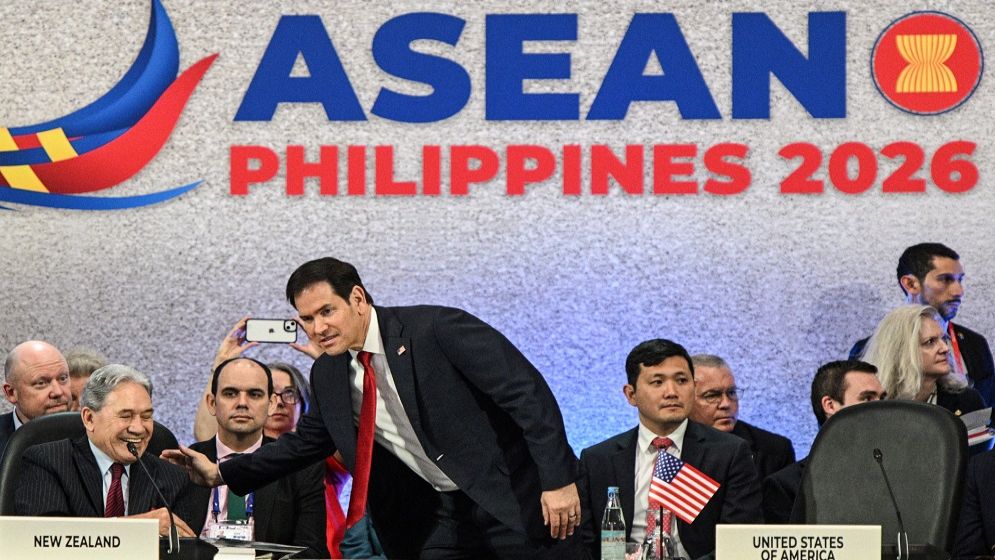
US Secretary of State Marco Rubio greets New Zealand's Minister of Foreign Affairs as he arrives at the 16th East Asia Summit Foreign Ministers' Meeting (EAS FMM) on the sidelines of the ASEAN Foreign Ministers' Meeting at the Philippine International Convention Center in Pasay, Metro Manila, Philippines, 23 July 2026. Photo: REUTERS
US Secretary of State Marco Rubio reassured Asian allies
that a US pursuit of positive ties with Beijing did not mean they were being
abandoned, as top diplomats joined a regional security gathering on Thursday
held amid an escalating Middle East conflict.
Speaking a day after meeting Chinese counterpart Wang Yi,
where the two discussed laying the groundwork for a September visit to the US
by President Xi Jinping, Rubio said cooperation with China would not come at
the expense of Washington's close Asian partners.
"We're already present. We have a role, and we're not
going to abandon our allies. We've made that abundantly clear," Rubio told
reporters.
"These are the two most powerful economies in the
world, two large militaries, two nuclear powers. We have to have a relationship
with China. We want it to be as positive as it possibly can be, but that won't
come at the expense of our allies and our partners in the region, or our
presence here either."
Rubio earlier joined the East Asia Summit in Manila and security-focused
ASEAN Regional Forum, where foreign ministers stressed the need for closer
engagement amid global threats and renewed and intensifying hostilities in the
Middle East.
The war in Iran and the blockade of the Strait of Hormuz are
a key concern in Asia and for the hosts, the 11-nation Association of Southeast
Asian Nations, a bloc heavily reliant on Middle East oil and collectively one
of the world's largest economies.
"We convene against the backdrop of profound
geopolitical and geoeconomic uncertainty," chair Maria Theresa Lazaro, the
Philippines' foreign secretary, said in opening remarks.
"No nation can address today's complex security
environment alone."
'Iran will pay higher price every day'
The US military completed a 12th successive night of attacks
on Iran on Wednesday, with Iranian-aligned Houthis claiming hits the following
day on two Saudi oil tankers, in a blockade that threatens a second chokehold
on global oil supplies in the Red Sea, alongside the Strait of Hormuz.
Rubio vented his frustration at diplomacy with Iran, which
he said was "begging every day" to make a deal, but kept moving the
goalposts at a time when it was suffering tremendous losses.
"It looks like they're not ready to make a deal, so
they're going to continue to pay a price, and every night the price gets higher
and higher and higher," he said.
The security concerns in Manila were not confined to the
Middle East.
Tensions have been simmering this week over the South China
Sea, with a second encounter in the space of four days on Thursday between
Beijing and US ally the Philippines, which Washington is treaty-bound to defend
in the event of an attack on its vessels.
Beijing has an armada of coast guard ships throughout the
South China Sea and claims sovereignty over almost the entire waterway,
including parts of the exclusive economic zones of Brunei, Indonesia, Malaysia,
the Philippines, and Vietnam.
'Provocative actions'
China's coast guard on Thursday accused the Philippines of
"provocative actions" and said it had thwarted an intrusion at the
strategic Scarborough Shoal, the South China Sea's most contested area, which,
according to Manila, included use of water cannon.
It came after an altercation on Monday between China's coast
guard and Philippine navy personnel at another disputed reef 650 km (400 miles)
away, also in Manila's EEZ, prompting the countries to summon each other's
ambassadors.
"The whole world saw it. It's disturbing," Rubio
said. "That's why we continue to reiterate our commitment to our treaty
partners, but also our commitment to freedom of navigation and respect for
territorial rights."
China's foreign minister Wang was not present for Thursday's
plenary gatherings due to what Beijing said was a scheduling issue, with
meetings in Kyrgyzstan. A day earlier Wang had urged ASEAN countries to work
with Beijing to ensure peace in the South China Sea and "resist the
incitement of foreign forces".
Japanese Foreign Minister Toshimitsu Motegi said he had
greeted Wang at the meeting a day earlier, in the first one-to-one interaction
between them since relations between Asia's top two economies nosedived late
last year.
As top ministers gathered for the security forum in Manila,
China's maritime authorities said two days of live-fire drills had been launched
in some parts of the Taiwan Strait near the shores of its southeastern province
of Fujian.
They follow war games in December that were China's most
extensive encircling Taiwan, a democratically governed island which China
claims as its own territory.
The Ukraine war also figured at the meeting and Russian
Foreign Minister Sergei Lavrov held talks on the sidelines with Rubio on
Thursday for just under an hour.
Lavrov "reaffirmed Russia's readiness for a political
and diplomatic settlement of the conflict", while Rubio said Washington
was prepared to play a constructive role in bringing about an end to "a
senseless war", though agreeing terms acceptable to all sides was a
challenge.