



 For all latest news, follow the Daily Sun's Google News channel.


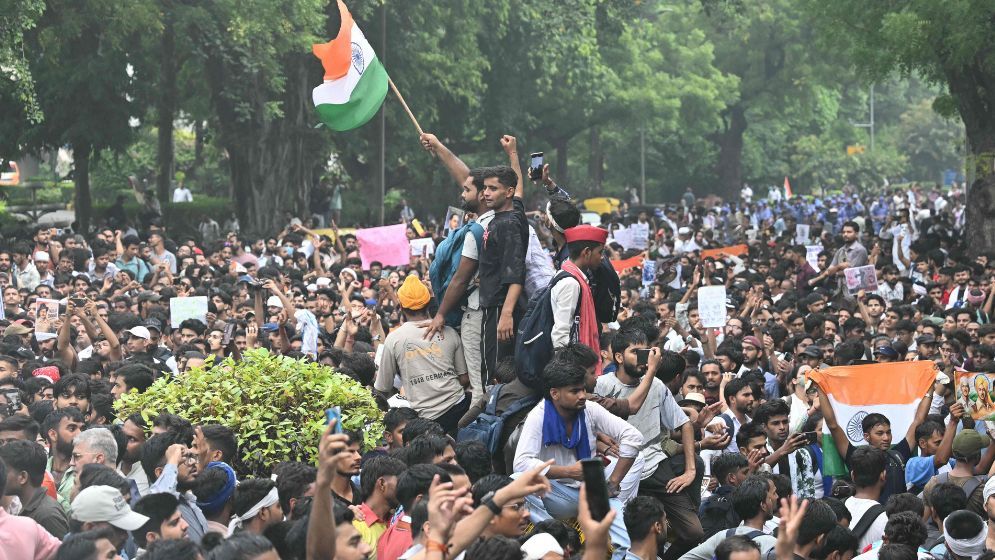
Supporters of the Cockroach Janta Party (CJP) protest demanding the resignation of India's Education Minister Dharmendra Pradhan over alleged NEET exam irregularities in New Delhi on 20 July 2026. Photo: AFP
Thousands of protesters from India’s Cockroach Janta Party (CJP) clashed with police near Parliament Street in New Delhi on Monday as they attempted to march to the House, demanding the resignation of Union Education Minister Dharmendra Pradhan over repeated examination leaks and other irregularities.
The confrontation began in the morning when demonstrators, who have been staging a sit-in at Jantar Mantar since early June, broke through multiple police barricades on Sansad Marg as part of a coordinated “Sansad Chalo” march.
Security forces responded with baton charges and tear gas to prevent the crowd from advancing into the high-security zone near Shastri Bhawan and Parliament. Scuffles ensued, resulting in minor injuries to protesters and around 50 police personnel. Several individuals were detained.
Traffic on major roads in central Delhi came to a standstill, and several metro stations—including Rajiv Chowk, Janpath, Patel Chowk, and Central Secretariat—were closed or had exits sealed, severely disrupting public movement.
Mobile internet services were temporarily suspended in parts of the area as authorities sought to maintain order.
The protesters’ primary demands include the immediate resignation of the education minister, accountability for those responsible for paper leaks in major examinations, including NEET, systemic reforms to prevent future irregularities, and compensation for the families of students who died by suicide due to exam-related stress.
Prominent activist Sonam Wangchuk, who joined the protest with an indefinite hunger strike, was hospitalised on 18 July after his health deteriorated.
In a handwritten note released from the hospital on Monday, Wangchuk said he would end his fast only if the government accepted responsibility for the failures or if parliamentarians from various parties committed to raising the issues in the House.
Despite prohibitory orders restricting large gatherings and processions outside the designated Jantar Mantar site, the crowd swelled significantly on Monday as students, youth, and supporters gathered overnight and through the morning. Slogans demanding Pradhan’s resignation and highlighting “exam scams” echoed through the area.
Delhi Police officials said they acted with restraint to prevent an unauthorised march into a restricted high-security zone during the parliamentary session.
“Our priority was to maintain law and order and ensure the safety of all,” a police spokesperson said, denying the excessive use of force and describing some circulating videos and reports as misinformation. Medical facilities were made available at Jantar Mantar for those injured.
In a parallel development, a CJP delegation met Union Minister JP Nadda in the afternoon. The meeting was described as cordial, with the delegation submitting a memorandum outlining their demands.
Nadda reportedly assured the group that their concerns would be conveyed to senior government leadership and appealed for the restoration of normalcy.
Opposition leaders condemned the police action, calling the use of batons and tear gas against young protesters an assault on democratic rights. “The government is trying to silence the voices of students who have lost faith in the system,” an opposition leader said.
By Monday evening, the main sit-in at Jantar Mantar was continuing, although security forces began clearing some peripheral areas. The CJP urged its supporters to remain peaceful.
The protests mark a significant escalation in weeks of demonstrations that have highlighted deep frustrations with India’s examination system.
With parliament still in session, political observers are watching whether the government will announce concrete measures—such as a judicial inquiry into the leaks, stricter security protocols for examinations, or support for affected students—to defuse the crisis.